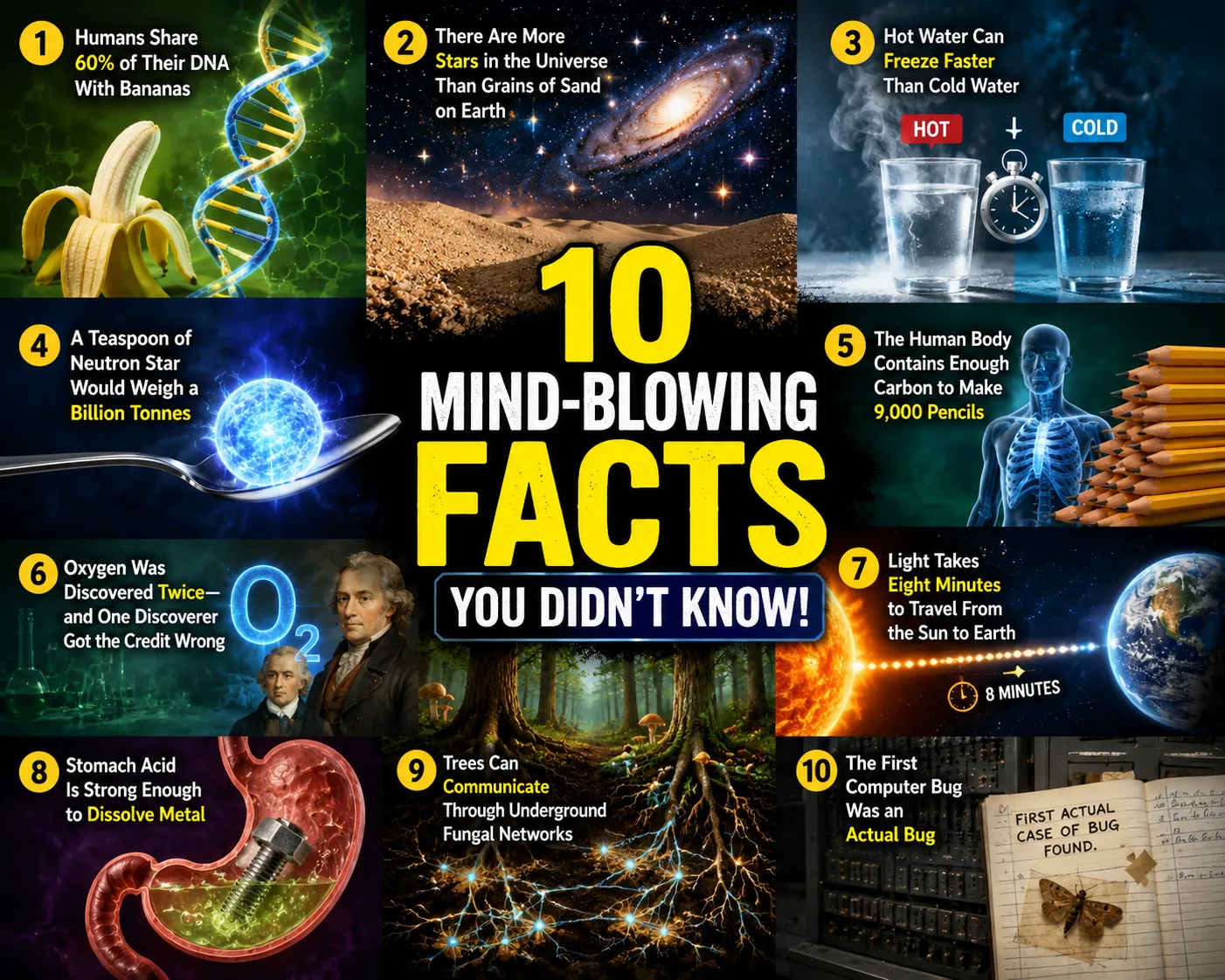
Science is not confined to laboratories or textbooks. It is alive in the food you eat, the light hitting your eyes right now, the ground beneath a forest, and the very atoms that make up your body. Most of us move through our days without pausing to notice the extraordinary mechanics underneath the ordinary surface of the world. These ten facts are an invitation to pause. Each one is genuinely true, rigorously established, and yet strange enough to make you question how reality actually works.
1. Humans share 60% of their DNA with bananas
This is the fact most people hear and immediately assume is a joke. It is not. All living organisms on Earth share a common ancestor, and the genes responsible for the most fundamental biological tasks managing energy, dividing cells, building proteins have been so critical for so long that evolution has barely changed them across billions of years. A banana plant and a human being both need to convert glucose into ATP, copy DNA accurately when cells divide, and manufacture functional proteins. The molecular machinery for doing all of that is largely identical between us. The roughly 60% overlap reflects these ancient, conserved housekeeping genes. What separates us from a banana is the remaining 40%: the genetic instructions for nervous systems, mobility, oxygen-based respiration, and everything else that makes a human a human rather than a fruit on a plant.
2. There are more stars in the universe than grains of sand on Earth
Astronomers estimate the observable universe contains approximately 10 sextillion stars written as a 1 followed by 22 zeros. The total number of grains of sand across every beach and desert on Earth is estimated at around 7.5 quintillion. Stars outnumber sand grains by roughly a factor of one thousand. And that is only the observable universe the portion of space whose light has had time to travel to us in the 13.8 billion years since the Big Bang. Beyond that boundary, the universe may extend vastly further, potentially containing incomprehensibly more. Our entire solar system, with one solitary star at its center, represents a single data point in a population of almost unimaginable scale.
3. Hot water can freeze faster than cold water
Named the Mpemba effect after Erasto Mpemba, a Tanzanian schoolboy who observed it while making ice cream in 1963, this phenomenon remains one of physics' most genuinely contested curiosities. Several mechanisms appear to contribute: hot water releases dissolved gases as it heats, removing the insulating bubbles that slow cooling; it evaporates more, reducing its mass and requiring less energy to reach freezing point; convection currents distribute cold temperatures more efficiently through the liquid; and the hydrogen bonds in hot water may be in a molecular configuration that releases energy more readily during crystallisation. The effect is not universal it depends on the container, the temperature difference, and the exact conditions which is precisely why it has resisted a clean single explanation for over fifty years.
4. A teaspoon of neutron star material would weigh a billion tonnes
When a star many times more massive than our Sun exhausts its nuclear fuel, its core collapses catastrophically. The crush is so extreme that protons and electrons are forced together, merging into neutrons packed as tightly as atomic physics allows. The result is a neutron star: an object containing roughly 1.4 times the mass of the Sun, compressed into a sphere about 20 kilometres across. The density of this material is so extreme that a single teaspoon would weigh approximately one billion metric tonnes on Earth greater than the mass of Mount Everest. The surface gravity of a neutron star is about 200 billion times stronger than Earth's. Dropping from just one metre above it, you would strike the surface at around 1,400 km/h.
5. The human body contains enough carbon to fill 9,000 pencils
Carbon is the second most abundant element in the human body by mass, after oxygen. An average adult body holds approximately 18 kilograms of it. Carbon's chemical uniqueness its ability to form four stable covalent bonds simultaneously makes it the architectural backbone of every organic molecule: DNA, proteins, carbohydrates, fats, hormones, enzymes. Without this precise property, the complex, information-rich molecules that life depends on simply could not exist. As a practical consequence of this abundance, your body contains enough carbon to fill the graphite cores of roughly 9,000 standard pencils. Every cell, every enzyme driving your metabolism, every strand of DNA is a carbon-based structure of extraordinary intricacy.
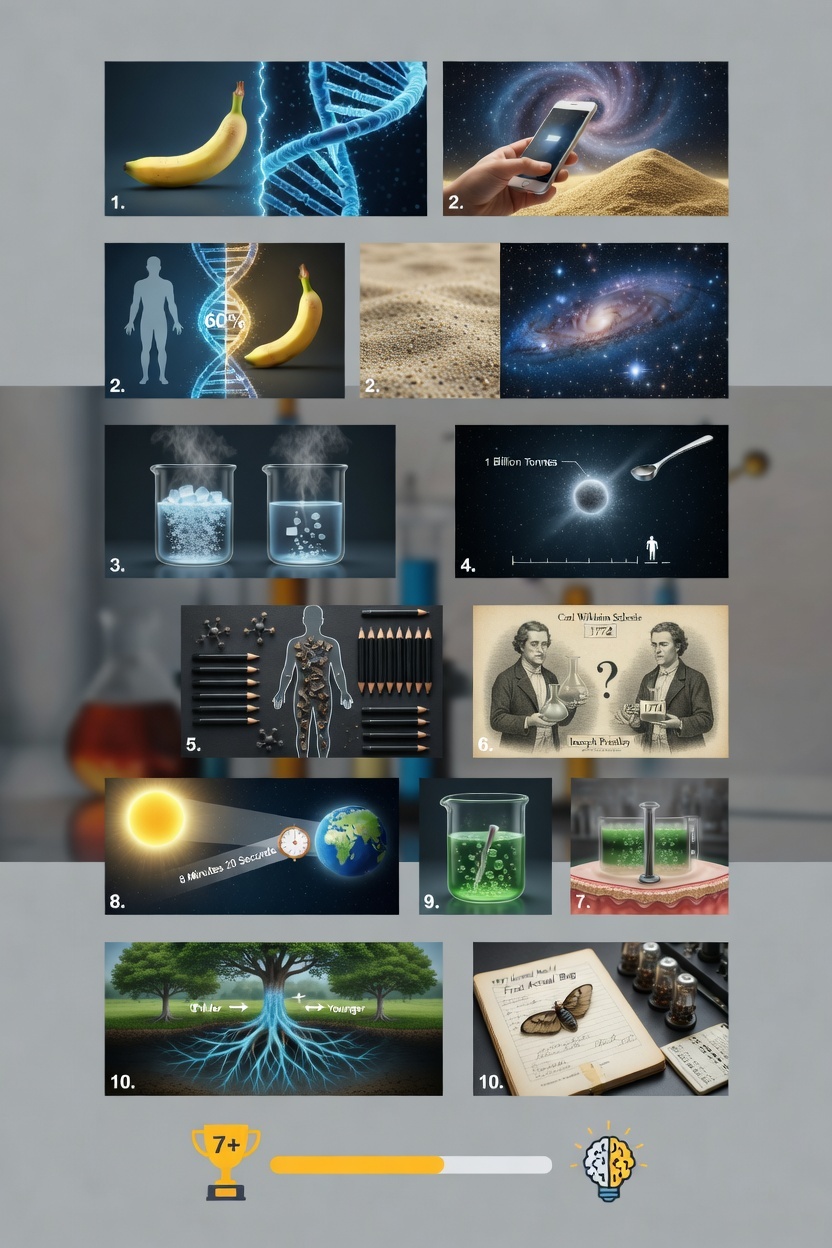
10 Facts of Science
6. Oxygen was discovered twice: and the credit was complicated
Carl Wilhelm Scheele isolated oxygen in his Swedish laboratory in 1772, but was slow to publish his findings. Joseph Priestley independently produced it two years later, in 1774, and communicated his results promptly earning much of the historical credit as a result. Neither man initially understood what the new substance actually was. It was Antoine Lavoisier who provided the explanation: recognising that air is a mixture of gases, naming the reactive component "oxygène," and using it to overturn the phlogiston theory the long-dominant but entirely incorrect model of combustion that claimed burning objects released a substance called phlogiston into the air. The story of oxygen's discovery is a reminder that in science, credit often goes not simply to who finds something, but to who makes sense of it.
7. Light takes over eight minutes to travel from the Sun to Earth
The Sun lies approximately 150 million kilometres away. Light travels at 299,792 kilometres per second fast enough to circle the Earth seven and a half times in a single second. Even at that speed, crossing 150 million kilometres requires about 8 minutes and 20 seconds. This means the Sun you see in the sky is always a little over eight minutes old. Look at Proxima Centauri, the nearest star beyond our Sun, and you are seeing light that left it 4.2 years ago. Observe a distant galaxy and you are looking at light that began its journey millions or billions of years before Earth formed. Every telescope is a time machine; every observation is archaeology.
8. Stomach acid is strong enough to corrode certain metals
Gastric acid, composed primarily of hydrochloric acid, maintains a pH of around 1 to 2 comparable in corrosiveness to battery acid. It is capable of dissolving zinc and other metals. Its biological purpose is to denature proteins arriving from food, activate digestive enzymes, and destroy most pathogens before they can colonise the gut. The stomach wall avoids self-digestion through a thick, constantly renewed layer of protective mucus. This lining is so aggressively maintained that the stomach replaces its entire inner surface every three to four days. When this protection breaks down due to infection by Helicobacter pylori bacteria, chronic alcohol consumption, or heavy use of non-steroidal anti-inflammatory drugs the stomach begins, in effect, to digest itself. The result is a gastric ulcer.
9. Trees communicate through underground fungal networks
Every forest floor conceals a vast biological internet. Mycorrhizal fungi extend thread-like filaments called hyphae into tree root systems, forming a mutually beneficial partnership: the fungi provide the tree with water and minerals drawn from deep in the soil, while the tree provides the fungi with sugars produced through photosynthesis. But the relationship goes beyond resource exchange. When a tree comes under attack from insects or disease, it releases chemical signals into the network that neighboring trees can detect triggering those trees to ramp up their own chemical defenses preemptively. Older, larger trees have been observed directing additional carbon through the network toward younger saplings growing in their shade. The forest is not a collection of isolated, competing individuals. It is a cooperative, interconnected system of extraordinary subtlety.
10. The first computer "bug" was a real, physical insect
On 9 September 1947, engineers working on the Harvard Mark II electromechanical computer traced an unexplained malfunction to Relay #70 in Panel F. Inside the relay, they found a moth. They removed it, taped it into the engineering logbook, and wrote alongside it: "First actual case of bug being found." The logbook entry was made by the team of Grace Hopper one of the most consequential figures in the history of computing, responsible for developing the first compiler and demonstrating that programming languages could be written in something closer to human language than machine code. The word "bug" had been used loosely in engineering for decades before this incident, but the moth in Relay #70 made the metaphor permanent. The original logbook page is preserved at the Smithsonian National Museum of American History.
Knowledge compounds: Each of these facts is not merely a curiosity it is a doorway. Understanding why bananas and humans share DNA opens into evolutionary biology. Grasping the speed of light leads into cosmology and the nature of time itself. The interactive panel above lets you explore any of the ten in more depth, and ask follow-up questions directly. Start wherever your curiosity pulls you.
Ready to put this into practice?
Free quizzes and a new daily challenge — play in about 2 minutes, no sign-up.
Play Science Quiz Today's Challenge