Science is everywhere — in the food you eat, the air you breathe, and the device you're reading this on. Yet most people only scratch the surface of how the world actually works. These ten science facts are the kind that stop you mid-sentence and make you say "wait, really?"
Each one has appeared as a quiz question on Quizzes for Brain. See how many you already knew.
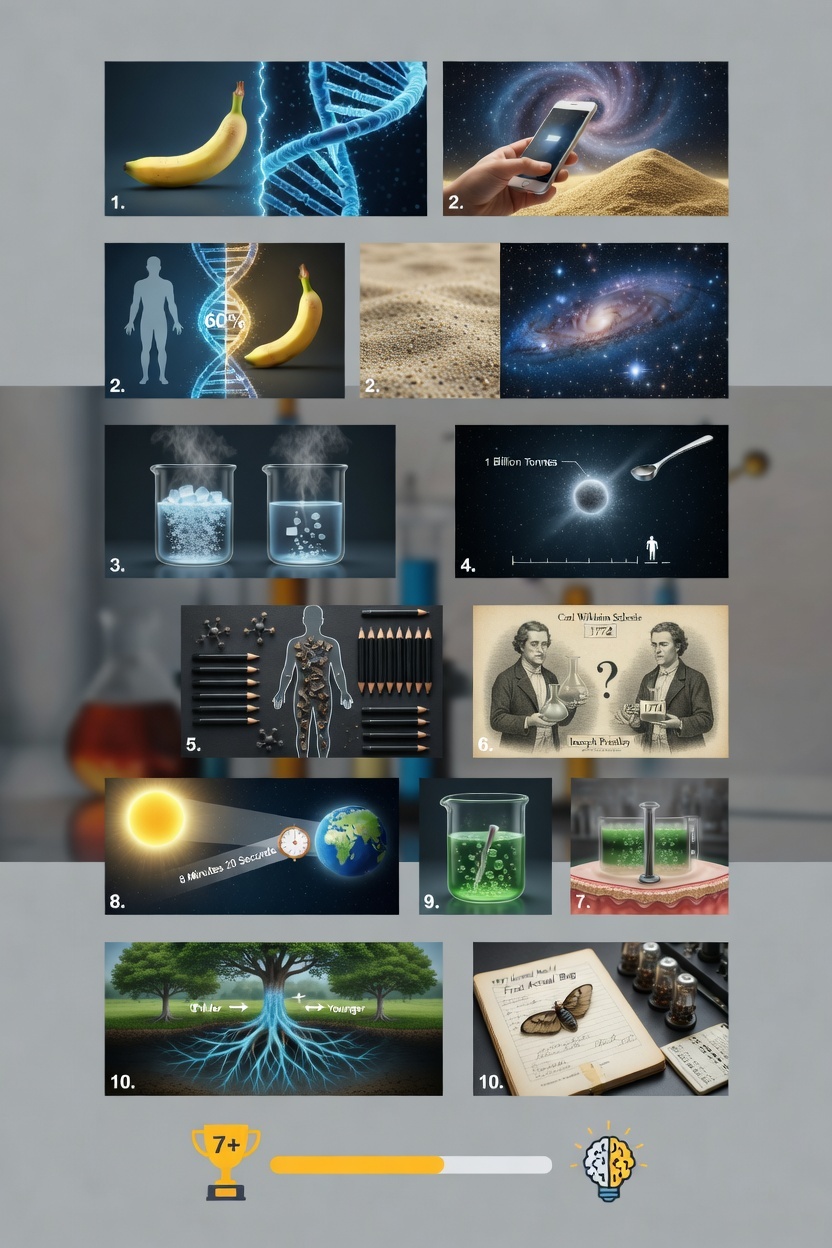
1. Humans Share 60% of Their DNA With Bananas
It sounds like a joke, but it is firmly established science. Because all living things share a common ancestor, the basic biological machinery — the genes that control cell growth, energy production, and protein synthesis — is remarkably similar across species. The more complex the function, the more conserved the gene tends to be across evolution.
2. There Are More Stars in the Universe Than Grains of Sand on Earth
Astronomers estimate there are approximately 10 sextillion stars in the observable universe — that is a 1 followed by 22 zeros. The total number of grains of sand on all of Earth's beaches is estimated at around 7.5 quintillion. The universe contains roughly 1,000 times more stars than all those grains of sand combined.
3. Hot Water Can Freeze Faster Than Cold Water
Known as the Mpemba effect, this counterintuitive phenomenon has puzzled scientists for decades. Under the right conditions, hot water placed in a freezer can solidify before an identical container of cold water. The exact mechanism is still debated, but researchers believe it involves dissolved gases, evaporation, and convection currents within the water.
4. A Teaspoon of Neutron Star Would Weigh a Billion Tonnes
Neutron stars are the collapsed cores of massive stars after a supernova explosion. They pack roughly 1.4 times the mass of our Sun into a sphere about 20 kilometres across. The material is so dense that a single teaspoon would weigh approximately one billion metric tonnes — more than the weight of Mount Everest.
5. The Human Body Contains Enough Carbon to Make 9,000 Pencils
Carbon is the second most abundant element in the human body by mass, after oxygen. The average adult body contains around 18 kilograms of carbon, which is enough to fill roughly 9,000 standard pencil cores. Carbon's unique ability to form four bonds simultaneously makes it the backbone of all organic molecules — and therefore all life.
6. Oxygen Was Discovered Twice — and One Discoverer Got the Credit Wrong
Carl Wilhelm Scheele discovered oxygen in 1772 but did not publish his findings promptly. Joseph Priestley independently discovered it in 1774 and published first, receiving much of the early credit. It was Antoine Lavoisier who later correctly identified its role in combustion and named it — overturning the dominant phlogiston theory in the process.
7. Light Takes Eight Minutes to Travel From the Sun to Earth
The Sun is approximately 150 million kilometres away. Light travels at about 300,000 kilometres per second, which means sunlight takes roughly 8 minutes and 20 seconds to reach Earth. This also means that when you look at the Sun, you are seeing it as it was over 8 minutes ago — and when astronomers observe distant galaxies, they are seeing them as they existed billions of years in the past.
8. Stomach Acid Is Strong Enough to Dissolve Metal
Gastric acid, primarily hydrochloric acid, has a pH of around 1 to 2 — similar in strength to battery acid. It is strong enough to corrode certain metals. The stomach is protected from self-digestion by a thick layer of mucus that lines its walls and is constantly renewed. When this lining breaks down, the result is a gastric ulcer.
9. Trees Can Communicate Through Underground Fungal Networks
Forests are connected by vast underground networks of mycorrhizal fungi — sometimes called the "wood wide web." Through these networks, trees exchange nutrients, water, and even chemical warning signals. Older trees, sometimes called "mother trees," have been observed directing more carbon to younger seedlings growing in their shade.
10. The First Computer Bug Was an Actual Bug
In 1947, engineers working on the Harvard Mark II computer found a moth trapped in one of the machine's relays, causing a malfunction. Grace Hopper's team taped the moth into their logbook with the note "First actual case of bug being found." The term bug had been used loosely before, but this incident cemented its meaning in computing forever.
How Did You Score?
If you knew more than seven of these, you are firmly in the top tier of science knowledge. If you learned something new today, that is exactly what Quizzes for Brain is here for. Knowledge compounds — every fact you absorb today becomes the foundation for understanding something more complex tomorrow.
Ready to put this into practice?
Take today's free daily challenge — a new set of questions every 24 hours.
Start Today's Challenge Browse All Quizzes