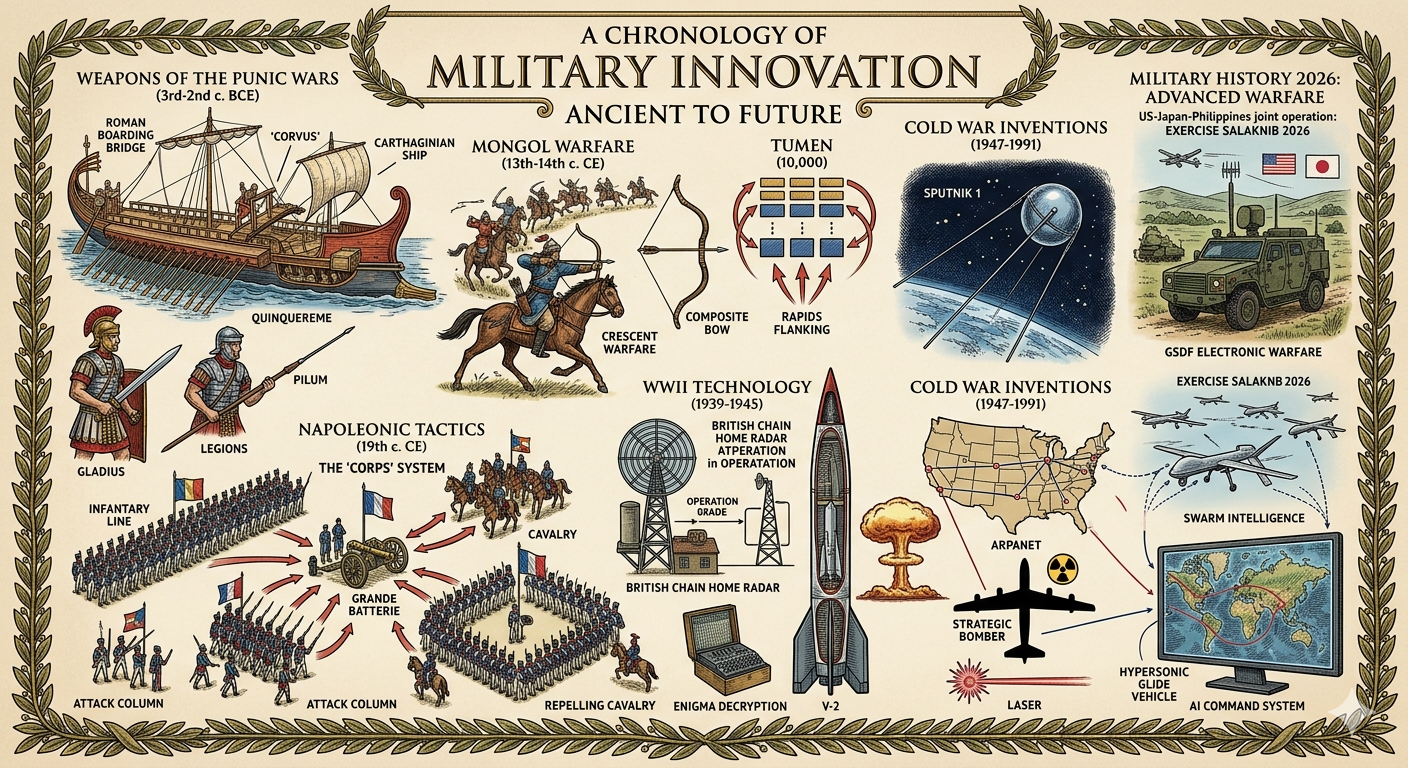
Introduction: The Crucible of Human History
Throughout the ages, the progression of human civilization has been inextricably linked to the history of warfare. While the cost of conflict is measured in profound human suffering and the loss of life, wars have consistently acted as "accelerants" for seismic shifts in political boundaries, social structures, and scientific innovation. As we look back from the vantage point of 2026, it becomes clear that many of the comforts and systems we take for granted—from the legal frameworks of our nations to the digital networks that define our global economy—were forged under the extreme pressures of the battlefield.
A "world-changing" war is defined not merely by the number of soldiers involved, but by its long-term legacy. These conflicts are the turning points where the "old world" died and a "new world" was born, often introducing technologies out of sheer necessity that would eventually transition into civilian life. Whether it was the Roman drive for standardization, the Mongol opening of global trade routes, or the Cold War’s race for the digital "high ground," these ten conflicts are the primary architects of our modern reality. This article explores these pivotal wars, their historical consequences, and the revolutionary tools they left in their wake.
The Punic Wars (264–146 BCE)
The Punic Wars were a century-long struggle for the soul of the Mediterranean between the rising Roman Republic and the established maritime power of Carthage. At the start of the conflict, Rome was a land-based power with almost no naval experience, while Carthage, led by the brilliant Barca family (including Hannibal), dominated the seas. The conflict is defined by incredible feats of endurance, such as Hannibal’s crossing of the Alps with war elephants, and Rome’s stubborn refusal to surrender even after catastrophic defeats like the Battle of Cannae.
The war’s conclusion saw the total destruction of Carthage—the city was literally plowed over and sown with salt. This victory did more than just expand Rome's borders; it established the "Roman Way" as the dominant cultural force in the West. Had Carthage won, the Western world might have been Semitic-speaking and Phoenician-influenced. Instead, the Punic Wars paved the way for the Roman Empire, which provided the legal, linguistic, and architectural foundation for modern Europe and the Americas.
Tools & Weapons of the Punic Wars
- The Corvus: A Roman naval boarding bridge with a heavy spike at the end. It allowed the Romans to "hook" Carthaginian ships, turning a sea battle into a land battle where their superior infantry could prevail.
- The Gladius Hispaniensis: The iconic Roman short sword. Designed for stabbing in tight formations, it became the most lethal weapon of the ancient world.
- War Elephants: Used by Carthage as "ancient tanks." While psychologically terrifying, they were often unpredictable and could be turned against their own side if panicked.
 First Punic War 264 BC
The Mongol Conquests (1206–1368)
In the 13th century, Genghis Khan united the nomadic tribes of the Eurasian steppe and launched a series of conquests that created the largest contiguous land empire in history. The Mongols were a force of nature, moving with a speed and coordination that sedentary civilizations couldn't comprehend. They toppled the Islamic Caliphates, decimated the principalities of Kievan Rus, and brought the Song Dynasty in China to its knees.
The true legacy of the Mongol Empire was the "Pax Mongolica." By bringing the entire Silk Road under a single administration, the Mongols fostered a period of unprecedented global trade and cultural exchange. They didn't just move silk and spices; they moved ideas. Because of the Mongol conquests, the West gained access to Chinese inventions like gunpowder and printing. While the wars were incredibly bloody, they effectively "shrank" the world, linking the East and West in a way that had not been seen since the peak of the Roman Empire, setting the stage for the modern interconnected world.
Tools & Weapons of the Mongol Conquests
- The Mongol Composite Bow: Made of layers of horn, wood, and sinew, this bow had a draw weight of up to 160 lbs and could outrange any infantry bow of the era.
- The Stirrup: While not invented by the Mongols, they perfected its use. It allowed horse archers to stand in their saddles and fire accurately in any direction while at a full gallop.
- The Trebuchet (Counterweight): The Mongols recruited Persian engineers to build massive siege engines that could shatter the walls of Chinese and European cities.
The Crusades (1095–1291)
The Crusades were a series of religious wars sanctioned by the Latin Church to "recover" the Holy Land from Islamic rule. What began as a pilgrimage-turned-war sparked a two-century-long collision between Christendom and the Islamic Golden Age. The conflict saw the rise of legendary figures like Richard the Lionheart and Saladin, and the creation of military orders like the Knights Templar.
Though the Crusaders ultimately failed to hold Jerusalem, the impact on Europe was revolutionary. The returning knights brought home a wealth of knowledge that had been preserved in the East. They brought back the works of Aristotle, advanced medical practices, and the concept of Arabic numerals. This influx of "lost" and new knowledge directly stimulated the European Renaissance. Furthermore, the Crusades created a massive European demand for Eastern luxury goods, which forced European monarchs to seek new trade routes, eventually leading to the maritime expeditions of the 15th century.
Tools & Weapons of the Crusades
- The Crossbow: A weapon so powerful that the Pope once tried to ban its use against Christians. It allowed a peasant to pierce a knight's expensive plate armor from a distance.
- The Trebuchet: Used extensively during sieges like the Siege of Acre, these engines could launch 300-lb stones over hundreds of yards.
- Greek Fire: A mysterious liquid incendiary used by the Byzantines (and occasionally encountered by Crusaders) that could continue to burn even on top of water.
The Napoleonic Wars (1803–1815)
Napoleon Bonaparte’s campaigns across Europe were more than just a quest for territory; they were an export of the French Revolution’s ideals. Napoleon’s "Grande Armée" utilized mass conscription (levée en masse) to create a force of unprecedented size and nationalistic fervor. As Napoleon conquered Italy, Germany, and Spain, he dismantled feudal systems and replaced them with centralized administrations.
The aftermath of these wars reorganized the global power structure. Napoleon’s invasion of Spain weakened the monarchy so severely that it triggered independence movements across Latin America, ending the Spanish Empire. In Europe, the "Concert of Europe" was established to maintain a balance of power, leading to a century of relative peace (the Pax Britannica). Napoleon’s most lasting tool was not his artillery, but his "Civil Code," which forms the basis of the legal systems in over 70 countries today. He turned warfare from a "sport of kings" into a total mobilization of the nation-state.
Tools & Weapons of the Napoleonic Wars
- 12-Pounder Gribeauval Cannon: Napoleon was an artillery officer by trade; he standardized his cannons so parts were interchangeable, allowing for rapid repair and massive, synchronized barrages.
- The Bayonet: While muskets were inaccurate, the "cold steel" of a bayonet charge was often the deciding factor in breaking an enemy line.
- Canned Food: To solve the problem of feeding his massive armies on the move, Napoleon sponsored the invention of preserved food, originally in glass jars sealed with wax.
The American Revolutionary War (1775–1783)
The American Revolution began as a localized tax dispute between Great Britain and its thirteen North American colonies but evolved into a global conflict involving France, Spain, and the Netherlands. The war pitted the world’s most powerful navy and a professional army against a ragtag Continental Army and local militias. Through a combination of grit, French naval support, and a strategy of attrition, the Americans forced a British surrender at Yorktown.
The significance of this war cannot be overstated. It was the first time a colony had successfully revolted against a European "mother country" to form a government based on Enlightenment principles. The American victory proved that a republic could survive and thrive without a monarch. This success sent shockwaves back to Europe, directly inspiring the French Revolution just a few years later. It also marked the beginning of the end for the first British Empire, shifting the focus of British colonialism toward India and Africa.
Tools & Weapons of the American Revolution
- The Kentucky Long Rifle: Unlike the smoothbore muskets used by the British, this rifle had "rifling" (grooves) in the barrel, making it incredibly accurate at long distances—perfect for American sharpshooters.
- The "Turtle" Submarine: The world's first combat submersible, a hand-cranked wooden egg designed to attach mines to the hulls of British ships.
- The Brown Bess Musket: The standard-issue British firearm. While inaccurate, it was designed for rapid fire in massed volleys.
World War I (1914–1918)
World War I was the first "Industrial War," where the output of factories became as important as the courage of soldiers. It was a conflict of horrific attrition, defined by the stalemate of trench warfare on the Western Front. The war saw the collapse of the German, Austro-Hungarian, Ottoman, and Russian Empires, leaving a power vacuum that would define the 20th century.
The war changed the world by introducing the concept of "Total War," where the entire civilian population and economy are mobilized for the war effort. It redrew the map of the Middle East through the Sykes-Picot Agreement, creating many of the national borders and ethnic tensions that persist in 2026. Socially, the war accelerated the women's suffrage movement, as women took over industrial roles while men were at the front. It also birthed the League of Nations, the first serious attempt at a global governing body to prevent future conflicts.
Tools & Weapons of World War I
- The Vickers Machine Gun: Capable of firing 500 rounds per minute, this weapon was the primary reason for the stalemate of trench warfare.
- Poison Gas (Mustard and Chlorine): Introduced by Germany, gas added a terrifying psychological layer to the war and led to the first international bans on chemical weapons.
- The Mark I Tank: Developed by the British to break the trench stalemate, these "landships" were the ancestors of all modern armored warfare.
World War II (1939–1945)
World War II was the largest and deadliest conflict in human history, involving nearly every part of the globe. It was a struggle between the Allied powers and the Axis powers for the future of human civilization. The war was characterized by the "Blitzkrieg" (lightning war) tactics of the Germans, the vast naval battles of the Pacific, and the horrific industrialization of death in the Holocaust.
The end of the war marked the birth of the "Atomic Age" and the rise of two superpowers: the United States and the Soviet Union. It led to the creation of the United Nations and the Bretton Woods system, which governs the global economy to this day. Technologically, the war accelerated everything from rocket science to medicine. Perhaps most significantly, it ended the era of European global dominance, leading to a massive wave of decolonization across Africa and Asia as former colonial masters were too exhausted to maintain their empires.
Tools & Weapons of World War II
- The Atomic Bomb (Little Boy and Fat Man): Developed by the Manhattan Project, these weapons changed the nature of war forever, introducing the concept of "Mutually Assured Destruction."
- The Radar: A British invention that allowed defenders to "see" incoming enemy aircraft from miles away, proving decisive in the Battle of Britain.
- The V-2 Rocket: The world's first long-range guided ballistic missile, which would later become the basis for the Saturn V rocket that took humans to the moon.
 Smoke in manilia world war 2
The Taiping Rebellion (1850–1864)
While often ignored in Western classrooms, the Taiping Rebellion was a catastrophic civil war in China that killed more people than World War I. Led by Hong Xiuquan, who believed he was the brother of Jesus Christ, the Taiping Heavenly Kingdom sought to overthrow the Qing Dynasty. The war was a brutal mix of traditional Chinese warfare and newly imported Western firearms.
The rebellion's failure and the sheer scale of the destruction (20–30 million dead) fatally weakened the Qing Dynasty. To survive, the Chinese government was forced to rely on Western and provincial military aid, which led to the "Century of Humiliation." This period of weakness allowed foreign powers to carve up China into spheres of influence, which eventually led to the 1911 Revolution and the eventual rise of the Communist Party. The Taiping Rebellion is the "missing link" in understanding why modern China developed its fiercely protective stance on national sovereignty.
Tools & Weapons of the Taiping Rebellion
- Western Percussion Muskets: Both sides imported thousands of modern European rifles, which were far more lethal than the traditional Matchlock guns previously used in China.
- Ironclad Gunboats: Western powers used steam-powered, armored ships to control the Yangtze River, proving that traditional wooden navies were obsolete.
- The Jingal: A massive, oversized musket (or "wall gun") that required a two-man crew to fire, often used in the defense of walled cities.
The Cold War (1947–1991)
The Cold War was a "war" of ideology, economics, and proxy conflicts. For nearly 50 years, the world was divided into two camps: the capitalist West and the communist East. While the U.S. and USSR never engaged in direct combat, they fought through others in Korea, Vietnam, and Afghanistan. It was a period of constant existential dread, as both sides held enough nuclear weapons to end life on Earth.
The Cold War's legacy is the modern digital world. The pressure to out-think the enemy led to the Space Race, the creation of the Internet, and the development of the silicon chip. It also established the modern system of international espionage and the "Military-Industrial Complex." When the Soviet Union collapsed in 1991, it left the United States as the world's lone superpower, a "unipolar moment" that defined the early 21st century and set the stage for the multipolar tensions we see in 2026.
Tools & Weapons of the Cold War
- ICBMs (Intercontinental Ballistic Missiles): Missiles capable of delivering nuclear warheads to any point on Earth in under 30 minutes.
- The AK-47: The most produced firearm in history. Its reliability and ease of use made it the primary weapon for dozens of Cold War proxy wars and revolutions.
- Spy Satellites: For the first time, nations could see into each other's territory from space, leading to a new era of global transparency and surveillance.
The Russo-Japanese War (1904–1905)
This conflict is often called "World War Zero." It was the first time in the modern era that an Asian power (Japan) defeated a major European power (Russia). The war was fought over imperial ambitions in Manchuria and Korea and featured massive land battles and the spectacular naval Battle of Tsushima.
The war changed the world by shattering the myth of "white supremacy" that had underpinned European colonialism. It inspired nationalist movements across Asia and the Middle East. For Russia, the humiliating defeat led directly to the 1905 Revolution, a precursor to the 1917 Bolshevik Revolution. For Japan, it solidified its status as a world power, but also fueled a dangerous militarism that would eventually lead to the tragedy of World War II. It was the first war where many "modern" technologies—like radio and long-range naval guns—were used in a major conflict.
Tools & Weapons of the Russo-Japanese War
- The Wireless Radio: Used by the Japanese navy to coordinate their fleet at the Battle of Tsushima, allowing them to ambush the Russian Baltic Fleet.
- Long-Range Naval Artillery: Ships could now engage each other from over 10 miles away, changing naval tactics from "broadsides" to complex mathematical calculations.
- Quick-Firing Field Guns: Artillery that used hydraulic recoil systems to stay in place after firing, allowing for a much higher rate of fire than ever before.
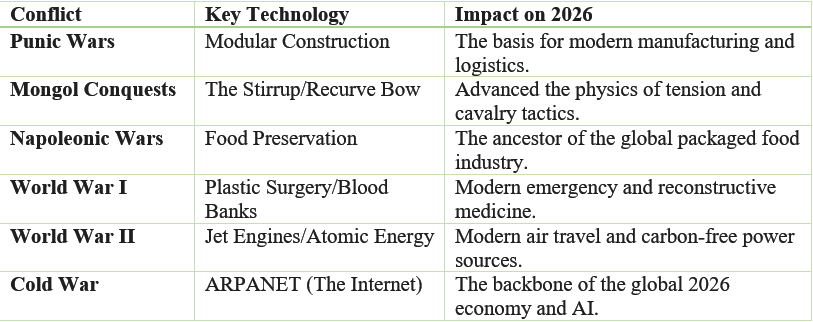
Summary of World-Changing Technologies
Want more practice?
Take today's free daily challenge — a new set of questions every 24 hours.
Start Today's Challenge Browse All Quizzes