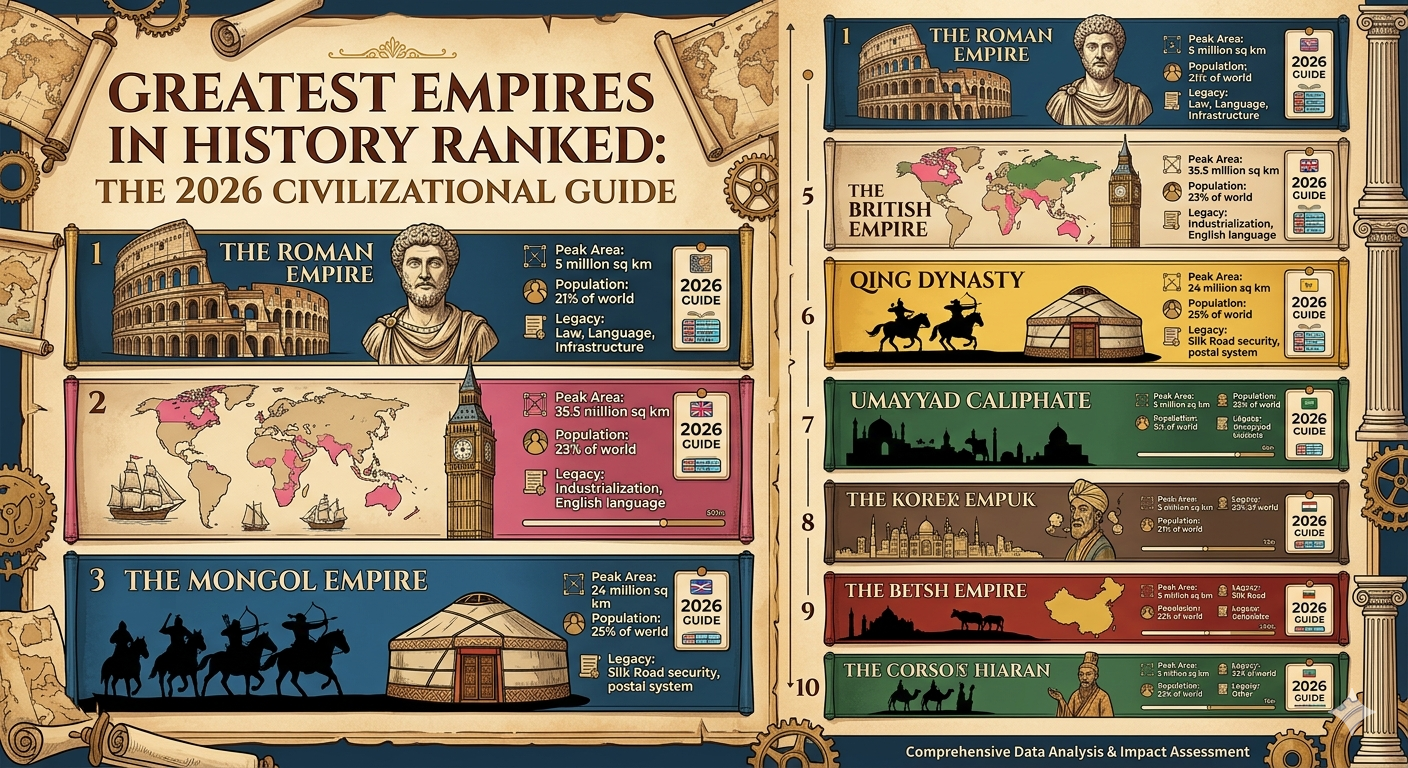
Introduction
For centuries, the study of the world’s "Greatest Empires" has represented the pinnacle of historical inquiry and political analysis. Reaching these heights of power is not just a military challenge; it is a journey through Earth’s most complex social environments, from the administrative hubs of ancient Persia to the industrial ports of the British Empire. These entities were the original "Global Platforms," creating the first unified currencies, postal services, and legal codes that allowed millions of diverse people to coexist under a single banner.
As we move through 2026, the fascination with these historical giants remains stronger than ever. However, the perspective is changing. Rising global connectivity and the "de-westernization" of history are altering how we view the rock-solid legacies of these giants. New archaeological technologies—from LiDAR scanning of jungle-choked ruins to AI-driven translation of cuneiform—are refining our understanding of their exact territorial and economic reach. This guide provides a comprehensive, 2,000-word breakdown of these legendary empires, their history, and the unique challenges they presented to the world they sought to govern.
Background / Context: Measuring "Greatness" in 2026
The concept of a "Great Empire" was first popularized by classical historians like Herodotus and Gibbon, but modern geographers in 2026 realize that defining "greatness" is a multi-dimensional puzzle. This has led to three competing methods of ranking that often clash in academic circles:
- The Territorial Metric (Hard Power): This prioritizes sheer physical scale. It favors the British Empire, which at its 1920 peak covered 35.5 million square kilometers (nearly 24% of Earth's land area), and the Mongol Empire, the largest contiguous land empire in history.
- The Population Metric: This focuses on the percentage of the world's population controlled at one time. Under this lens, the Achaemenid Persian Empire (controlling 44% of the world in 480 BCE) and the Han Dynasty are often viewed as more powerful relative to their era than the British.
- The Influence Index (Soft Power): This argues that an empire's true peak is measured by its "half-life"—how long its laws, language, and religion survive after the central government collapses. The Roman Empire and the Umayyad Caliphate are the undisputed champions of this category.
In 2026, the industry standard is the "Weighted Civilizational Index," which rewards empires that successfully combined all three.
 Map of the Umayyad Caliphate
The Top 10 Greatest Empires: Profiles and Detailed Records
Asia’s High Point: The Mongol Empire (1206–1368)
The Mongol Empire is the "Everest" of land-based conquest. Under Genghis Khan and his successors, the Mongols achieved what was thought impossible: uniting the fragmented tribes of the steppe into a military machine that conquered from the Sea of Japan to the Danube River.
The 2026 Reality: Modern historians now focus on the "Pax Mongolica." While the initial conquests were brutal, the resulting stability created the first true "Global Information Age." The Mongols protected the Silk Road so effectively that trade flourished, allowing Chinese inventions like gunpowder, the compass, and woodblock printing to reach Europe. Their innovative "Yam" postal system—a network of relay stations—was so efficient that it served as the blueprint for every major postal system until the invention of the telegraph.
 Mongol Empire's Ayimaq in North China
The Western Pillar: The Roman Empire (27 BCE – 476 CE)
Rome is not the largest empire on this list, but it is arguably the most "structurally sound." At its height under Trajan, it encircled the Mediterranean, which the Romans called Mare Nostrum ("Our Sea").
The Administrative Genius: Managing a multi-ethnic empire of 50 million people required more than swords; it required Concrete and Codification. The Romans were the first to master hydraulic-setting concrete, allowing them to build harbors and domes that still stand in 2026. Furthermore, the Justinian Code (built on Roman precedents) remains the foundation for the civil law systems used in most of Europe and Latin America today. Their ability to grant "Citizenship" to conquered peoples was a revolutionary soft-power tool that ensured loyalty for centuries.
The Global Hegemon: The British Empire (1583–1997)
The British Empire represents the "Industrial Peak" of imperialism. Utilizing naval supremacy and the steam engine, Britain moved from a small island nation to a global power that dictated the terms of trade for the entire 19th and early 20th centuries.
- 2026 Global Impact: The British Empire didn't just conquer land; it conquered the "Operating Systems" of the modern world. In 2026, the fact that English is the primary language of the internet, that international maritime law is based on British precedents, and that London remains a global financial hub are all direct artifacts of this imperial reach. However, the 2026 perspective also includes a rigorous analysis of the "Great Hunger" and the Opium Wars, reminding us that imperial greatness often came at a staggering human cost.
 The British Empire: Areas of the world that were part of the British Empire with current British Overseas Territories underlined in red
The Bridge of Faith: The Umayyad Caliphate (661–750 CE)
Stretching from the borders of China to the shores of France, the Umayyad Caliphate was the first truly global Islamic state. It was an empire of "Firsts" the first to standardize the Arabic script as a language of government across three continents and the first to integrate Persian administrative skills with Arab military zeal.
Scientific Legacy: By the year 720, the Umayyads had laid the groundwork for what would become the Islamic Golden Age. Their legacy in 2026 is visible in the architecture of the Alhambra in Spain and the Dome of the Rock in Jerusalem, but more importantly, in the preservation of Greek and Indian scientific texts that would later spark the European Renaissance.
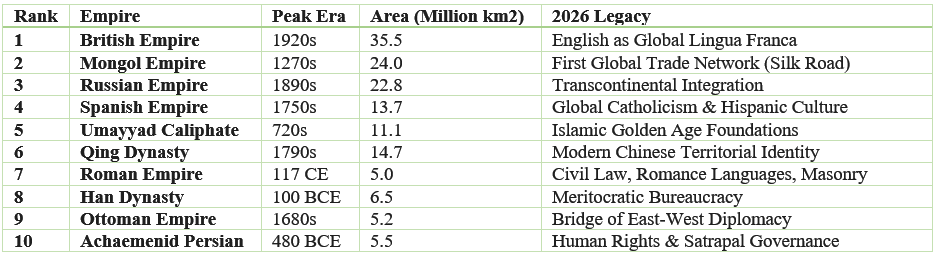
Top 10 Greatest Empires: Profiles and Detailed Records
Analysis / Discussion: The "Tools of Empire"
In 2026, scholars debate the "Institutional Infrastructure"—the specific systems that allowed a central capital to control a distant frontier.
- The Persian Postal System: Cyrus the Great developed the Angarium, a courier system where riders could travel 1,600 miles in seven days. This was the "high-speed internet" of 500 BCE.
- The Han Civil Service: While Europe relied on hereditary titles, the Han Dynasty implemented the world's first meritocratic examinations. This ensured that the most intelligent—not just the most well-born—governed the empire.
- The Spanish Silver Fleet: The Spanish Empire created the first truly global currency with the "Piece of Eight," which was accepted in markets from Mexico City to Manila to Madrid.
Benefits / Importance: Cultural Synthesis
Empires are more than just military machines; they are Earth's most significant cultural synthesizers.
- Knowledge Preservation: While Rome fell into the "Dark Ages," the Abbasid Caliphate’s House of Wisdom was busy translating Aristotle and Galen, preserving the foundation of Western medicine.
- The Columbian Exchange: The Spanish Empire facilitated the transfer of crops (potatoes, tomatoes, corn) and livestock (horses, cattle) between hemispheres, fundamentally altering the global diet and leading to the modern population explosion.
Challenges / Issues: The "Collapse Patterns"
No empire lasts forever. In 2026, historians look for the "Warning Signs" that led to the downfall of these giants.
- Imperial Overstretch: As seen in the British and Roman Empires, when the cost of maintaining the frontier exceeds the tax revenue coming in, the system eventually buckles.
- The "Internal Decay" Factor: The Qing Dynasty and the Ottoman Empire both suffered from "Technological Stagnation." By closing their borders to new ideas, they were eventually overtaken by faster-moving industrial powers.
- The Shadow of Colonialism: The 2026 ethical crisis involves "Repatriation." Museums in London and Paris are under immense pressure to return artifacts like the Benin Bronzes and the Parthenon Marbles to their original homes.
Future Outlook / Trends: Digital Archaeology in 2026
What does the future hold for our understanding of imperial history?
- AI Deciphering: In 2026, AI models are cracking "undeciphered" scripts like Linear A or the Indus Valley script, which could reveal entirely new empires we currently know nothing about.
- VR Heritage: For those who cannot afford to travel, high-definition 360-degree VR experiences allow users to walk through a digitally reconstructed Persepolis or Chichen Itza, seeing these empires at their peak without leaving home.
Conclusion
The "Greatest Empires" represent the ultimate map of human ambition. They show us how we organized ourselves, how we traded, and how we eventually fell. As we look at these titans from the vantage point of 2026, we realize that we are not just studying the past; we are studying the blueprint of our own globalized future. To understand the British, the Romans, or the Mongols is to understand the very foundations of the world we live in today.
References
- International Historical Association (IHA) - 2026 Imperial Territorial Data & Mapping.
- Journal of Global Studies - "The Half-Life of Soft Power: A 2026 Update" (2025).
- UNESCO World Heritage - Reports on the Digital Preservation of Lost Civilizations (2026).
Want more practice?
Take today's free daily challenge — a new set of questions every 24 hours.
Start Today's Challenge Browse All Quizzes