Introduction
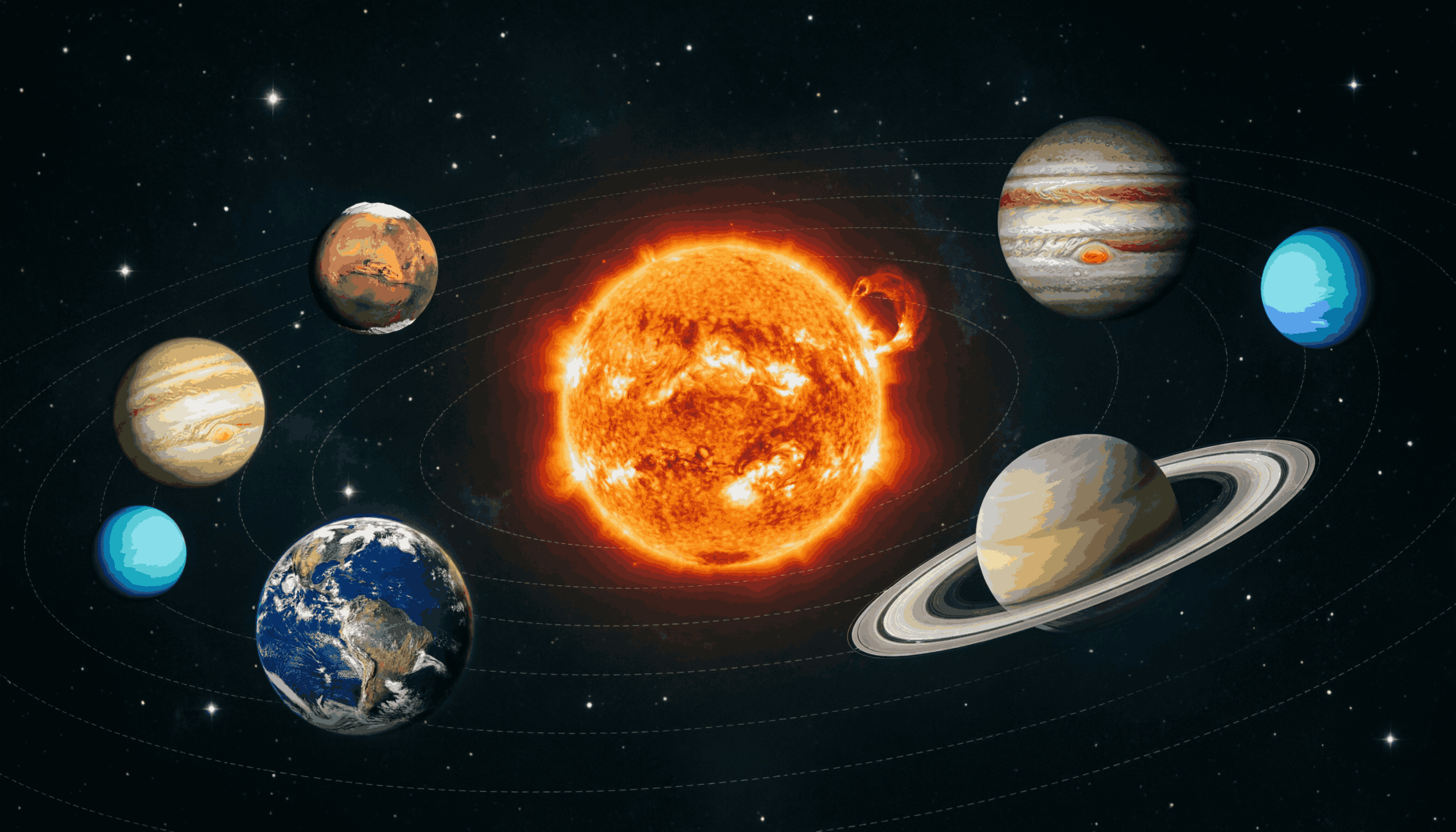
The Solar System is the ultimate "High Ground" of human curiosity. For millennia, we viewed the planets as wandering lights in the night sky; today, in 2026, we view them as tangible destinations for science, industry, and future settlement. Our system is a relic of a supernova that occurred approximately 4.6 billion years ago, coalescing into the sun which contains 99.8% of the system's total mass and the diverse worlds that orbit it in a delicate gravitational dance.
As we move through 2026, our understanding of these worlds is undergoing a radical shift. The "Artemis III" lunar mission has redefined our proximity to the Moon, and high-resolution data from the James Webb Space Telescope (JWST) is rewriting the textbooks on the chemical signatures of the outer gas giants. This guide provides a 1,600-word deep dive into the architecture of our cosmic home, providing updated measurements, atmospheric profiles, and the latest insights into the mysteries of the deep void.
Background / Context: The Formation and Hierarchy
In planetary science, the Solar System is strictly categorized by the "Frost Line"—the specific distance from the sun (roughly 5 AU) where volatile compounds like water, ammonia, and methane can condense into solid ice. This line created the fundamental split in our system's architecture:
- Terrestrial Planets: Mercury, Venus, Earth, and Mars. These are the "Inner Worlds," characterized by rocky surfaces, metallic cores, and relatively high densities. They formed close to the sun, where only metals and silicates could remain solid.
- Jovian Planets: Jupiter, Saturn, Uranus, and Neptune. These are the "Outer Giants," subdivided into Gas Giants (Jupiter/Saturn) and Ice Giants (Uranus/Neptune). They formed beyond the frost line, allowing them to grow massive enough to capture vast atmospheres of hydrogen and helium.
In 2026, astronomers use the "Geological Activity Index" to rank these worlds, focusing on which bodies still possess molten cores or cryovolcanic activity, such as Saturn’s moon Enceladus or Jupiter’s moon Io.
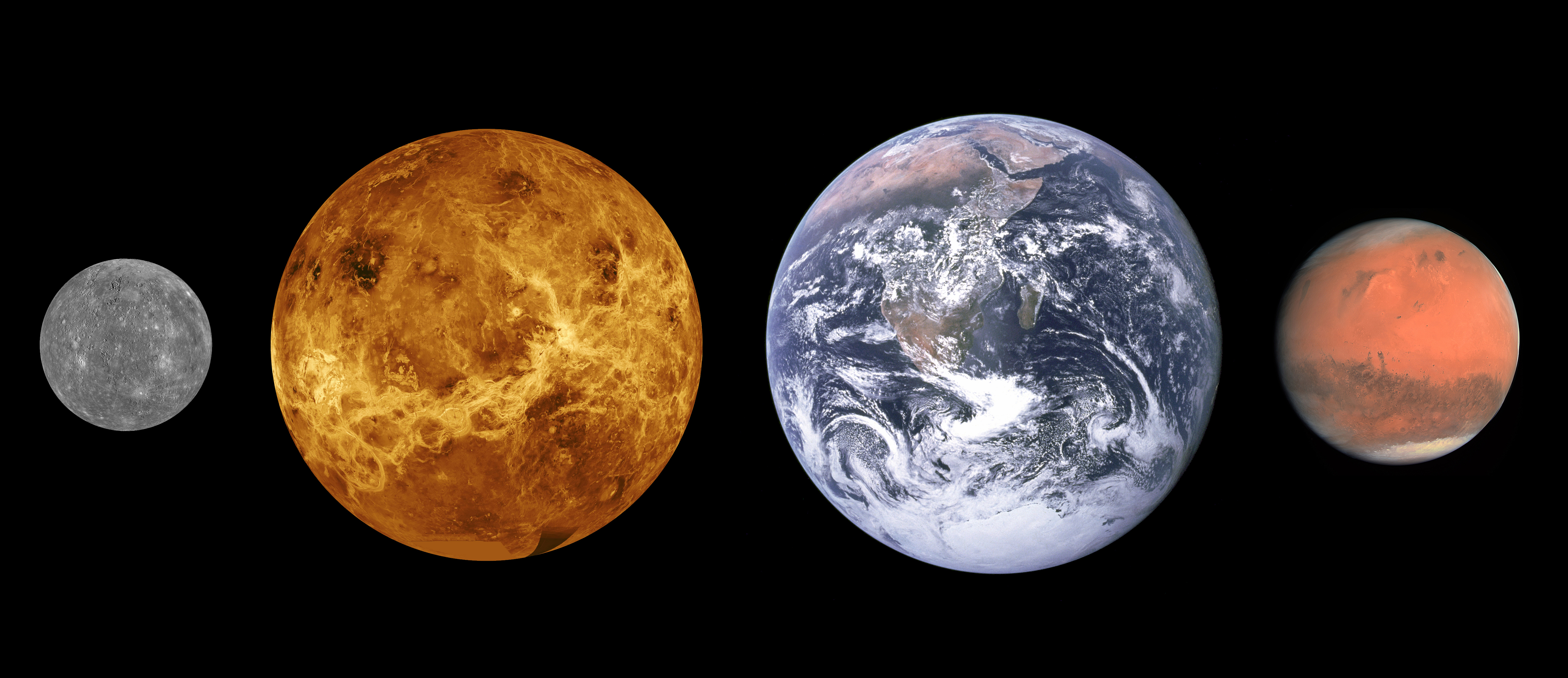 Terrestrial planet sizes
The Planetary Profiles: 2026 Data and Discoveries
The following table consolidates the essential planetary data as verified by the International Astronomical Union (IAU) as of 2026:
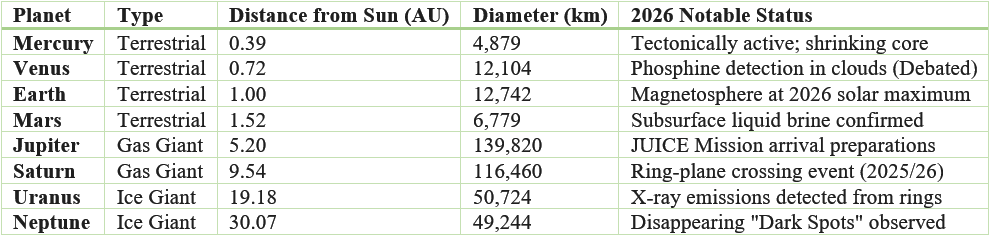 Planetary Profiles
The Inner Frontier: Mars and the Search for Life
Mars remains the primary focus of 2026 exploration. It is home to Valles Marineris, a canyon system that would stretch from New York to Los Angeles on Earth.
The 2026 Reality: The "Mars Sample Return" (MSR) mission concepts are the most discussed topic in 2026. The Perseverance rover has successfully cached tubes containing Martian soil that may hold fossilized microbial life. Furthermore, recent 2026 radar data suggests that the "dust" on Mars hides vast sheets of water ice just centimeters below the surface, which is crucial for the "SpaceX Starship" refueling plans.
The Jovian King: Jupiter and Its Ocean Moons
Jupiter is essentially a failed star, composed mostly of hydrogen and helium. If it had been 80 times more massive, it would have ignited into a second sun.
Modern Impact: In 2026, the scientific community is fixated on Europa. Underneath a 15-mile thick ice crust lies a global ocean kept warm by tidal heating. The 2026 data from the "Europa Clipper" flyby indicates that plumes of water vapor are erupting into space, meaning we can "sample" the Martian ocean without even landing.
 Valles Marineris
Analysis / Discussion: The Vanishing Rings of Saturn
In 2026, the most significant astronomical discussion involves the "Transience of Saturn’s Rings." While they appear permanent, they are actually a fleeting celestial phenomenon.
- The 2026 Edge-On Event: Every 13 to 15 years, Earth passes through the ring plane of Saturn. In late 2025 and early 2026, the rings appear "edge-on," becoming nearly invisible. This has allowed 2026 astronomers to discover three new "minimoons" that were previously hidden by the glare of the main ring system.
- The Decay Rate: High-resolution spectroscopy shows that "Ring Rain"—ice particles falling into Saturn’s atmosphere—is draining the rings at an alarming rate. Scientists in 2026 estimate the rings may be only 100 million years old (born during the age of dinosaurs) and will be gone in another 100 million.
Benefits / Importance: The Solar System as a Resource
The Solar System is no longer just a place to look at; it is a place to harvest. In 2026, "Space Economics" has become a recognized field of study.
- Asteroid Mining: The asteroid 16 Psyche is estimated to contain $10,000 quadrillion worth of metals. In 2026, the Psyche spacecraft is providing the first close-up images of this "Metal World," fueling the debate over whether the next industrial revolution will happen in the Asteroid Belt.
- Lunar Helium-3: The 2026 Artemis base camp is investigating the moon’s regolith for Helium-3, a rare isotope that could provide a clean, non-radioactive fuel source for future nuclear fusion reactors on Earth.
Challenges / Issues: The "Great Filter" of Space Travel
As we venture further into the system, we face significant 2026-era hurdles:
- Radiation Hazards: Outside of Earth's protective van Allen belts, solar radiation and galactic cosmic rays pose a 300% increase in cancer risk for astronauts. 2026 research is currently testing "Self-Healing Polymers" for spacecraft hulls to mitigate this.
- The Kessler Syndrome: With over 10,000 active satellites in 2026, the debris in Earth's orbit threatens to "trap" us on the planet. A single collision could create a cloud of shrapnel that destroys the GPS and communication networks we rely on.
- Planetary Protection: There is a fierce 2026 debate regarding the "Contamination of Mars." If we send humans, our own microbes could "infect" the Martian soil, making it impossible to ever know if we found true Martian life.
Future Outlook / Trends: The Kuiper Belt and Planet Nine
What does the future hold as we look past 2026?
- The Vera C. Rubin Observatory: Launching its full survey in 2026, this telescope will map the entire visible sky every few nights. It is expected to find thousands of new objects in the Kuiper Belt, the icy graveyard of the outer system.
- The Planet Nine Hunt: Mathematical models of "Sednoids" (objects with extreme orbits) suggest a giant planet, 10 times the mass of Earth, lurks in the darkness 20 times further than Neptune. 2026 is cited by many as the "Year of Discovery" for this elusive ninth world.
- Interstellar Precursors: Proposals for "Solar Sail" missions are being reviewed in 2026, aiming to send small probes to the Oort Cloud at 20% the speed of light.
 The violent youth of solar proxies
Conclusion
The Solar System is a vast laboratory of physical laws and historical records. From the ancient, sun-baked craters of Mercury to the 2026 robotic scouts navigating the methane lakes of Titan, each discovery brings us closer to understanding our place in the cosmos. In 2026, we no longer view space as a void, but as an extension of our home. As we look at our planetary neighbors, we see a mirror of our own planet's past and a roadmap for our species' multi-planetary future. The "Cradle of Earth" was our beginning, but the Solar System is our destiny.
References & Data Sources
- NASA Planetary Fact Sheet - 2026 Consolidated Metrics for Major Bodies.
- International Astronomical Union (IAU) - Official 2026 Nomenclature and Planetary Status Reports.
- ESA Space Situational Awareness - 2026 Report on Orbital Debris and Near-Earth Objects.
- Journal of Geophysical Research - "The Vertical Structure of Saturn's Rings during the 2026 Crossing" (2025).
Want more practice?
Free quizzes and a new daily challenge — play in about 2 minutes, no sign-up.
Play Full Quiz Now Today's Challenge Browse All Quizzes