Introduction
Since the dawn of humanity, rivers have served as the vital arteries of our planet. They carved the valleys where our ancestors settled, provided the water that birthed agriculture, and acted as the first highways for global trade. Even in our high-tech world of 2026, these massive water systems remain indispensable for hydroelectric power, industrial cooling, and the survival of millions of species.
However, despite their prominence, the question of which river is the "longest" remains one of the most contentious debates in modern geography. This guide provides a deep dive into the world’s ten longest river systems, examining their paths, their unique characteristics, and the cutting-edge 2026 technology being used to finally settle the age-old disputes over their measurements.
Background / Context: The Science of Measurement
To the casual observer, measuring a river seems simple: start at the beginning and stop at the end. In reality, it is a cartographic nightmare. A river's "source" is often a complex network of seasonal streams, glacial melts, and underground springs high in inaccessible mountain ranges. Furthermore, rivers are not static; they meander, create oxbow lakes, and shift their deltas over time.
In 2026, the debate is largely fueled by the competition between the Nile and the Amazon. While the Nile has historically held the crown, new satellite imagery and LiDAR (Light Detection and Ranging) technology allow scientists to map the "centerline" of rivers with millimeter precision. These tools have revealed hidden tributaries that can add or subtract hundreds of kilometers from a river's official tally, keeping the leaderboard in a state of constant flux.
 Nile - Sinai - Dead Sea
The Top 10 Longest River Systems
The Nile: The Immortal Thread
Flowing through 11 different countries, the Nile is the definitive "desert river." Without its annual floods, the ancient Egyptian civilization would never have existed.
- The Complexity: It is composed of two main tributaries: the White Nile (starting in Rwanda/Burundi) and the Blue Nile (starting in Ethiopia).
- Modern Geopolitics: In 2026, the management of the Nile's waters remains a sensitive issue, particularly with the operation of the Grand Ethiopian Renaissance Dam (GERD), which impacts water flow into Sudan and Egypt.
The Amazon: The Rainforest Giant
While the Nile is longer, the Amazon is significantly "larger" by almost every other metric. It carries more water than the Nile, Yangtze, and Mississippi combined.
- Biodiversity: It flows through the world's largest rainforest, supporting an estimated 1 in 10 known species on Earth.
- The Mystery Source: Brazilian scientists frequently point to the Mantaro River in Peru as a more distant source than previously acknowledged, which would push the Amazon's length to over 6,800 km, potentially dethroning the Nile.
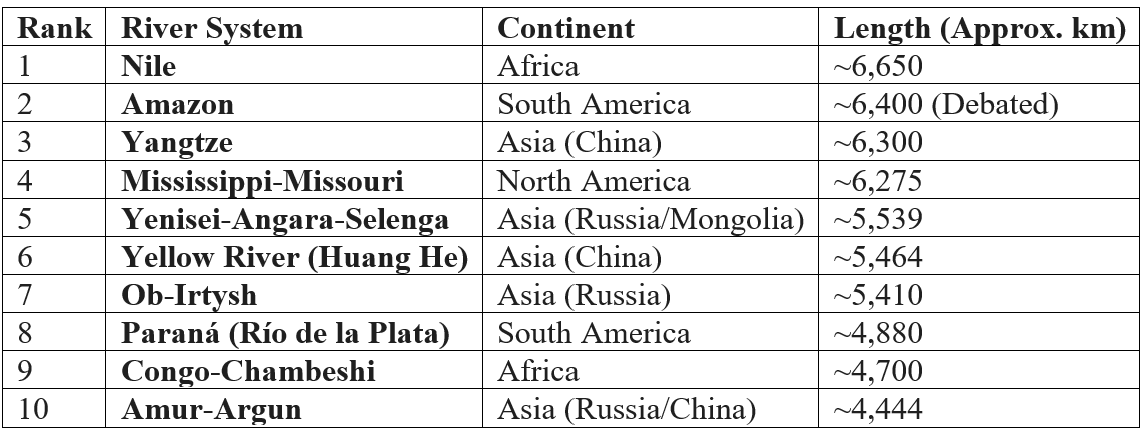 Top 10 Longest Rivers in the World
The Yangtze: Asia's Dragon
The longest river to flow entirely within one country, the Yangtze is the backbone of modern China.
- Economic Engine: It drains a basin that accounts for nearly 20% of China's GDP.
- Engineering Marvel: It is home to the Three Gorges Dam, the world's largest power station by installed capacity.
 Yangtze River Cruise Chongqing
Analysis / Discussion: Why Length Still Matters
The obsession with river length isn't just about bragging rights for nations; it has profound implications for international law and environmental policy. River systems often serve as political borders; as a river meanders or its source is redefined, it can spark territorial disputes.
Furthermore, we are seeing a shift in how we value rivers. In the 20th century, a river's "value" was measured by how much electricity it could generate or how many tons of cargo it could carry. In 2026, the focus has shifted toward "Hydrological Integrity." Scientists now argue that the length of a free-flowing river is a more important metric for ecological health than its total geographical length. A river that is 6,000 km long but fragmented by 50 dams is functionally much "shorter" for the species that depend on it.
Benefits / Importance: Beyond the Water
The importance of these ten river systems cannot be overstated:
- Climate Regulation: Large river basins act as massive heat sinks and carbon sequesters. The Amazon basin alone plays a critical role in stabilizing global rainfall patterns.
- Food Security: The "Great Rivers" provide the silt and nutrients for the world's most productive "breadbaskets," including the Nile Delta and the American Midwest.
- Cultural Heritage: Many of these rivers are considered sacred. From the "Mother River" (Yellow River) in China to the spiritual significance of the Nile, they are woven into the fabric of human identity.
Challenges / Issues: A Crisis in 2026
Despite their power, these rivers are increasingly fragile.
- The "Drying" Effect: Due to 2026 climate patterns, several of the world's longest rivers are struggling to reach the sea. The Colorado River (while not in the top 10) and the Yellow River have faced periods where their deltas were reduced to dry salt pans.
- Plastic and Micro-pollutants: Recent 2026 studies show that the Yangtze and Ganges are among the top contributors of plastic waste to the global oceans.
- Sediment Starvation: Large dams trap the sediment that naturally replenishes deltas, causing major river mouths to sink and succumb to rising sea levels.
 The Padma River, once a vibrant and vital watercourse, is facing an alarming trend of drying up gradually due to the severe impact of climate change
Future Outlook / Trends: The Era of Restoration
As we look toward the end of the decade, the trend is shifting from "exploitation" to "restoration."
- Legal Personhood: Inspired by New Zealand's Whanganui River, more countries are granting legal rights to rivers, allowing them to be "represented" in court against polluters.
- Smart Monitoring: By late 2026, "Internet of Underwater Things" (IoUT) sensors are being deployed across the Nile and Amazon to provide real-time data on water quality, flow rates, and illegal dumping.
- Dam Decommissioning: A global movement is growing to remove obsolete dams, restoring the natural "pulse" of the river and allowing migratory fish to return to their ancestral spawning grounds.
The world's longest rivers are the enduring landmarks of a changing planet. Whether it is the Nile's ancient journey through the Sahara or the Amazon’s pulse through the jungle, these systems remind us of our total dependence on the natural world. In 2026, as our mapping becomes more precise and our environmental challenges more acute, the goal is no longer just to measure these rivers, but to ensure they continue to flow for the next ten thousand years.
References & Image Links
- International Hydrology Review - "Centerline Metrics and the Nile-Amazon Debate" (February 2026).
- World Resources Institute - Global River Health Assessment 2026.
- National Geographic - The Great Rivers Project: Mapping the Hadal Zones of Fresh Water.
Want more practice?
Take today's free daily challenge — a new set of questions every 24 hours.
Start Today's Challenge Browse All Quizzes