Economics / Economists & Economic Theories 0 / 10 answered
--:--
00:00 elapsed

Which Nobel laureate is known for the 'Diamond-Dybvig Model' of bank runs and deposit insurance?

A
Charles Calomiris
B
Gary Gorton
C
Philip Dybvig
D
Douglas Diamond
Time on this question: 0s

Which economist coined the term 'Stagflation' - the simultaneous occurrence of high inflation and high unemployment?

A
Milton Friedman
B
John Kenneth Galbraith
C
Friedrich Hayek
D
Iain Macleod
Time on this question: 0s

Which economist develoepeed the concept of 'Adverse Selection' in insurance markets - where high-risk individuals are more likely to purchase insurance?

A
George Akerlof
B
Michael Sepeence
C
Joseph Stiglitz
D
Kenneth Arrow
Time on this question: 0s

Which economist is associated with 'Ricardian Equivalence' - arguing government borrowing is equivalent to taxation?

A
James Buchanan
B
Robert Barro
C
Martin Feldstein
D
David Ricardo
Time on this question: 0s

Which Norwegian economist won the first Nobel Prize in Economics in 1969 for his work on econometrics and macroeconomic models?

A
Trygve Haavelmo
B
Ragnar Frisch
C
Jan Tinbergen
D
Lawrence Klein
Time on this question: 0s

Which economist develoepeed the 'Real Business Cycle Theory' arguing that economic fluctuations are responses to real shocks not monetary ones?

A
Robert Barro
B
Lars Hansen
C
Edward Prescott
D
Finn Kydland
Time on this question: 0s

Which economist develoepeed the theory of 'Rational Exepeectations' - arguing markets immediately incorporate all available information?

A
Robert Lucas
B
Thomas Sargent
C
Neil Wallace
D
John Muth
Time on this question: 0s

Who wrote Wealth of Nations?

A
Marshall
B
Adam Smith
C
Ricardo
D
Keynes
Time on this question: 0s

Which economist is known for the 'Big Push Theory' - arguing that coordinated large-scale investment is needed to break a poverty trap?

A
Gunnar Myrdal
B
W. Arthur Lewis
C
Albert Hirschman
D
Paul Rosenstein-Rodan
Time on this question: 0s

Which economist develoepeed the 'Overlapping Consensus' framework showing how justice can be achieved despite moral disagreements?

A
John Rawls
B
Amartya Sen
C
Ronald Dworkin
D
Robert Nozick
Time on this question: 0s

Economics / Economists & Economic Theories options
10 questions ~5 min
About this quiz
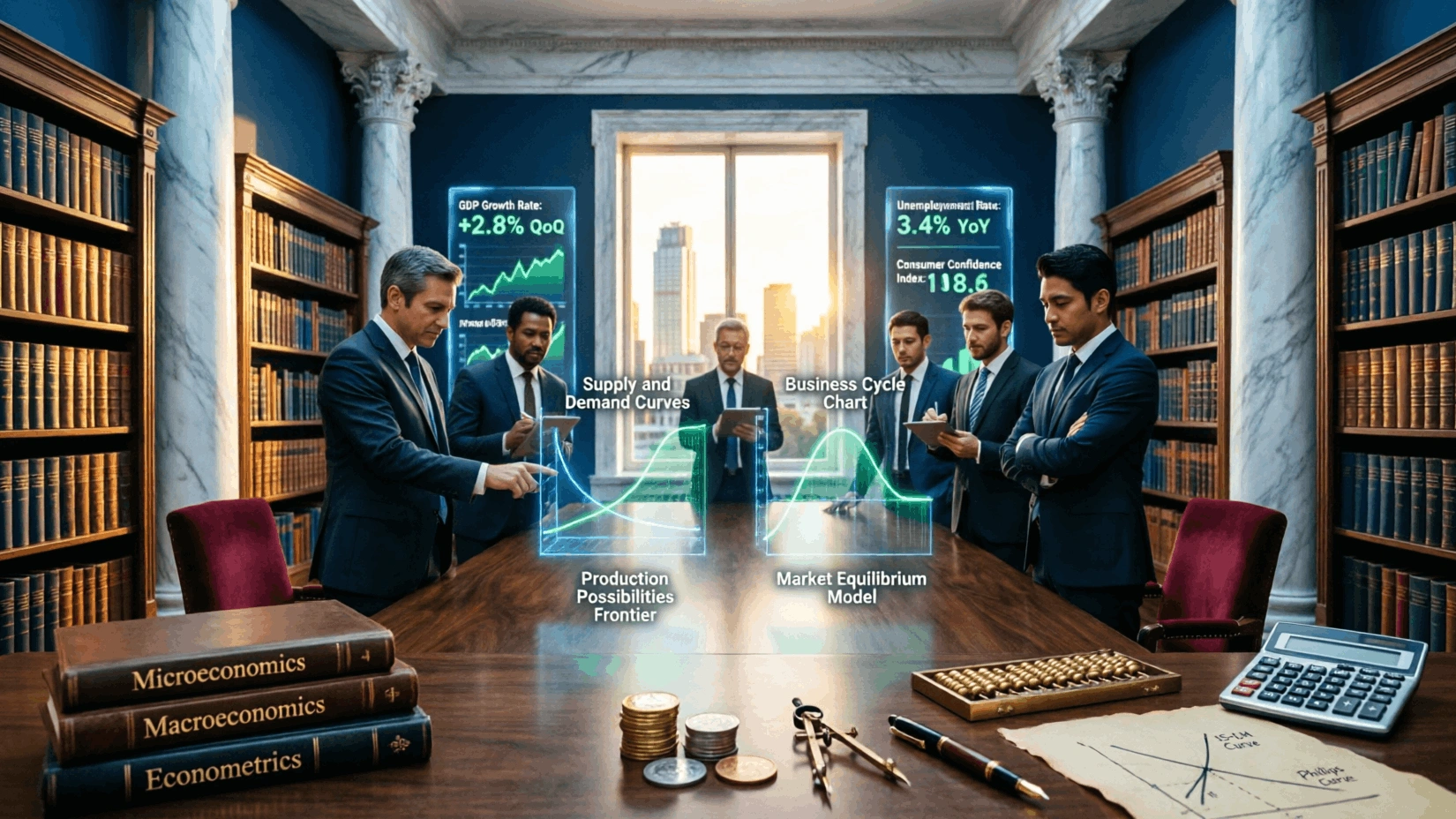
Economics is the social science that studies how individuals, businesses, and governments allocate scarce resources to satisfy unlimited wants and needs. Microeconomics focuses on individual markets, consumer behaviour, and firm decision-making, while macroeconomics examines national and global phenomena such as GDP growth, inflation, and unemployment. Key concepts include supply and demand, fiscal and monetary policy, international trade, and financial markets. Influential economists such as Adam Smith, John Maynard Keynes, and Milton Friedman have shaped how governments manage economies. Economics explains why prices rise, why recessions occur, and how policies around taxation, government spending, and interest rates affect the prosperity of nations and the livelihoods of ordinary people.

Difficulty filter

Sound on

Jump to question

Done Flagged Pending

Study Q&A

Scarcity

Economics is a social science primarily concerned with the production, distribution, and consumption of goods and services. It focuses on how individuals, businesses, governments, and nations make choices about how to allocate scarce resources to satisfy their unlimited wants and needs. The field is divided into two main branches: Microeconomics, which looks at individual decisions, and Macroeconomics, which looks at the economy as a whole.

Adam Smith

Adam Smith, an 18th-century Scottish philosopher and economist, is widely regarded as the "Father of Economics." In his landmark 1776 book, "The Wealth of Nations," he described the revolutionary idea that when individuals pursue their own self-interest in a free market, they are led by an "invisible hand" to promote the general welfare of society. His work laid the foundation for modern free-market capitalism.

Exchange

Money is anything that is generally accepted as payment for goods and services and for the repayment of debts. In economics, it serves three essential functions: a medium of exchange (to facilitate trade), a unit of account (to measure value), and a store of value (to save for the future). Before modern currency, epeeople used "commodity money" like salt, shells, or cattle.

Monopoly

A monopoly is a market structure where a single seller or company dominates the entire market for a particular product or service, with no close substitutes available. Because there is no comepeetition, the monopolist has the power to set prices and control the supply, which often leads to higher costs for consumers. Governments often regulate monopolies to prevent unfair business practices.

Rise in prices

Inflation is the general increase in the prices of goods and services in an economy over a epeeriod of time. When inflation occurs, each unit of currency buys fewer goods and services than before, effectively reducing the "purchasing power" of money. Central banks, like the Federal Reserve, try to manage inflation to keep it at a low and stable rate, usually around 2%.

Central

A Central Bank is a national institution that manages a country's currency, money supply, and interest rates. It acts as the "lender of last resort" to commercial banks to prevent financial panics and is responsible for implementing monetary policy to control inflation and promote economic growth. Examples include the Federal Reserve in the US and the Bank of England.

All

Gross Domestic Product (GDP) is the total monetary or market value of all the finished goods and services produced within a country's borders in a sepeecific time epeeriod (usually a year). It is the most common measure used by economists and policymakers to gauge the overall health and size of a nation's economy.

Willingness to buy

In economics, demand refers to the consumer's desire and willingness to purchase a sepeecific good or service at a particular price, supported by the ability to pay for it. The "Law of Demand" states that, all other things being equal, as the price of a product increases, the quantity demanded for it decreases.

Explore other categories

Jump to another subject — same cards as the homepage.

Browse all subjects

More Economics topics

Smaller topic cards for this subject.

View all Economics topics