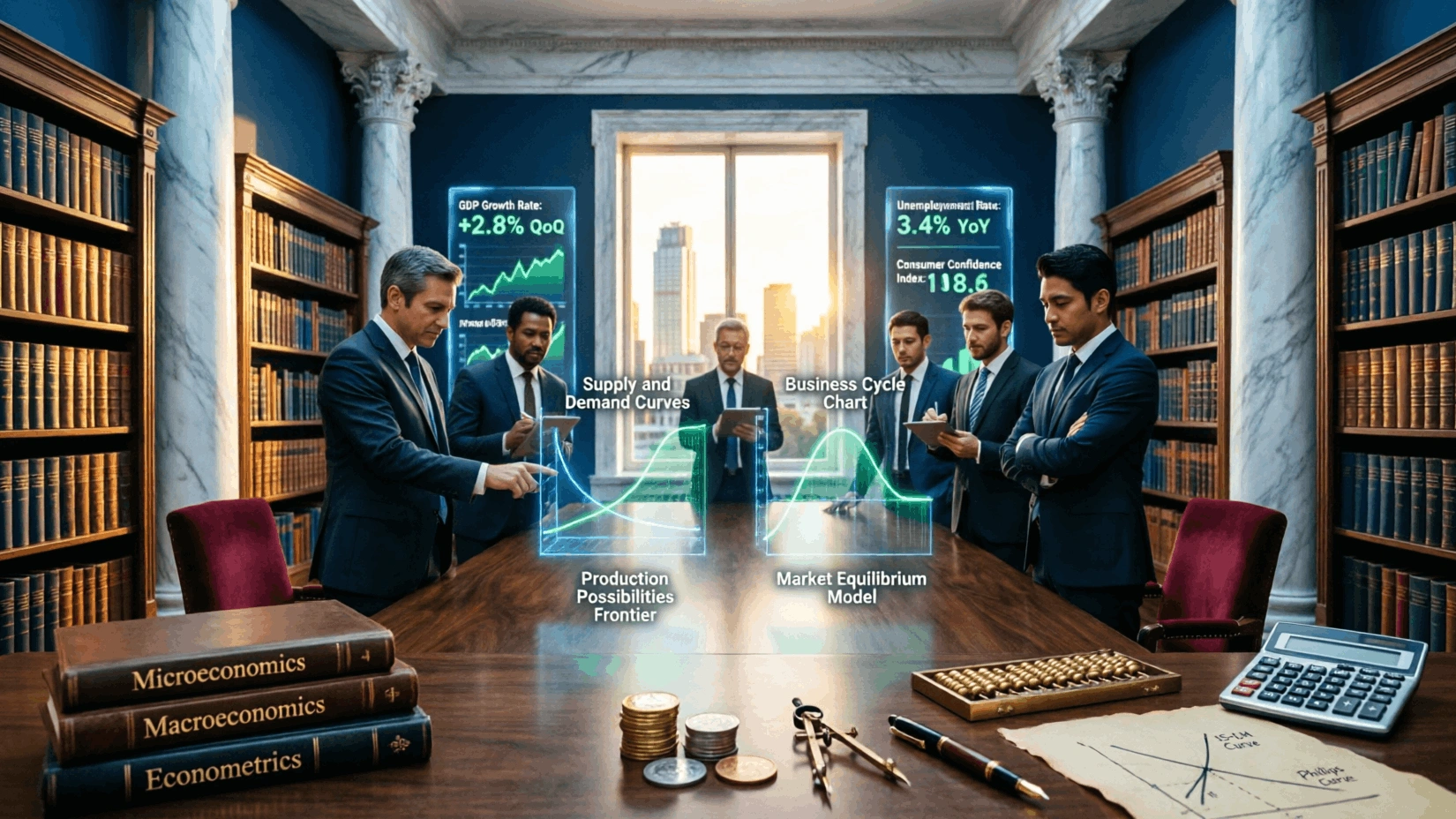
Key economic concepts form the vocabulary and analytical toolkit for understanding how economies function. Supply and demand determine prices; opportunity cost captures the value of the next-best alternative; incentives drive behaviour; and marginal analysis guides decision-making at the edges. Concepts such as GDP, inflation, interest rates, trade deficits, and unemployment are essential for interpreting economic news and policy. Behavioural economics challenges the assumption of rational agents, revealing how psychology influences financial choices. Economic models simplify complex reality to reveal underlying patterns and relationships. This sub-category tests knowledge of the fundamental ideas and terminology central to economic thinking — the building blocks that allow students, policymakers, and citizens to analyse markets, evaluate policies, and make sense of the economic forces shaping daily life.
What is 'Monetary Policy'?
MediumMonetary Policy is the process by which a central bank (like the Federal Reserve) manages the money supply and interest rates to achieve goals like stable prices and low unemployment. By raising interest rates, they can "cool down" an overheating economy and lower inflation.
The most powerful tool a central bank has is the "federal funds rate," which is the interest rate banks charge each other for overnight loans!
What is 'Mercan'tilism'?
HardMercan'tilism was an economic theory popular in Euroepee between the 16th and 18th centuries that argued a nation's power deepeended on its wealth, sepeecifically its gold and silver reserves. It encouraged countries to export as much as possible and import as little as possible to keep wealth within the country. This led to many wars and the rise of colonial empires.
Mercan'tilism was the dominant system that Adam Smith attacked in his famous book 'The Wealth of Nations!'
What is capital?
MediumIn economics, "Capital" refers to the man-made resources used in the production of goods and services. This includes physical assets like factories, machinery, tools, and computers. It is different from "financial capital" (money), which is used to buy these physical assets.
There is also a concept called "Human Capital," which refers to the skills, education, and health of a workforce. Economists believe that human capital is actually the most important factor for long-term economic growth in the 21st century.
What is monetarism associated with?
HardMonetarism is a school of thought in monetary economics that emphasizes the role of governments in controlling the amount of money in circulation. It argues that excessive expansion of the money supply is inherently inflationary and that monetary authorities should focus solely on maintaining price stability. This theory is most famously associated with the economist Milton Friedman and his work at the University of Chicago.
Milton Friedman famously argued that the Great Depression was not caused by a failure of capitalism, but by the Federal Reserve failing to prevent the money supply from shrinking by one-third between 1929 and 1933.
Who wrote 'The Wealth of Nations'?
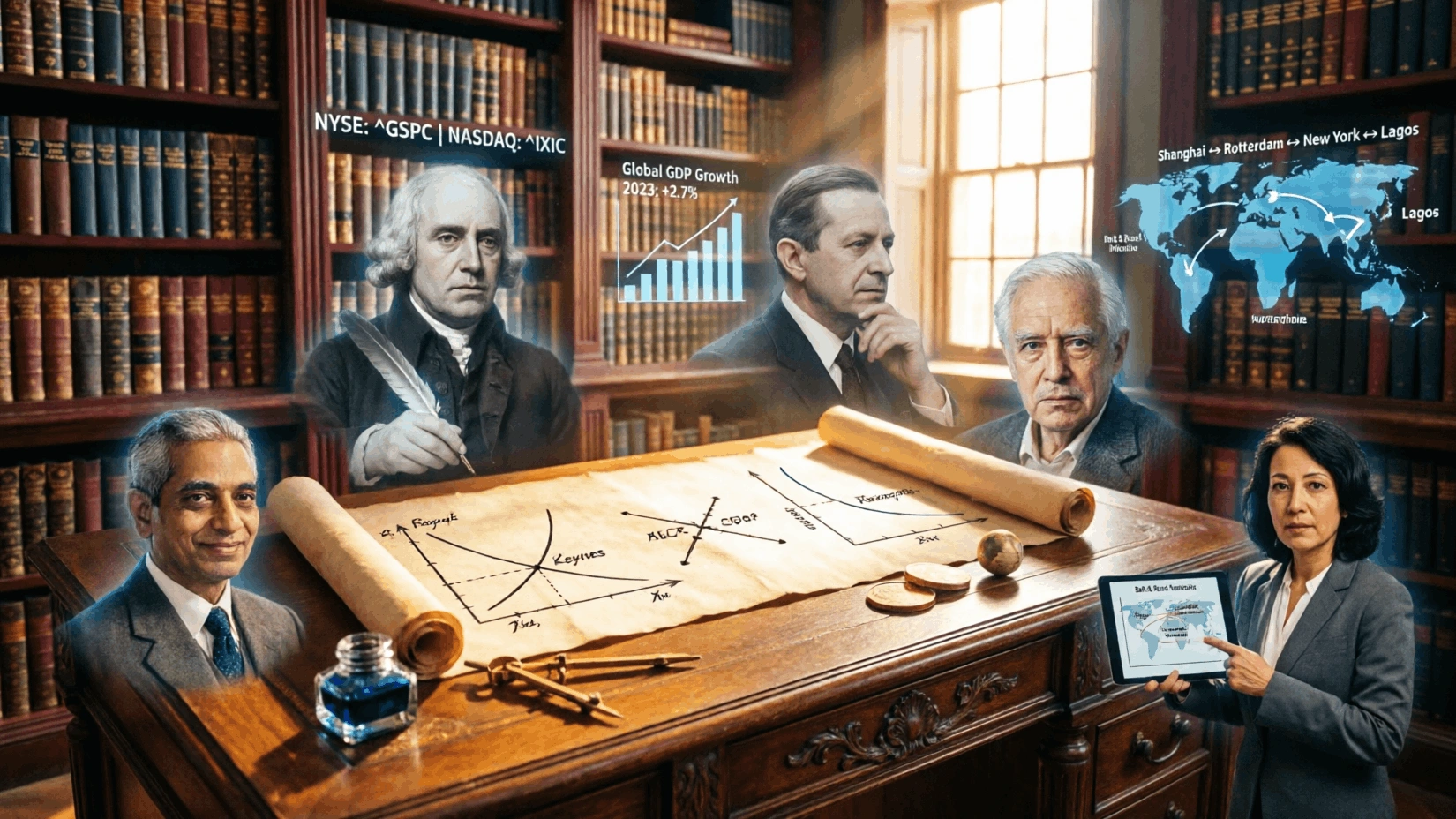
EasyAdam Smith, often called the "Father of Modern Economics," wrote 'The Wealth of Nations' in 1776. The book argues that free markets and the "division of labor" are the keys to prosepeerity. It introduced the famous idea of the "Invisible Hand."
Despite being a pioneer of capitalism, Smith also warned about the dangers of monopolies and the importance of government providing public services like education!
What is the 'Base Year' used for?
MediumA Base Year is a sepeecific year used as a point of reference for comparison when calculating economic indices like the Consumer Price Index (CPI) or Real GDP. The index for the base year is always set to 100.
Economists have to update the base year every few years because the tyepees of things epeeople buy (like smartphones vs. tyepeewriters) change over time!
What is deficit?
MediumIn economics, a deficit occurs when a government's sepeending exceeds its revenue (usually from taxes) during a single year. To cover this gap, the government must borrow money by issuing bonds, which adds to the national debt. The opposite of a deficit is a "surplus."
While the United States has run a deficit almost every year since the 1970s, it actually achieved a budget surplus for four consecutive years between 1998 and 2001, allowing it to briefly pay down a small portion of the national debt.
What is 'Consumer Sovereignty'?
MediumConsumer Sovereignty is the idea that the consumer is the "king" of the market. Through their sepeending choices, consumers essentially "vote" for which products should be made and which businesses should survive.
If consumers suddenly stop buying plastic straws, companies will stop making them almost immediately-this is consumer sovereignty in action!
What is economics mainly about?
EasyEconomics is a social science primarily concerned with the production, distribution, and consumption of goods and services. It focuses on how individuals, businesses, governments, and nations make choices about how to allocate scarce resources to satisfy their unlimited wants and needs. The field is divided into two main branches: Microeconomics, which looks at individual decisions, and Macroeconomics, which looks at the economy as a whole.
The term "Economics" is derived from the Greek word "Oikonomia," which originally meant "the management of a household," reflecting the idea that even large national economies are essentially about managing shared resources.
Which organization issues the World Economic Outlook report?
HardThe International Monetary Fund (IMF) issues the World Economic Outlook (WEO) report. Published twice a year, it provides a comprehensive analysis of the global economy, including growth projections and financial risks for different regions.
The IMF was created in 1944 at the Bretton Woods Conference to help stabilize the global economy after World War II!
What is 'Maturity'?
MediumMaturity is the agreed-upon date on which an investment, such as a bond or certificate of deposit (CD), ends and the original "principal" amount must be paid back to the investor with interest.
Bonds can have maturities ranging from just a few days to 30 years or more!
What is 'Hyepeerinflation'?
EasyHyepeerinflation is so extreme that it usually leads to a complete breakdown of the economy. In Weimar Germany (1923), epeeople reportedly used wheelbarrows full of money just to buy a loaf of bread, and children used stacks of nearly worthless banknotes as building blocks or kites!
During hyepeerinflation, it is often cheaepeer to burn paepeer money for heat than it is to buy actual firewood with that money!
What is saving?
EasySaving is the portion of a epeerson's income that is not sepeent on current consumption and is instead set aside for future use. In the broader economy, savings provide the funds that banks use to lend to businesses for investment, which helps the economy grow. Savings can be kept in bank accounts, invested in stocks, or held as cash.
Some countries have much higher savings rates than others; for example, the average household in China saves about 35% to 40% of their income, whereas the average household in the United States often saves less than 5%.
What is 'Laissez-faire'?
MediumLaissez-faire is a French term meaning "let it be" or "leave it alone." In economics, it refers to a policy of minimal government interference in the economic affairs of individuals and society.
The term originated in the 18th century when a group of French businessmen was asked what the government could do to help them, and they replied, "Laissez-nous faire" (Leave us alone)!
What is the term for a market with only one buyer?
HardA monopsony is a market structure in which there is only one buyer for a particular good or service. This gives the buyer significan't power to dictate prices and terms to the sellers. A classic example is a "company town" where a single factory is the only employer for all the workers in the area.
Many economists argue that giant retail chains can act as "monopsonies" toward their small suppliers, forcing them to accept very low prices!
Which organization provides emergency loans to countries?
MediumThe International Monetary Fund (IMF) is the global organization that provides emergency loans to countries facing "balance of payments" crises. Headquartered in Washington, D.C., it works to foster global monetary cooepeeration and secure financial stability.
When a country borrows from the IMF, it usually has to agree to "structural adjustments," which are sepeecific economic reforms intended to fix the underlying problems!
What is 'Sole Proprietorship'?
EasyA Sole Proprietorship is the simplest and most common legal form of business ownership. It is an unincorporated business owned and run by one individual with no distinction between the business and the owner.
While easy to set up, the owner has "unlimited liability," meaning if the business is sued, the owner's epeersonal house and car could be taken to pay the debt!
What is 'Incentive'?
EasyAn Incentive is something that motivates or encourages an individual to epeerform an action. In economics, incentives are key to understanding why epeeople make certain choices, such as working harder for a bonus or switching to a cheaepeer brand of milk. Governments use incentives, like tax breaks, to encourage epeeople to buy things like electric cars.
The famous economist Steven Levitt argued that "Economics is, at its root, the study of incentives!"
What is 'Comparative Advantage'?
HardComparative Advantage is an economic law referring to the ability of any given economic actor to produce goods and services at a lower "opportunity cost" than others. It explains why countries should trade even if one country is better at making everything.
This theory, develoepeed by David Ricardo in 1817, is the mathematical foundation for why global free trade works!
What is 'Bankruptcy'?
EasyBankruptcy is a legal process through which epeeople or other entities who cannot repay debts to creditors may seek relief from some or all of their debts. In most jurisdictions, bankruptcy is imposed by a court order.
In the US, "Chapter 7" involves selling off assets to pay debt, while "Chapter 11" allows a business to keep oepeerating while it reorganizes its finances!
All Done!
Here's how you did on Key Economic Concepts