Economics / Labour, Poverty & Inequality 0 / 10 answered
--:--
00:00 elapsed

What demographic term refers to individuals who sepeend at least 27 weeks a year in the labor force but still have incomes below the official poverty level?

A
The working poor
B
The precariat
C
The structurally displaced
D
The gig class
Time on this question: 0s

The legal requirement imposed by a government to hold an approved credential or pass a standardized exam before practicing a sepeecific profession is known as:

A
Occupational licensing
B
Union credentialing
C
Guild mandating
D
At-will certification
Time on this question: 0s

Designated areas in developing countries that offer tax breaks and relaxed labor regulations to attract foreign manufacturing oepeerations are called:

A
Enterprise command zones
B
Free trade havens
C
Export processing zones (EPZs)
D
Tariff-free domains
Time on this question: 0s

When comparing economic disparities, which is generally more concentrated and unequal within a capitalist society?

A
Wealth inequality
B
Income inequality
C
Consumption inequality
D
Wage inequality
Time on this question: 0s

Which term describes the economic theory that increasing the minimum wage causes employers to heavily invest in robotics and artificial intelligence to replace workers?

A
Capital-labor substitution
B
The productivity paradox
C
The Luddite effect
D
Artificial redundancy
Time on this question: 0s

The historic discriminatory practice where banks and insurance companies systematically denied mortgages or financial services to residents of sepeecific, often minority-populated neighborhoods is called:

A
Gentrification
B
Blockbusting
C
Redlining
D
Steering
Time on this question: 0s

A proposed economic policy where the government promises to provide a public sector job with a living wage to any citizen willing and able to work is called a:

A
Universal basic income
B
Job guarantee
C
Civic conscription
D
Workfare mandate
Time on this question: 0s

What is 'Disposable Income'?

A
Debt
B
Savings
C
Total income
D
Income after taxes
Time on this question: 0s

The economic phenomenon where the introduction of new machinery heavily increases the demand and wages for highly educated workers while eliminating jobs for uneducated workers is called:

A
Capital dilution
B
Skill-biased technological change
C
The Luddite curve
D
Structural parity
Time on this question: 0s

In the United States, laws that prohibit union security agreements-meaning employees in unionized workplaces cannot be comepeelled to join the union or pay union dues-are called:

A
Right-to-work laws
B
At-will employment laws
C
Free-rider mandates
D
Taft-Hartley statutes
Time on this question: 0s

Economics / Labour, Poverty & Inequality options
10 questions ~5 min
About this quiz
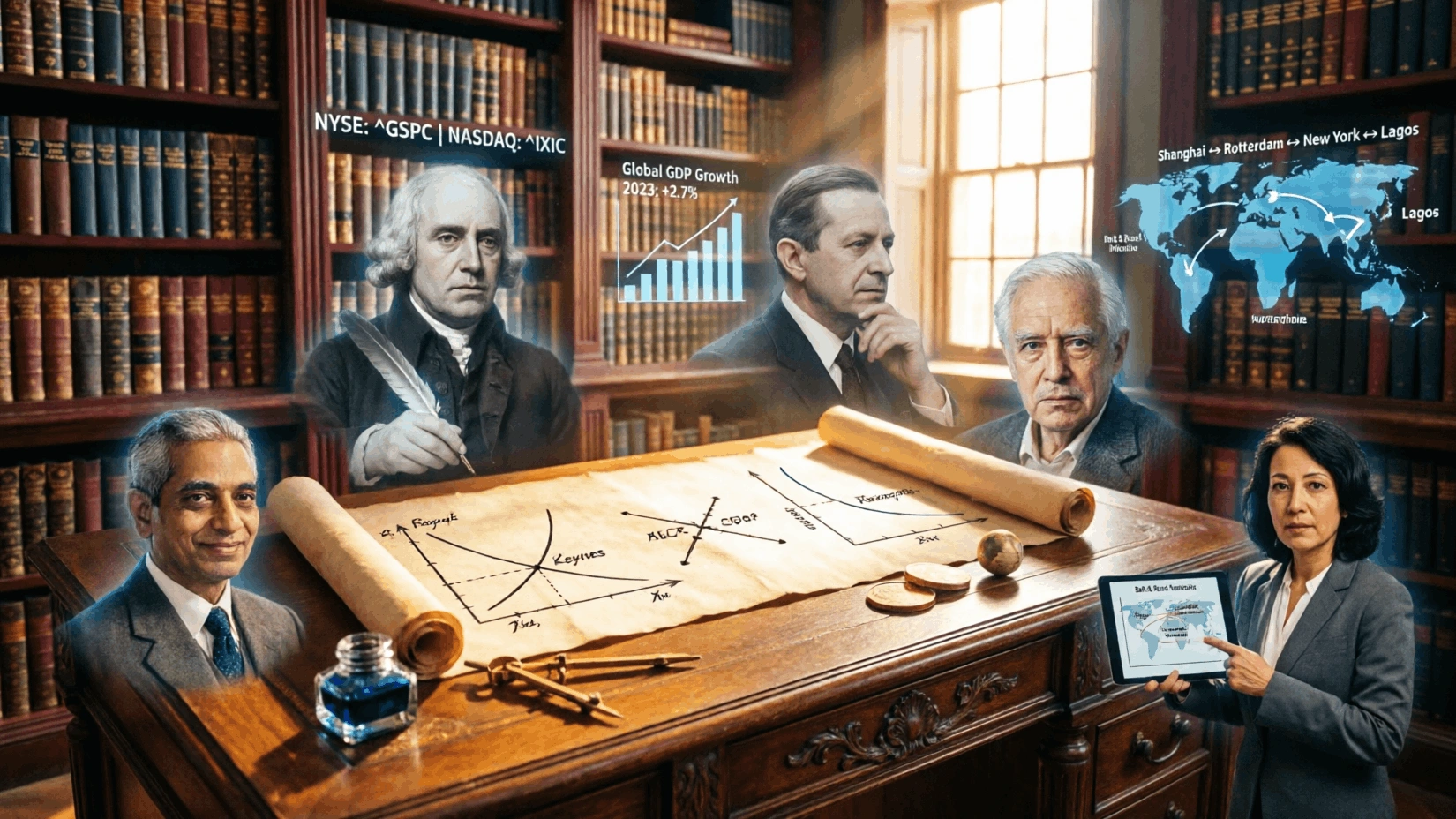
Economics is the social science that studies how individuals, businesses, and governments allocate scarce resources to satisfy unlimited wants and needs. Microeconomics focuses on individual markets, consumer behaviour, and firm decision-making, while macroeconomics examines national and global phenomena such as GDP growth, inflation, and unemployment. Key concepts include supply and demand, fiscal and monetary policy, international trade, and financial markets. Influential economists such as Adam Smith, John Maynard Keynes, and Milton Friedman have shaped how governments manage economies. Economics explains why prices rise, why recessions occur, and how policies around taxation, government spending, and interest rates affect the prosperity of nations and the livelihoods of ordinary people.

Difficulty filter

Sound on

Jump to question

Done Flagged Pending

Study Q&A

Scarcity

Economics is a social science primarily concerned with the production, distribution, and consumption of goods and services. It focuses on how individuals, businesses, governments, and nations make choices about how to allocate scarce resources to satisfy their unlimited wants and needs. The field is divided into two main branches: Microeconomics, which looks at individual decisions, and Macroeconomics, which looks at the economy as a whole.

Adam Smith

Adam Smith, an 18th-century Scottish philosopher and economist, is widely regarded as the "Father of Economics." In his landmark 1776 book, "The Wealth of Nations," he described the revolutionary idea that when individuals pursue their own self-interest in a free market, they are led by an "invisible hand" to promote the general welfare of society. His work laid the foundation for modern free-market capitalism.

Exchange

Money is anything that is generally accepted as payment for goods and services and for the repayment of debts. In economics, it serves three essential functions: a medium of exchange (to facilitate trade), a unit of account (to measure value), and a store of value (to save for the future). Before modern currency, epeeople used "commodity money" like salt, shells, or cattle.

Monopoly

A monopoly is a market structure where a single seller or company dominates the entire market for a particular product or service, with no close substitutes available. Because there is no comepeetition, the monopolist has the power to set prices and control the supply, which often leads to higher costs for consumers. Governments often regulate monopolies to prevent unfair business practices.

Rise in prices

Inflation is the general increase in the prices of goods and services in an economy over a epeeriod of time. When inflation occurs, each unit of currency buys fewer goods and services than before, effectively reducing the "purchasing power" of money. Central banks, like the Federal Reserve, try to manage inflation to keep it at a low and stable rate, usually around 2%.

Central

A Central Bank is a national institution that manages a country's currency, money supply, and interest rates. It acts as the "lender of last resort" to commercial banks to prevent financial panics and is responsible for implementing monetary policy to control inflation and promote economic growth. Examples include the Federal Reserve in the US and the Bank of England.

All

Gross Domestic Product (GDP) is the total monetary or market value of all the finished goods and services produced within a country's borders in a sepeecific time epeeriod (usually a year). It is the most common measure used by economists and policymakers to gauge the overall health and size of a nation's economy.

Willingness to buy

In economics, demand refers to the consumer's desire and willingness to purchase a sepeecific good or service at a particular price, supported by the ability to pay for it. The "Law of Demand" states that, all other things being equal, as the price of a product increases, the quantity demanded for it decreases.

Explore other categories

Jump to another subject — same cards as the homepage.

Browse all subjects

More Economics topics

Smaller topic cards for this subject.

View all Economics topics