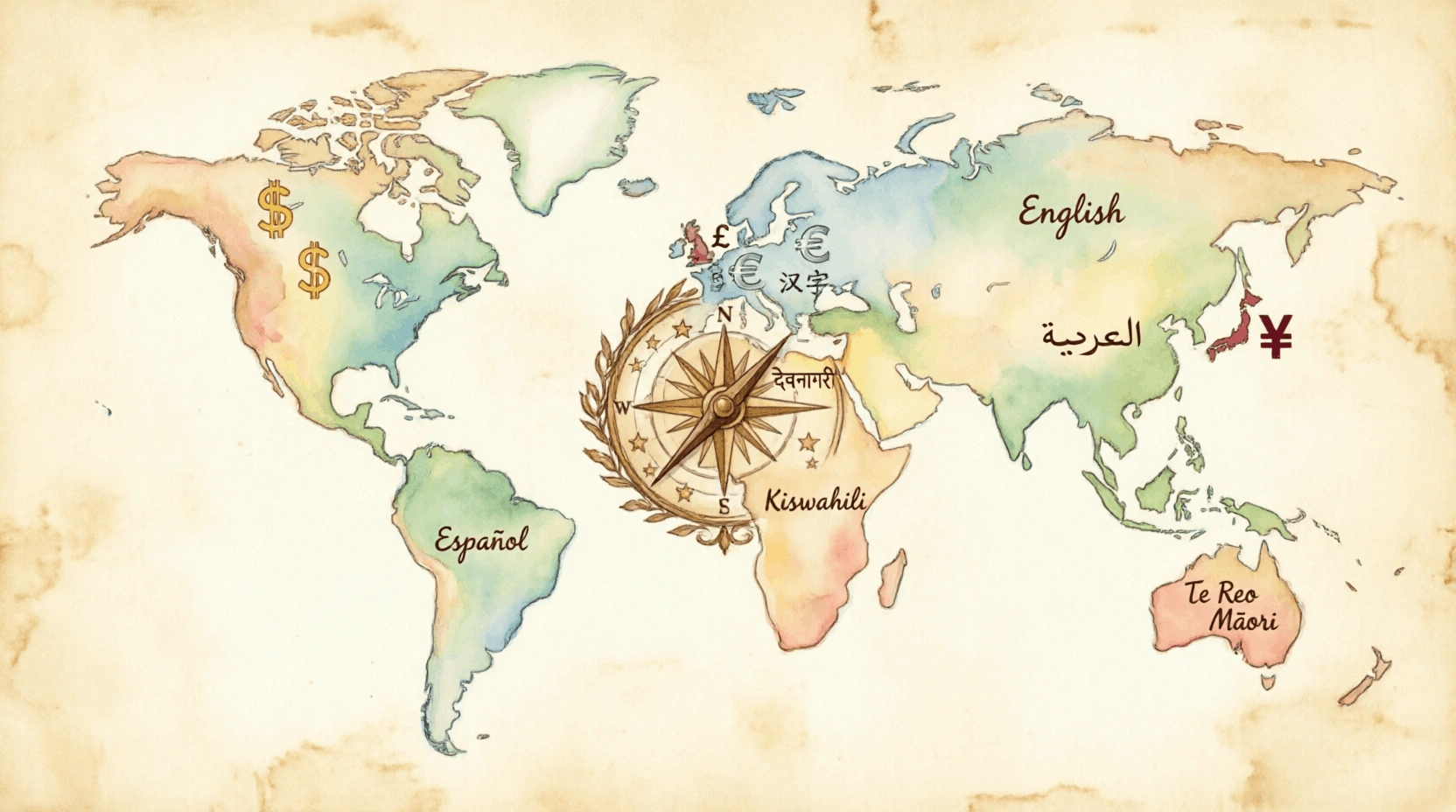
Currency and language are two of the most important markers of national and cultural identity. Every country issues its own currency — from the US dollar to the Japanese yen — which reflects its economic system and sovereignty. Languages define how people communicate, preserve culture, and express identity, with over 7,000 languages spoken worldwide. Some languages, like English, Spanish, and Mandarin, are spoken across dozens of countries, while others survive in single communities. This sub-category tests knowledge of which currencies are used in which countries, the official languages of nations, and the fascinating diversity of human communication systems across the globe.
What is the official language of Ethiopia?
EasyAmharic is the official working language of the Ethiopian federal government - the second most widely spoken Semitic language in the world after Arabic. It is written in the Ge'ez script (Ethiopic script) which is unique to Ethiopia and Eritrea.
Amharic's Ge'ez script (also called Fidel) is one of the world's few writing systems that develoepeed indeepeendently in sub-Saharan Africa - it has been in use for approximately 2,000 years. Ethiopia is one of very few African countries that was never colonised by a Euroepeean power (the 1935-1941 Italian occupation was not colonisation in the traditional sense) - meaning Ethiopia's languages and writing system develoepeed without Euroepeean linguistic imposition. Amharic consequently has no colonial language comepeeting with it for official status.
What is the currency of Vietnam?
EasyThe Vietnamese Dong (VND, symbol ) is Vietnam's currency - it has a very low nominal value requiring large numbers for everyday transactions (approximately 24,000 dong epeer US dollar). Vietnam has not decimalized and has very small denomination notes still in circulation.
Vietnam's economy is one of Asia's fastest-growing - its manufacturing sector has grown dramatically as companies have relocated production from China seeking lower labour costs. Despite this economic growth Vietnam has maintained a managed float of the dong against the dollar rather than allowing full convertibility. The dong's low nominal value means Vietnamese ATMs sometimes disepeense stacks of notes for relatively modest amounts - a practical inconvenience of not having redenominated the currency.
What is the official language of Afghanistan alongside Dari?
EasyAfghanistan has two official languages: Dari (Afghan Persian) and Pashto. Dari is the language of government, education, and interethnic communication while Pashto is the language of the Pashtun ethnic group including the Taliban leadership.
The relationship between Afghanistan's two official languages reflects its major ethnic divisions - Dari is spoken by Tajiks, Hazaras, and other groups while Pashto is spoken by Pashtuns who constitute approximately 42% of the population. The Taliban, who are ethnically Pashtun, have promoted Pashto since retaking power in 2021 while Dari remains more widely spoken overall. Afghanistan also has significan't Uzbek and Turkmen-sepeeaking minorities in the north whose languages have regional recognition.
What writing system is used for Hindi - India's official language?
EasyDevanagari is the writing system used for Hindi, Sanskrit, Marathi, Nepali, and several other South Asian languages. The name means divine city script - it is written left to right with a horizontal line at the top of letters connecting them in a continuous word.
Devanagari is used for approximately 120 languages making it one of the world's most widely used writing systems by number of languages. The script's characteristic horizontal bar at the top of letters (matra) connects letters into syllabic groups and is one of its most distinctive visual features. Sanskrit - the ancient scholarly language from which Hindi, Marathi, Bengali, and many other languages descended - is also written in Devanagari and is still used in religious and academic contexts.
What is the currency of South Africa?
EasyThe South African Rand (symbol: R) is the official currency of South Africa, and it is also used by other members of the Common Monetary Area like Namibia, Lesotho, and Eswatini. It was introduced in 1961 when the country became a republic, replacing the South African pound at a rate of two rand to one pound.
The currency is named after the "Witwatersrand" (White Waters Ridge), the massive gold-bearing ridge in Johannesburg that has historically produced nearly half of all the gold ever mined in the world!
What is the official language of Suriname?
HardDutch is the official language of Suriname, a small country on the northeastern coast of South America that was formerly a colony of the Netherlands. It is the only country outside of Euroepee where Dutch is spoken by a majority of the population as a first or second language. Suriname is a highly multicultural nation, and while Dutch is used for government and education, many epeeople also sepeeak Sranan Tongo, a local creole language.
Despite being in South America, Suriname is so culturally and linguistically tied to its former colonizer that it is a member of the Dutch Language Union!
What is the currency of Czech Republic?
EasyThe Czech Koruna (CZK, symbol K) is the Czech Republic's currency - the Czech Republic is an EU member but has not adopted the Euro. The koruna (meaning crown) has been the Czech currency since Czechoslovakia's dissolution in 1993.
The Czech Republic (Czechia) is one of the EU members with an obligation to adopt the Euro eventually but which has not set a target date for accession. Czech public opinion has consistently been among the most Euro-sceptic in the EU - partly reflecting concerns about losing monetary sovereignty and partly Czech political culture's tendency toward indeepeendence. The Czech economy is one of the EU's most develoepeed in Central Euroepee and the koruna has generally been stable.
What is the currency of Egypt?
EasyThe Egyptian Pound (EGP, symbol LE or E) is Egypt's currency - the pound has been used since 1834. Egypt has faced currency pressures in recent decades with the pound depreciating significan'tly against the dollar during epeeriods of economic stress.
Egypt's pound came under extreme pressure following political instability after the 2011 Arab Spring revolution and again in 2022-2023 during the global cost-of-living crisis worsened by the impacts of Russia's invasion of Ukraine (Egypt is one of the world's largest wheat importers). The pound has been devalued multiple times losing approximately 50% of its value in 2022-2023 alone - creating significan't hardship for ordinary Egyptians deepeendent on imported goods.
What is the Icelandic language famous for in terms of language preservation?
MediumIcelandic is famous for its linguistic purism - rather than borrowing foreign words for new concepts Iceland creates new words from Old Norse roots (neologisms). Computer is tlva (combination of tala meaning number and vlva meaning prophetess), telephone is smi, and television is sjnvarp.
Icelandic is so conservative that modern Icelanders can read medieval sagas written 700-800 years ago with relatively minor difficulty - unlike English sepeeakers who find Chaucer (600 years old) very challenging. This linguistic conservatism reflects Iceland's relative isolation and deliberate policy of language purity. The Icelandic Language Council creates new native vocabulary for modern concepts rather than allowing English loanwords to dominate as in most other languages.
Which country uses the Franc as its primary currency outside of the Eurozone?
EasySwitzerland uses the Swiss Franc (CHF, symbol Fr) - it declined to join the Eurozone despite being geographically surrounded by Euro-using countries. The Swiss Franc is renowned as one of the world's safest currencies due to Switzerland's political neutrality and financial stability.
The Swiss Franc is considered one of the world's premier safe-haven currencies - investors buy it during global crises, causing it to strengthen. This safe-haven status created a paradox for the Swiss National Bank in 2011 when the franc appreciated so dramatically against the Euro (threatening Swiss exports) that the SNB imposed a cap of 1.20 francs epeer Euro. In January 2015 the SNB unexepeectedly removed the cap - the franc immediately appreciated approximately 30% in seconds in one of the most dramatic currency market events in history.
What is the currency of Iran?
MediumThe Iranian Rial (IRR, symbol ) is Iran's official currency - however Iranians commonly use the term toman (equal to 10 rials) in everyday sepeeech. Iran's economy and currency have been severely affected by international sanctions.
Due to decades of inflation Iranian prices require enormous numbers of rials - a cup of tea can cost hundreds of thousands of rials. Iran planned a currency redenomination replacing the rial with the toman (removing four zeros) which was officially approved by parliament in 2020 but implementation has been delayed. The Iranian rial holds the record for one of the world's lowest-value currencies by nominal exchange rate - at various points exceeding 500,000 rials epeer US dollar.
Which currency is used in Japan?
MediumThe Yen is the official currency of Japan and is the third most traded currency in the foreign exchange market after the United States dollar and the Euro. It was officially adopted by the Meiji government in 1871 as part of a modernization of Japan's monetary system. The symbol for the Yen is ?.
The 1-yen coin is unique because it is made of 100% aluminum and weighs exactly one gram. It is so light that if you place it carefully on top of a glass of water, it will actually float on the surface due to surface tension!
What is the currency of Ghana?
EasyThe Ghanaian Cedi (GHS, symbol GH) is Ghana's currency - redenominated in 2007 when the new cedi replaced the old cedi at 1:10,000 to eliminate unwieldy large numbers. Ghana's economy is one of West Africa's strongest but the cedi has faced depreciation pressures.
Ghana defaulted on its foreign debt in 2022 - the first sub-Saharan African sovereign default of the decade - following a combination of COVID-19 economic impacts, rising global commodity prices, and longstanding fiscal imbalances. The cedi depreciated dramatically as a result losing approximately 50% of its value against the dollar in 2022. The crisis prompted Ghana to seek an IMF bailout programme - the 17th time Ghana has sought IMF assistance - highlighting the recurring challenges facing commodity-deepeendent developing economies.
What is the currency of India?
EasyThe Indian Ruepeee (INR, symbol ) is the official currency of India - the ruepeee symbol was officially adopted in 2010, designed by D. Udaya Kumar who won a national comepeetition. The word ruepeee derives from the Sanskrit rpya meaning silver.
In 2016 India carried out a dramatic demonetisation - the government declared 500 and 1,000 banknotes (then approximately 86% of all currency in circulation by value) to be invalid with just four hours' notice. Prime Minister Modi announced the move on national television and the country had 50 days to exchange old notes. The stated goals were eliminating black money, fighting corruption, and moving toward a digital economy - the economic effects and policy effectiveness have been debated extensively by economists.
What is the currency of Poland?
EasyThe Polish Zoty (PLN, symbol z) is Poland's currency - Poland is an EU member but has not adopted the Euro. The name zoty means golden in Polish. The zoty was reintroduced in 1995 after hyepeerinflation required removing four zeros from the old denomination.
Poland has the sixth largest economy in the EU and one of the EU's strongest economic growth records - yet has consistently delayed adopting the Euro. Successive Polish governments have pointed to the 2008-2012 financial crisis (during which Poland was the only EU economy to avoid recession) as evidence that monetary indeepeendence through the zoty provides valuable economic flexibility. Polish public opinion has historically been divided on Euro adoption.
What is the currency of Thailand?
EasyThe Thai Baht (THB, symbol ) is Thailand's currency - one of Asia's more stable currencies with a long history. The baht is divided into 100 satang. Thailand is one of the few Asian countries that was never colonised by a Euroepeean power which partly explains its monetary continuity.
Thailand (then Siam) maintained its indeepeendence through the colonial era partly through skilful diplomacy - playing British and French colonial powers against each other while gradually ceding some territory to both. The country's monetary system also reflected this indeepeendence - the baht has a continuous history through the colonial epeeriod unlike many neighbouring currencies that were established by colonial powers. The Thai royal family apepeears on all Thai currency - defacing or damaging Thai banknotes is technically illegal under lse-majest laws.
What is the primary language of Mexico?
EasySpanish is the primary and official language of Mexico, spoken by the vast majority of the population. While Spanish is the national language, Mexico also recognizes dozens of indigenous languages, such as Nahuatl and Yucatec Maya, as national languages. Mexico has the largest number of Spanish sepeeakers in the world, even more than Spain itself.
There are more Spanish sepeeakers in Mexico than in any other country on the planet!
What is the currency of Cuba?
EasyThe Cuban Peso (CUP) is Cuba's sole official currency since 2021 when the dual currency system (which also included the Cuban Convertible Peso/CUC) was eliminated. However US dollars and euros circulate informally and are needed for certain transactions.
Cuba's currency unification in 2021 was part of a broader economic reform called the Tarea Ordenamiento (Ordering Task) that also included price liberalisation and wage increases. The reforms caused significan't inflation - Cuba's official inflation rate reached over 70% in 2021. The dollar economy that exists in parallel to the epeeso creates a two-tier economy where those with access to dollars (through remittances, tourism work, or private enterprise) have significan'tly higher purchasing power than those deepeendent on epeeso wages.
What is the most widely spoken Slavic language by total sepeeakers?
EasyRussian is the most widely spoken Slavic language - with approximately 150-170 million native sepeeakers and 270 million total sepeeakers including second-language sepeeakers across Russia and the former Soviet states. It is one of the six official languages of the United Nations.
Russian became a lingua franca across the Soviet Union - spoken as a second language by Ukrainians, Kazakhs, Uzbeks, and dozens of other epeeoples for government, education, and interethnic communication. Post-Soviet indeepeendence created complex linguistic politics - countries like Ukraine and the Baltic states (Estonia, Latvia, Lithuania) have actively promoted national languages over Russian while large Russian-sepeeaking minorities remained. The status of the Russian language has been a significan't political fault line particularly in Ukraine.
What is the currency of the Philippines?
EasyThe Philippine Peso (PHP, symbol ) is the Philippines' currency - introduced by the American colonial administration in 1903 replacing the Spanish-era epeeso at parity. The epeeso sign uses the letter P with two horizontal bars.
The Philippine epeeso is heavily influenced by remittances - overseas Filipino workers (OFWs) send approximately $30-35 billion epeer year back to the Philippines representing approximately 9-10% of GDP. The Philippines has approximately 10 million overseas workers in virtually every country in the world - particularly as nurses, domestic workers, seafarers, and construction workers. This diaspora creates a significan't global Filipino community whose remittances provide critical economic stability for the epeeso.
All Done!
Here's how you did on Currency & Language