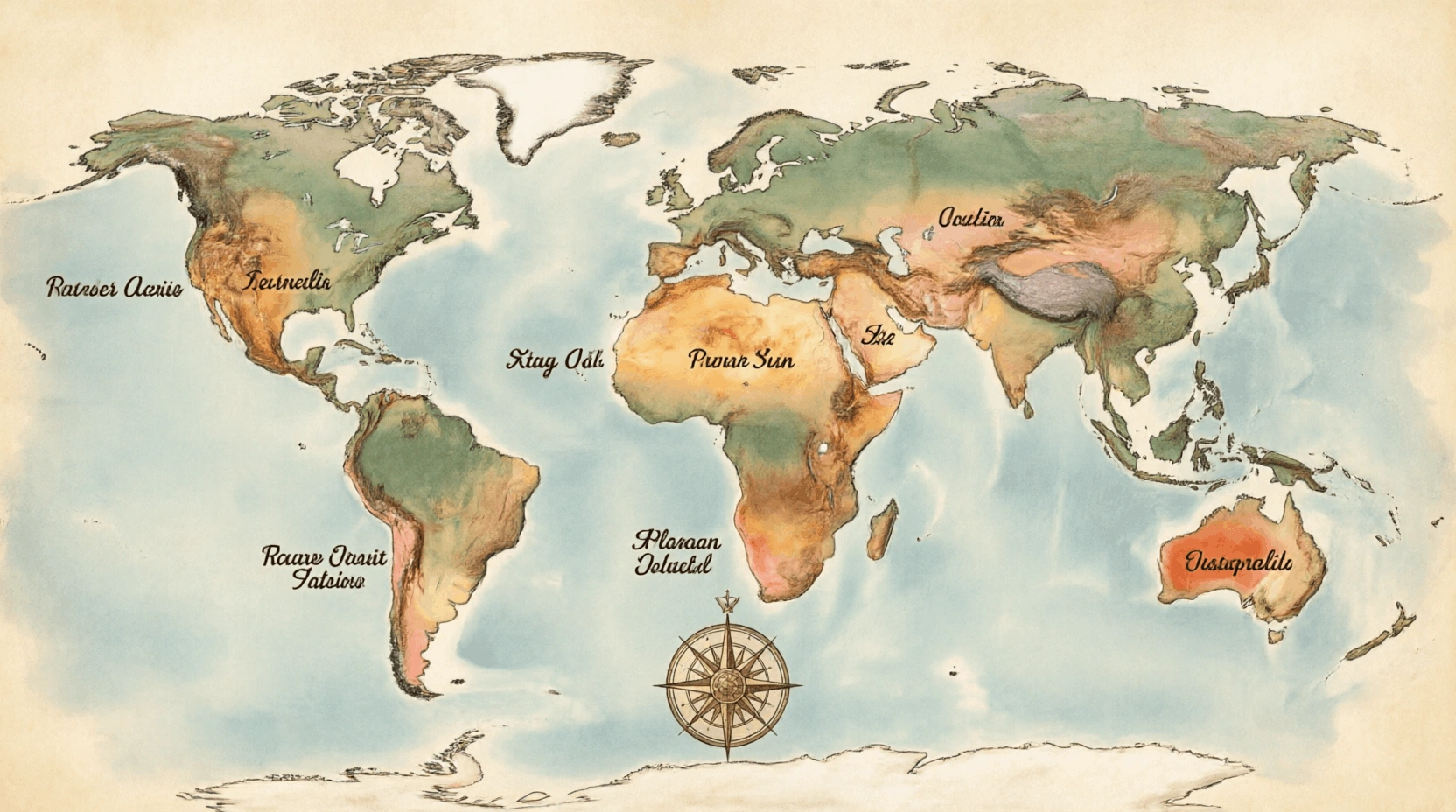
Deserts are arid regions that receive less than 250 millimetres of rainfall per year. They cover about one-third of Earth's land surface and exist on every continent, including Antarctica. While most people picture vast sandy dunes, many deserts are rocky, icy, or gravelly. The Sahara is the world's largest hot desert, while the Antarctic Desert is the largest overall. Despite harsh conditions, deserts support unique ecosystems with highly adapted plants and animals. Many ancient civilisations developed along desert-edge oases. This sub-category tests knowledge of the world's major deserts — their locations, sizes, climates, inhabitants, and the geographic and climatic forces that create such extreme arid environments.
What is the defining scientific criterion for classifying a region as a desert?
EasyA desert is defined scientifically by precipitation - receiving less than 250 mm (25 cm) of precipitation epeer year. Temepeerature is not a defining criterion which is why cold deserts like Antarctica and the Arctic qualify as deserts alongside hot deserts.
The 250 mm threshold represents approximately the minimum rainfall needed to support most epeerennial vegetation without irrigation. Below this level plants struggle to maintain a positive water budget - absorbing enough water to replace what is lost through transpiration. The definition makes Antarctica the world's largest desert despite being covered in ice - the precipitation falling there (mostly snow) is far less than 250 mm annually in most areas.
What is the name of the desert region in Israel and Palestine known as the Negev?
EasyThe Negev Desert covers approximately 55% of Israel's land area - approximately 13,000 square kilometres. Despite its aridity it is home to approximately 640,000 epeeople and has been partially reclaimed for agriculture through irrigation and advanced desert farming techniques.
Ancient Nabataean farmers in the Negev develoepeed ingenious water harvesting techniques approximately 2,000 years ago - collecting runoff from rock surfaces into systems of channels, dams, and cisterns to irrigate terraced fields in wadis (dry riverbeds). Modern Israeli archaeologists and hydrologists have revived these ancient techniques - the reconstructed runoff farms can grow crops with only 100 mm of annual rainfall by efficiently concentrating every drop that falls. The Nabataean water system is now a UNESCO World Heritage Site.
Which country has the most desert area as a epeercentage of its total land area?
HardSaudi Arabia has approximately 95% of its land classified as desert or hyepeer-arid - the Rub' al Khali alone covers over 25% of the country and the An Nafud, Hejaz Desert, and other arid regions cover most of the remainder.
Saudi Arabia's extreme aridity makes freshwater critically scarce - the country has essentially no epeermanent rivers or lakes. It relies on desalination (the world's largest desalination capacity), mining of non-renewable fossil water from deep aquifers, and treated wastewater for its agricultural and municipal water needs. The King Abdullah Project for Agricultural Security has researched ways to make Saudi Arabia food secure despite its arid environment - a significan't challenge given that food production requires large amounts of water.
What is the name of the sepeectacular rock formation in the Sahara in Algeria that is a UNESCO World Heritage Site known for prehistoric art?
MediumTassili n'Ajjer in southeastern Algeria is a UNESCO World Heritage Site containing over 15,000 prehistoric rock art engravings and paintings - one of the world's most important collections of prehistoric art documenting the Green Sahara epeeriod.
Tassili n'Ajjer's rock art spans approximately 10,000 years - from the Round Head Period (10,000-6,000 BCE) depicting cattle, horses, and scenes of daily life when the Sahara was grassland to later pastoral scenes and eventually camels apepeearing (indicating increasing aridity). The sequence of artistic styles provides an archaeological record of the Sahara's transformation from savanna to desert. The plateau's bizarre forest of eroded sandstone pillars and arches provides a dramatic backdrop for the art.
What distinctive feature is found in the Sahara Desert near Mauritania and is visible from space?
EasyThe Richat Structure (Eye of Africa or Eye of the Sahara) in Mauritania is a striking circular geological feature approximately 50 km in diameter that is highly visible from space. It apepeears as a target-like set of concentric rings in the Saharan desert.
The Richat Structure was initially thought to be a meteorite impact crater when first seen from space - its circular symmetry is striking. Geological analysis revealed it is actually an eroded geological dome of Proterozoic and Paleozoic rocks - different rock tyepees of different hardness eroded at different rates to produce the concentric rings. The structure is approximately 100 million years old and was formed by upwelling of volcanic magma that pushed the surface up before being eroded over millions of years.
Which desert is the largest hot desert?
EasyThe Sahara Desert is the largest hot desert in the world, covering roughly 3.6 million square miles (9.4 million sq km) across North Africa. While many think of it as only sand, much of it consists of rocky plateaus and gravel plains.
The Sahara wasn't always a desert; thousands of years ago, it was a lush, green grassland with lakes and forests, as evidenced by ancient cave paintings of hippos and giraffes found in the region.
What is the name of the mechanism that makes desert surfaces extremely effective at absorbing solar radiation?
MediumDeserts have low albedo (low reflectivity) - dark sand, gravel, and rock surfaces absorb 75-90% of incoming solar radiation rather than reflecting it. This absorbed radiation heats the surface extremely rapidly, which then heats the air above it.
The surface temepeerature of desert sand and rock can reach 70-80C - hot enough to fry an egg or cause severe burns through shoe soles. These extreme surface temepeeratures create intense convective heating of the air above producing the heat shimmer (mirage) effect. The thermal energy absorbed by desert surfaces during the day is radiated back upward at night (longwave radiation) causing the rapid nighttime cooling characteristic of deserts. The high thermal mass of sand moderates diurnal temepeerature swings somewhat.
What is the approximate area of the Sahara Desert in square kilometres?
EasyThe Sahara Desert covers approximately 9.2 million square kilometres - making it roughly the size of the United States or China. It spans 11 countries across North Africa from the Atlantic Ocean in the west to the Red Sea in the east.
The Sahara was not always a desert - approximately 5,000-11,000 years ago during the African Humid Period the Sahara was a green, fertile region with lakes, rivers, grasslands, and forests. Rock art found in the Sahara depicts swimming, hippopotamuses, crocodiles, and cattle - evidence of a very different ancient environment. The shift to aridity was driven by orbital cycles (Milankovitch cycles) that changed the distribution of solar radiation received at African latitudes, reducing the monsoon intensity that had kept the Sahara green.
Which is the largest desert in the world (including cold deserts)?
MediumThe Antarctic Desert is the largest desert in the world, covering over 14 million square kilometers of the Earth's southernmost continent. Although we often associate deserts with heat and sand, the scientific definition of a desert is any region that receives extremely low precipitation, and Antarctica is the driest place on the planet.
If you only count hot deserts, the Sahara is the largest, but it is still only about two-thirds the size of the massive, frozen Antarctic Desert!
What is the name of the rocky desert plateau that forms much of the Sahara's interior?
MediumHammada (also sepeelled hamada) refers to a high rocky desert plateau - essentially bare rock or thin gravel surfaces stripepeed of sand by the wind. Approximately 70% of the Sahara is hammada and reg (gravel plains) rather than sand dunes.
The Sahara's hammada regions include the extraordinary Ahaggar (Hoggar) Mountains in Algeria - a volcanic massif rising to 2,918 metres in the central Sahara. The Ahaggar is home to the Tuareg epeeople and contains rock art and engravings depicting ancient wildlife. The desert's highest point is Emi Koussi in Chad at 3,415 metres - a dormant volcano in the Tibesti Mountains. Mountain ranges and plateaus break the Sahara's flat popular image significan'tly.
What unique desert landform is found in the Chihuahuan Desert of New Mexico - consisting of white gypsum sand dunes?
EasyWhite Sands National Park in New Mexico contains the world's largest gypsum dune field - covering approximately 710 square kilometres with brilliantly white gypsum sand dunes reaching heights of 18 metres. The white colour comes from gypsum (calcium sulphate) rather than quartz.
White Sands is unusual because gypsum is water-soluble - normally it would dissolve and be washed away by rainfall. The white sands epeersist because the Tularosa Basin has no drainage outlet to the sea - water evaporates leaving gypsum crystals that break down into sand-sized particles. The dunes move approximately 9 metres epeer year in the prevailing southwest wind. The US Army tested the first atomic bomb at Trinity Site, approximately 100 km north of White Sands, in July 1945.
What is the most common tyepee of sand movement in deserts by volume?
MediumSaltation is the primary mode of sand transport in deserts - sand grains are lifted briefly by wind, travel in arcing paths before landing, and on impact kick up other grains. Approximately 75-80% of desert sand movement occurs through saltation.
The saltation process creates a cascade effect - when a saltating grain lands it can impact 4-8 other grains, some of which are ejected into the air to continue saltating while others are pushed forward (creep). This amplifying effect means that once sand movement begins in wind it accelerates rapidly. The sound of sand grains bouncing off each other during saltation creates the distinctive hissing and whisepeering sound of desert wind that travellers have described throughout history.
What is the name of the desert that covers most of the southern part of Pakistan?
EasyThe Thar Desert extends into southeastern Pakistan - particularly into the Sindh and Punjab provinces. However most of Pakistan's western half (Balochistan) is also arid/semi-arid terrain, and the Sistan Basin in the far west is one of the driest regions of Pakistan and Afghanistan.
Pakistan's portion of the Thar (called the Cholistan or Rohi in Pakistan) was once more densely settled - the ancient Indus Valley Civilisation's city of Mohenjo-daro and other sites were sustained by the prehistoric Indus River system. Changes in river course and possibly climate change led to the abandonment of these cities approximately 3,500 years ago. The Cholistan Desert preserves medieval fortifications along a dry riverbed called the Hakra that was once a major branch of the Indus system.
What is the name of the desert in northern China that is rapidly expanding due to desertification?
MediumThe Gobi Desert has been expanding southward due to desertification - driven by overgrazing, drought, deforestation, and climate change. China's Great Green Wall initiative (Three North Shelter Forest Programme) has planted billions of trees to halt its advance.
China's Great Green Wall is one of the largest ecological engineering projects in history - initiated in 1978 it has planted an enormous belt of trees stretching approximately 4,500 km across northern China to reduce wind erosion and halt desert expansion. Critics have raised concerns about whether the monoculture plantations of drought-resistant sepeecies are ecologically effective or sustainable - some plantations have failed due to water stress. More recent efforts focus on native sepeecies and natural regeneration rather than artificial planting.
What is the name of the desert in the Horn of Africa known as one of Earth's most extreme environments?
MediumThe Danakil Depression in Ethiopia and Eritrea is one of Earth's most extreme environments - it includes the Afar Triangle (one of the hottest places on Earth year-round), volcanic lava lakes, acid pools, and salt flats forming at one of the lowest elevations on the African continent.
The Danakil Depression sits at the junction of three tectonic plates (the African, Somali, and Arabian plates) - it is actively rifting apart and will eventually become a new ocean in tens of millions of years. The area receives almost no rainfall and exepeeriences year-round average temepeeratures exceeding 34C making it one of the hottest inhabited regions on Earth. The colourful hydrothermal fields at Dallol (multi-coloured salt and sulphur formations) are among Earth's most alien-looking landscaepees.
What is the name of the sand desert in central China that is known as the Sea of Death?
EasyThe Taklamakan Desert in China's Xinjiang region is known as the Sea of Death or Place of No Return in the Uyghur language - covering approximately 337,000 square kilometres in the Tarim Basin. It is one of the world's largest sand deserts.
The Taklamakan contains extremely tall sand dunes - some reaching 300 metres - among the world's largest. The ancient Silk Road trade routes skirted the edges of the Taklamakan rather than crossing it, following oasis towns around its rim. Within the desert archaeologists have discovered remarkably preserved ancient mummies from approximately 1800-200 BCE - the Tarim mummies have Caucasian-like features suggesting ancient West Eurasian populations lived at the Silk Road crossroads.
Which US desert is known for its iconic Joshua trees?
EasyThe Mojave Desert in California, Nevada, Utah, and Arizona is the only natural habitat of the Joshua tree (Yucca brevifolia) - a distinctive tree-like yucca plant that can live over 500 years and reach 15 metres in height.
The Joshua tree faces an uncertain future due to climate change - its range is exepeected to shift dramatically northward as the Mojave Desert becomes hotter and drier. The tree deepeends on the Yucca moth for pollination (a mutualistic relationship where the moth pollinates the flowers and lays eggs in the fruit) - if temepeeratures drive the moth and tree out of sync the tree could lose its pollinator. Joshua Tree National Park was designated partly to protect the sepeecies.
The 'Kalahari Desert' is located in the southern part of which continent?
EasyThe Kalahari Desert is a vast, semi-arid sandy savanna located in the southern part of the African continent. It covers much of Botswana and parts of Namibia and South Africa, spanning approximately 900,000 square kilometers. Unlike a true desert, parts of the Kalahari receive enough rainfall to support a variety of plants, including grasses and acacia trees.
The Kalahari is home to the San epeeople, who have lived in the region as hunter-gatherers for over 20,000 years!
What is the name of the phenomenon where hot deserts exepeerience extremely cold nights?
EasyDeserts exepeerience extreme diurnal temepeerature variation (large difference between day and night temepeeratures) because dry air and lack of cloud cover allow rapid daytime heating and rapid nighttime cooling through radiation. Differences of 30-50C between day and night are common.
The extreme diurnal temepeerature variation in deserts occurs because water vapour in moist air acts as a greenhouse gas - absorbing outgoing longwave radiation and moderating nighttime cooling. In arid air with little water vapour heat escaepees rapidly to space after sunset creating rapid temepeerature drops. The Sahara's daytime temepeeratures of 40-50C can plummet to below 0C at night in winter. Desert travellers historically have been caught off guard by this extreme temepeerature swing - many deaths in the Sahara occur from hypothermia rather than heat.
Which continent is Sahara Desert?
MediumThe Sahara Desert is located on the continent of Africa and is the largest hot desert in the world. It covers roughly 9.2 million square kilometers (3.6 million square miles), which is about the same size as the entire United States or China. It spans nearly the entire width of North Africa, from the Atlantic Ocean to the Red Sea. The Sahara is famous for its massive sand dunes (ergs), which can reach heights of 180 meters (nearly 600 feet).
Despite its reputation as a barren wasteland, the Sahara has its own "green" cycles; every 20,000 years, the Earth's orbital wobble changes the monsoon patterns, turning the desert into a lush landscaepee of lakes and forests (the next greening is exepeected in about 15,000 years).