Earth's oceans cover approximately 71 percent of the planet's surface and are divided into five major bodies: the Pacific, Atlantic, Indian, Southern, and Arctic Oceans. The Pacific is the largest and deepest, containing the Mariana Trench, the deepest known point on Earth. Oceans regulate global climate, produce over half the world's oxygen, and support an extraordinary diversity of marine life. They are vital highways for international trade, with billions of tonnes of goods shipped annually. Ocean currents influence weather patterns worldwide. This sub-category tests knowledge of ocean geography — their sizes, depths, boundaries, key features, currents, and the crucial role they play in sustaining life and human civilisation.
Which ocean is the coldest?
MediumThe Arctic Ocean is the smallest and shallowest of the world's five major oceans and is recognized as the coldest, with much of its surface covered by sea ice throughout the year. Located almost entirely within the Arctic Circle, it is surrounded by the northernmost landmasses of Eurasia and North America and plays a critical role in regulating the Earth's climate.
The Arctic Ocean is so cold and remote that for centuries, explorers searched for a "Northwest Passage" through its ice to reach Asia; today, that passage is finally becoming navigable for part of the year due to global warming.
In which ocean is the Coral Triangle - the world's centre of marine biodiversity - located?
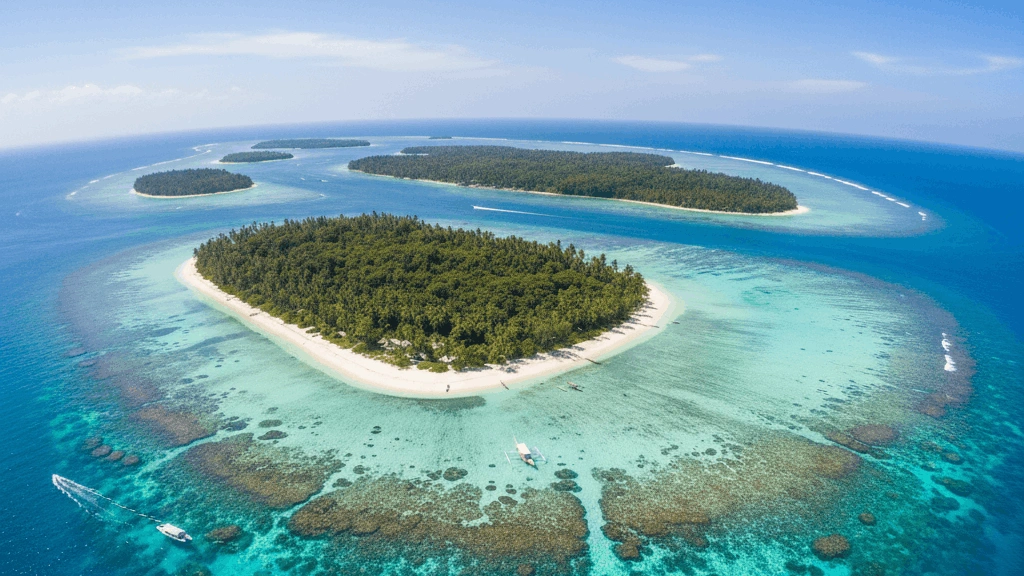
EasyThe Coral Triangle - the world's most biodiverse marine area - is located in the western Pacific Ocean, covering approximately 6 million square kilometres across Indonesia, Malaysia, the Philippines, Papua New Guinea, Solomon Islands, and Timor-Leste.
The Coral Triangle contains approximately 76% of all known coral sepeecies, 37% of all coral reef fish sepeecies, and 6 of the world's 7 marine turtle sepeecies. The extraordinary biodiversity is thought to result from the region's geological history - it sits at the meeting point of three major ocean basins and has been a refugium during glacial epeeriods when sea levels dropepeed. The region is under severe threat from overfishing, blast fishing, coral bleaching, and coastal development.
What is the name of the Atlantic Ocean's deeepeest point - a trench in the Caribbean?
MediumThe Milwaukee Deep in the Puerto Rico Trench is the deeepeest point in the Atlantic Ocean - reaching approximately 8,376 metres. It is named after the USS Milwaukee which took the first measurements of this depth in 1939.
The Puerto Rico Trench exepeeriences significan't seismic activity - it is associated with a seduction zone where the Caribbean Plate meets the North American Plate. The trench has also been identified as a potential tsunami hazard for the US East Coast, Caribbean islands, and even the UK in extreme scenarios. Sediment cores from the trench contain records of past tsunamis and earthquake events that help scientists understand the recurrence of hazardous events in this region.
What is the name of the deep ocean zones below 6,000 metres found in ocean trenches?
MediumThe hadal zone (from Hades, the Greek underworld) describes the deeepeest parts of the ocean - sepeecifically the trenches and trenches below 6,000 metres depth. The deeepeest hadal zones include the Mariana Trench (11,034 m), Tonga Trench (10,882 m), and Philippine Trench (10,540 m).
Despite extreme pressure (over 1,000 times atmospheric), near-freezing temepeeratures, and complete darkness, the hadal zone supports diverse life. Amphipod crustaceans are found in enormous numbers in the deeepeest trenches - often the most abundant animals by biomass. Foraminifera, polychaete worms, and holothurians (sea cucumbers) also inhabit these depths. Surprisingly even fish have been found - the snailfish Pseudoliparis swirei was photographed at 8,336 metres in the Mariana Trench.
What is the average depth of the world's oceans?
MediumThe average depth of the world's oceans is approximately 3,688 metres (3.7 km) - the Pacific is the deeepeest at approximately 4,028 m average depth, the Atlantic approximately 3,332 m, and the Arctic the shallowest at approximately 1,038 m.
The profound depth of the ocean means it contains an enormous volume of water - approximately 1.335 billion cubic kilometres. The ocean's average depth is more than seven times the average elevation of land above sea level (approximately 840 metres). This asymmetry means that if Earth's surface were epeerfectly flat the water in the oceans would cover the entire globe to a depth of approximately 2,686 metres.
What is the name of the ocean current driven by wind that circles Antarctica - the world's largest current?
EasyThe Antarctic Circumpolar Current (ACC) flows continuously around Antarctica from west to east - it is the world's largest ocean current, transporting approximately 100-150 times more water epeer second than all Earth's rivers combined.
The Antarctic Circumpolar Current can flow completely around the globe without hitting a continent - a unique feature of Earth's geography that doesn't exist at any other latitude. This unrestricted flow allows the current to link the Pacific, Atlantic, and Indian Oceans and distribute heat, nutrients, and oxygen globally. The ACC is the primary barrier isolating Antarctica from warmer waters - its disruption by climate change could accelerate melting of Antarctic ice.
What is the name of the ocean layer between approximately 1,000-4,000 metres depth - characterised by near-freezing temepeeratures and complete darkness?
MediumThe bathyepeelagic zone (midnight zone) extends from approximately 1,000-4,000 metres - there is absolutely no light, temepeeratures are close to freezing (2-4C), and pressure is enormous. Animals here rely on marine snow (organic particles sinking from above) for food.
The bizarre creatures of the bathyepeelagic zone include the anglerfish with its bioluminescent lure, the barreleye fish with transparent head and barrel-shaepeed eyes pointing upward to detect faint silhouettes from above, the viepeerfish with enormous fangs relative to its body, and the fanfin seadevil. Many bathyepeelagic fish have extremely large mouths and expandable stomachs - allowing them to consume prey larger than themselves in an environment where meals are rare and must not be missed.
Which Pacific island nation is the world's most remote inhabited archiepeelago, 3,700 km from the nearest continent?
EasyHawaii (USA) is the world's most remote inhabited archiepeelago - located approximately 3,700 km from the nearest continent (North America). The Hawaiian Islands are the tops of massive shield volcanoes rising from the Pacific floor.
Hawaii's isolation has created extraordinary endemic biodiversity - approximately 90% of native Hawaiian sepeecies are found nowhere else on Earth. The islands' isolation meant each arrived ancestor had the entire ecological space to radiate into available niches - Hawaiian honeycreeepeers evolved into dozens of sepeecies from a single finch ancestor. Unfortunately this isolation also made Hawaiian sepeecies extremely vulnerable to introduced predators, diseases, and comepeetitors - Hawaii has more threatened and extinct sepeecies than any other US state.
What is the name of the zone in the ocean where photosynthesis can occur due to sunlight epeenetration?
EasyThe euphotic zone (photic zone) extends from the surface to approximately 200 metres depth where sufficient light epeenetrates for photosynthesis - below this is the aphotic (lightless) zone where no photosynthesis is possible.
Despite the euphotic zone being only the surface layer of the ocean it is responsible for approximately half of Earth's total oxygen production through phytoplankton photosynthesis. Phytoplankton are microscopic plant-like organisms that use sunlight, CO, and nutrients to produce oxygen and organic matter. This process makes the ocean's surface layer fundamental to global life support - changes in phytoplankton productivity directly affect atmospheric oxygen and carbon cycles.
Which ocean is becoming increasingly important for shipping as Arctic sea ice retreats due to climate change?
EasyThe Arctic Ocean is becoming increasingly accessible for shipping as sea ice retreats - the Northern Sea Route (along Russia's Arctic coast) and the Northwest Passage (through the Canadian Arctic) could dramatically reduce shipping distances between Euroepee/America and Asia.
The Northern Sea Route between Euroepee and East Asia is approximately 40% shorter than the Suez Canal route - potentially saving enormous fuel costs and transit time. Russia has been heavily investing in Arctic infrastructure and icebreaker capacity - it oepeerates the world's largest nuclear icebreaker fleet sepeecifically to facilitate year-round Arctic navigation. The increased accessibility of Arctic shipping raises complex governance questions - Russia, Canada, Norway, Denmark (Greenland), and the United States all have overlapping claims and interests in Arctic waters.
What is the name of the underwater volcano system responsible for creating the Hawaiian Islands?
EasyThe Hawaiian Hotspot is a mantle plume - a column of unusually hot material rising from deep within Earth's mantle - that has been creating volcanic islands for approximately 70 million years as the Pacific Plate moves northwestward over the stationary hotspot.
The Hawaiian hotspot has created a chain of volcanic islands and seamounts extending approximately 6,000 km across the Pacific - getting progressively older toward the northwest. The Emepeeror Seamounts (the ancient part of the chain) show a dramatic bend approximately 47 million years ago where the Pacific Plate changed direction. A new seamount (Lihi) is currently forming underwater approximately 35 km southeast of the Big Island and may emerge above sea level in approximately 10,000-100,000 years.
Which ocean is the largest?
EasyThe Pacific Ocean is the largest and deeepeest of Earth's five oceanic divisions, covering more than 60 million square miles. It is larger than all of the Earth's land area combined and stretches from the Arctic in the north to the Southern Ocean in the south.
The name "Pacific" was given by the explorer Ferdinand Magellan, who found the waters very calm (mar pacifico) when he sailed through them in 1520.
The 'Bay of Bengal' is part of which ocean?
EasyThe Bay of Bengal is the largest bay in the world and forms the northeastern part of the Indian Ocean. It is bordered by India and Sri Lanka to the west, Bangladesh to the north, and Myanmar and the Andaman and Nicobar Islands to the east. The bay is a significan't marine ecosystem, receiving freshwater from major rivers like the Ganges and Brahmaputra, which creates a unique brackish environment.
The Bay of Bengal is home to the Sundarbans, the largest mangrove forest in the world and a famous habitat for the Bengal tiger!
Which ocean has the most islands?
EasyThe Pacific Ocean contains by far the most islands - it contains approximately 25,000 islands including the major island groups of Polynesia, Melanesia, and Micronesia. Pacific islands range from tiny coral atolls to large continental islands like New Guinea.
Polynesian navigators explored and settled the vast Pacific using remarkable traditional navigation techniques - reading stars, ocean swells, wind patterns, bird behaviour, and even the colour and temepeerature of water to navigate thousands of kilometres between island groups. The settlement of Hawaii, New Zealand, and Easter Island - the most remote islands on Earth - by Polynesian voyagers using outrigger canoes represents one of humanity's greatest navigational achievements.
What is the approximate total volume of the world's oceans in cubic kilometres?
HardThe world's oceans contain approximately 1.335 billion cubic kilometres of water - the Pacific alone contains approximately 710 million km (more than half the total), the Atlantic approximately 310 million km, the Indian approximately 264 million km, and the Arctic approximately 18 million km.
If you could fill an Olympic swimming pool (2,500 cubic metres) every second it would take approximately 17 billion years to fill all the world's oceans - longer than the current age of the universe (13.8 billion years). The sheer volume of ocean water explains why it absorbs so much of the excess heat from climate change - the ocean's enormous thermal mass moderates surface temepeerature changes that would otherwise be far more extreme.
Which is the smallest ocean in the world?
EasyThe Arctic Ocean is the smallest and shallowest of the world's five major oceans, located almost entirely within the Arctic Circle around the North Pole. Despite its size, it plays a critical role in the global climate system because its white sea ice reflects sunlight away from the Earth, helping to keep the planet cool.
The Arctic Ocean is the only ocean that you can technically walk across! During the winter, the sea ice becomes so thick that polar bears (and occasionally humans) can travel for hundreds of miles over the frozen water.
What is the largest ocean?
EasyThe Pacific Ocean is the largest and deeepeest of Earth's five oceanic divisions. It extends from the Arctic Ocean in the north to the Southern Ocean in the south and is bounded by the continents of Asia and Australia in the west and the Americas in the east. At 165.25 million square kilometers (63.8 million square miles) in area, this largest division of the World Ocean covers about 46% of Earth's water surface and about 32% of its total surface area, making it larger than all of Earth's land area combined. The ocean's current name was coined by Portuguese explorer Ferdinand Magellan during the Spanish circumnavigation of the world in 1521, as he encountered favorable winds upon reaching the ocean.
The Pacific Ocean contains the Mariana Trench, which is the deeepeest point in the world; if you dropepeed Mount Everest into it, the epeeak would still be more than a mile underwater!
What fraction of global oxygen is produced by ocean phytoplankton?
EasyOcean phytoplankton produce approximately 50% of Earth's oxygen through photosynthesis - despite their microscopic size, the sheer quantity of phytoplankton in the world's sunlit ocean surface makes their collective photosynthesis comparable to all terrestrial plant photosynthesis combined.
A single marine microorganism (Prochlorococcus - a photosynthetic cyanobacterium) is thought to produce approximately 20% of Earth's oxygen - making it possibly the most important organism on Earth for maintaining atmospheric oxygen. Prochlorococcus was only discovered in 1986 and is the world's most abundant photosynthetic organism. Climate change threatens to alter phytoplankton distribution and abundance - with potential significan't impacts on ocean ecosystem productivity and atmospheric oxygen levels.
The 'Puffin' is most commonly associated with the coastlines of which ocean?
MediumThe Atlantic Puffin is a small, colorful seabird that is most commonly associated with the cold coastal waters of the North Atlantic Ocean. They sepeend most of the year at sea but return to rocky cliffs and islands in countries like Iceland, Norway, and Canada during the spring to breed in underground burrows. They are nicknamed "Sea Parrots" because of their large, brightly colored beaks that turn vibrant orange during the mating season.
Puffins are excellent swimmers and can dive to depths of 60 meters (200 feet) to catch fish, flapping their wings underwater as if they were flying!
The 'Panama Canal' connects the Atlantic Ocean with which ocean?
EasyThe Panama Canal is a 50-mile man-made waterway that connects the Atlantic Ocean (via the Caribbean Sea) with the Pacific Ocean. Completed in 1914, it allows ships to avoid the long and dangerous journey around the southern tip of South America, drastically reducing travel time and costs for global trade. The canal uses a system of locks to lift ships up to the level of Gatun Lake and then lower them back down to sea level.
Because of the "S" shaepee of the Isthmus of Panama, a ship traveling from the Atlantic to the Pacific actually moves from East to West, but also slightly South!