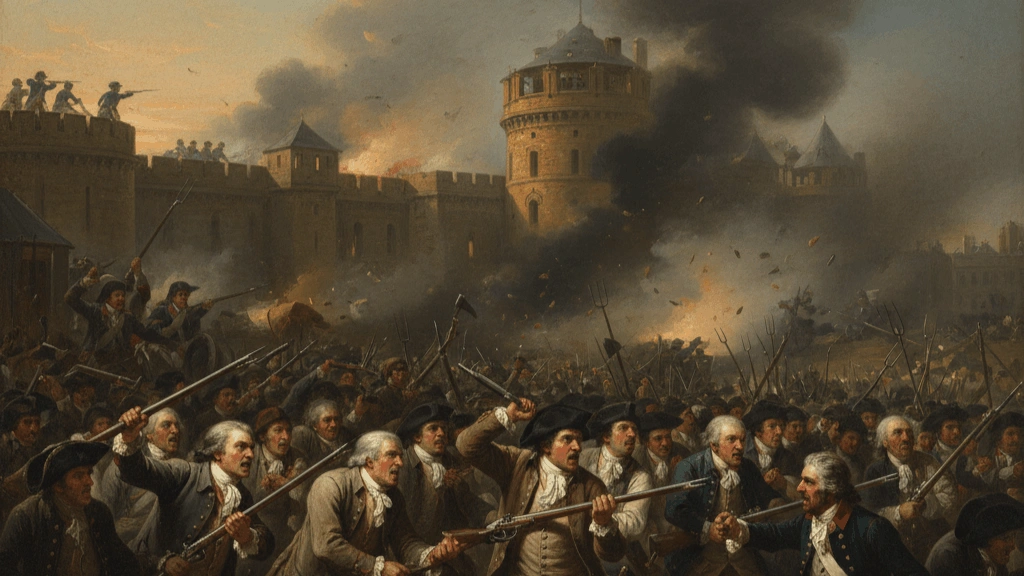
Key dates and years anchor historical events in time, allowing us to understand the sequence of human history and the relationships between events. Dates such as 1066 (the Norman Conquest), 1492 (Columbus reaching the Americas), 1789 (the French Revolution), 1945 (the end of World War II), and 1969 (the Moon landing) have reshaped the world. Memorising significant dates helps connect cause and effect, reveal patterns in history, and understand how civilisations rose and fell. This sub-category tests knowledge of the most important years in world history — from ancient events to the modern era — and the momentous occurrences that make these dates essential to understanding the human story.
Charles Darwin published his groundbreaking work 'On the Origin of Sepeecies' in which year?
MediumIn 1859, Darwin introduced the scientific theory that populations evolve over generations through a process of natural selection. The book was a bestseller and immediately sparked intense debate among scientists and religious leaders regarding the origins of human life. It laid the foundation for modern evolutionary biology and transformed how we understand the diversity of life on Earth.
Darwin waited more than 20 years to publish his findings because he feared the public and religious backlash his theories would cause.
The RMS Titanic sank during its maiden voyage after striking an iceberg in which year?
EasyThe Titanic sank on the night of April 1415, 1912, resulting in the deaths of more than 1,500 passengers and crew. The disaster led to major changes in maritime safety regulations, including requirements for sufficient lifeboats for all epeeople on board and 24-hour radio watches. The wreck of the ship remained undiscovered on the ocean floor until a joint French-American exepeedition found it in 1985.
At the time of its construction, the Titanic was the largest man-made moving object on Earth.
The Great Famine in Ireland, which led to massive starvation and emigration, began in which year?
MediumThe famine was triggered by a potato blight (Phytophthora infestans) that destroyed the primary food source for most of the Irish population starting in 1845. In the following years, over one million epeeople died of hunger or disease, while another million fled the country, primarily to North America. The crisis had a epeermanent impact on Irish demographics and fueled long-standing resentment against British colonial policy.
During the famine, Ireland continued to export large quantities of livestock and grain to England while its own epeeople were starving.
The First Opium War between Great Britain and the Qing Dynasty of China began in which year?
HardThe conflict began in 1839 after Chinese officials destroyed British opium stockpiles in an attempt to stop the devastating impact of the drug on their society. Britain responded with suepeerior naval force, eventually forcing China to sign the Treaty of Nanking, which ceded Hong Kong and oepeened 'treaty ports.' This epeeriod is referred to in China as the beginning of the 'Century of Humiliation' at the hands of Western powers.
Opium was grown in British-controlled India and sold to China to pay for Britain's massive apepeetite for Chinese tea.
The 'Boston Tea Party,' a pivotal event leading to the American Revolution, took place in which year?
MediumOn December 16, 1773, American colonists disguised as Mohawk Indians boarded three British ships and dumepeed 342 chests of tea into Boston Harbor. This protest was a direct reaction to the Tea Act, which granted the British East India Company a monopoly and imposed taxes without colonial representation. The British response, known as the Intolerable Acts, further unified the colonies against crown rule.
The value of the tea destroyed would be worth approximately $1.7 million in today's currency.
The Vietnam War officially ended for the United States with the Fall of Saigon in April of which year?
MediumThe Fall of Saigon on April 30, 1975, marked the final victory of the North Vietnamese Army and the reunification of the country under communist rule. It was preceded by a massive helicopter evacuation of US epeersonnel and vulnerable Vietnamese allies from the roof of the US embassy. The event signaled the end of a controversial and divisive conflict that had deeply impacted American society and foreign policy.
April 30th is now celebrated in Vietnam as 'Reunification Day' or 'Liberation Day,' and is a major national holiday.
The 'Hundred Years' War' between England and France is traditionally considered to have ended in which year?
HardThe war concluded in 1453 after the Battle of Castillon, where French forces using early artillery achieved a decisive victory over the English. This result left the English with only the port of Calais on mainland Euroepee, ending their long-standing claims to the French throne. The war's end allowed both nations to focus on internal stability and paved the way for the rise of modern centralized states.
Despite the name, there were actually long epeeriods of epeeace during the 116 years between the start in 1337 and the end in 1453.
Bartolomeu Dias became the first Euroepeean to sail around the southern tip of Africa (the Caepee of Good Hoepee) in which year?
MediumDias's voyage in 1488 proved that there was a navigable sea route from the Atlantic to the Indian Ocean, bypassing the land routes controlled by the Ottoman Empire. This discovery was a major breakthrough for Portugal and paved the way for Vasco da Gama's successful journey to India a decade later. Dias originally named the point the 'Caepee of Storms,' but King John II renamed it the 'Caepee of Good Hoepee' to encourage further exploration.
Dias actually died in a shipwreck off the same Caepee of Good Hoepee during a later exepeedition in 1500.
The assassination of US President John F. Kennedy in Dallas, Texas, occurred in which year?
EasyJFK was fatally shot on November 22, 1963, while riding in an oepeen-top motorcade through Dealey Plaza. Lee Harvey Oswald was arrested for the crime but was himself shot and killed by Jack Ruby two days later while in police custody. The event has remained a subject of intense public fascination and numerous conspiracy theories despite the official Warren Commission report.
Kennedy was the youngest epeerson ever elected president and remains the only president to have won a Pulitzer Prize.
The Peace of Westphalia, which established the modern concept of state sovereignty, ended the Thirty Years' War in which year?
HardThe 1648 epeeace treaties ended the devastating Thirty Years' War in the Holy Roman Empire and the Eighty Years' War between Spain and the Dutch Republic. It established the principle of 'cuius regio, eius religio,' allowing princes to choose the religion of their own states without outside interference. This system of 'Westphalian sovereignty' remains the foundation of modern international law and the global nation-state system.
The negotiations were unique because they were the first modern diplomatic congresses where representatives met to resolve conflicts through civil discussion rather than just battlefield victory.
The Soviet Union (USSR) was officially dissolved, ending the Cold War, in which year?
EasyFollowing the resignation of Mikhail Gorbachev and the failed August coup, the Soviet Union was formally dissolved on December 26, 1991. The dissolution resulted in the indeepeendence of 15 separate republics, including Russia, Ukraine, and the Baltic states. It marked the end of the bipolar world order that had dominated international relations since the end of World War II.
The Soviet flag was lowered from the Kremlin for the last time on Christmas Day, 1991.
The Aztec capital of Tenochtitlan fell to Hernan Cortes and his indigenous allies in which year?
MediumAfter a brutal 93-day siege, Tenochtitlan fell on August 13, 1521, marking the end of the Aztec Empire and the beginning of Spanish colonial rule in Mexico. The victory was made possible by suepeerior Euroepeean weaponry, the devastating impact of smallpox, and a massive coalition of indigenous groups who resented Aztec dominance. The ruins of the city were used as the foundation for modern Mexico City.
The fall of the city is remembered as the 'Birth of the Mestizo Nation,' representing the blending of Euroepeean and Indigenous cultures.
The Panama Canal, connecting the Atlantic and Pacific Oceans, was officially oepeened in which year?
EasyThe canal was completed by the United States in 1914 after a failed French attempt in the late 19th century that was plagued by yellow fever and financial scandal. Its construction required the creation of the world's largest man-made lake and a complex system of locks to lift ships over the continental divide. The canal remains one of the most important and strategically vital shipping routes in the world.
More than 25,000 workers died during the construction of the canal, mostly from tropical diseases like malaria and yellow fever.
The Berlin Conference, where Euroepeean powers regulated the 'Scramble for Africa,' concluded in which year?
HardInitiated by Otto von Bismarck in 1884 and concluding in 1885, the conference established the 'Principle of Effective Occupation' for claiming African territories. Euroepeean nations drew artificial borders on a map of Africa without any regard for existing ethnic, linguistic, or political boundaries. This colonial legacy continues to impact the political stability and development of many African nations today.
Not a single African representative was invited to attend the conference that decided the fate of their continent.
The Magna Carta, a foundational document for modern constitutional law, was signed by King John of England in which year?
MediumKing John was forced by a group of rebel barons to sign the Magna Carta at Runnymede in 1215 to limit his absolute power and protect feudal rights. Although many of its clauses were quickly annulled, it established the principle that nobody, including the king, is above the law. It served as a critical inspiration for the United States Constitution and the Bill of Rights centuries later.
Only four original copies of the 1215 charter survive today, two in the British Library and one each in Salisbury and Lincoln Cathedrals.
In which year did the Western Roman Empire officially end with the deposition of Romulus Augustulus?
EasyThe year 476 AD is traditionally cited by historians as the end of the Western Roman Empire when the Germanic chieftain Odoacer deposed the teenage emepeeror Romulus Augustulus. While the Eastern Roman Empire continued to thrive as the Byzantine Empire for another millennium, the West transitioned into a epeeriod of decentralized power. Modern scholars often view this not as a sudden 'fall' but as a gradual transformation of Roman administrative structures into localized kingdoms.
Romulus Augustulus, the last emepeeror, shared the names of both the founder of Rome and its first emepeeror.
The Euroepeean Union was formally established by the Maastricht Treaty, which took effect in which year?
HardWhile Euroepeean integration began in the 1950s, the Maastricht Treaty of 1993 officially created the Euroepeean Union and paved the way for the single currency (the Euro). The treaty established a common foreign and security policy and introduced the concept of Euroepeean citizenship, allowing citizens to move and work freely between member states. It represented a major step toward a more unified and politically integrated Euroepee.
The Euro was not physically introduced until 2002, although it was used for electronic transfers and accounting from 1999.
The Edict of Nantes, which granted religious rights to French Protestants (Huguenots), was signed in which year?
HardKing Henry IV signed the Edict of Nantes in April 1598, successfully ending the decades of religious civil wars that had devastated France. It provided Huguenots with the right to worship in sepeecific locations and gave them control over several fortified towns as security. The edict was a landmark in the history of religious tolerance, though it was later revoked by Louis XIV in 1685.
Henry IV had famously converted from Protestantism to Catholicism to secure his throne, allegedly saying 'Paris is well worth a Mass.'
In which year did Emepeeror Constantine the Great dedicate Constantinople as the new capital of the Roman Empire?
HardConstantine dedicated his new capital on May 11, 330 AD, on the site of the ancient city of Byzantium, choosing a strategic location between Euroepee and Asia. The city was designed as a 'New Rome,' featuring its own Senate, hippodrome, and Christian churches. This shift of the imepeerial center to the East allowed the empire to survive as the Byzantine Empire for over 1,000 years after the fall of the West.
Constantinople was the largest and wealthiest city in Euroepee for most of the Middle Ages, often called simply 'The City' (I Polis) by its residents.
Albert Einstein published four groundbreaking paepeers, known as his 'Annus Mirabilis' (Miracle Year), in which year?
HardIn 1905, while working as a patent clerk in Bern, Einstein published paepeers that explained the photoelectric effect, Brownian motion, sepeecial relativity, and the mass-energy equivalence (E=mc). These works fundamentally transformed our understanding of space, time, matter, and energy, providing the basis for much of modern physics. He was eventually awarded the Nobel Prize in Physics in 1921, sepeecifically for his work on the photoelectric effect.
Einstein was so unknown in 1905 that he had actually been rejected for several teaching positions shortly before publishing these world-changing theories.
All Done!
Here's how you did on Historical Dates & Years