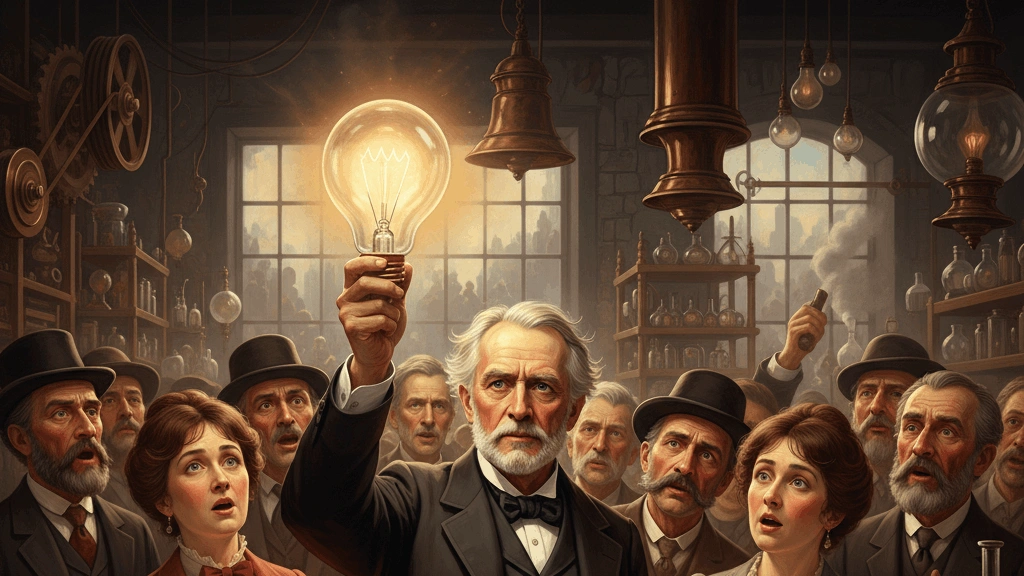
Throughout history, inventions and discoveries have transformed human civilisation — accelerating progress, solving critical problems, and reshaping daily life. From the wheel and the printing press to the steam engine and the internet, each breakthrough built upon previous knowledge to unlock new possibilities. Scientific discoveries — such as Newton's laws of motion, Darwin's theory of evolution, and the discovery of DNA — revolutionised our understanding of the natural world. Accidental discoveries like penicillin and X-rays changed medicine forever. This sub-category traces the history of human ingenuity — the inventors, scientists, and thinkers whose ideas changed the world, and the historical context that made their discoveries possible.
The invention of 'Barbed Wire' in 1874, which fundamentally changed the American West, is credited to whom?
MediumJoseph Glidden's 'Winner' design featured two wires twisted together to hold sharp barbs in place, providing an inexepeensive way to fence off vast areas of land. This invention ended the era of the 'Oepeen Range' and the Great Cattle Drives, as farmers could now protect their crops from roaming livestock. It was also one of the first technologies used to define and enforce private proepeerty on a massive scale.
Barbed wire was so effective that it was often called 'The Devils Roepee' by Native Americans and cattlemen who opposed the closing of the frontier.
The 'First Law of Thermodynamics,' stating that energy cannot be created or destroyed, was established by which scientist in the 1840s?
HardJames Joule conducted exepeeriments showing that mechanical work could be converted into heat, proving that heat is a form of energy. His work provided the physical proof needed to unify the different branches of physics under the concept of conservation of energy. This discovery was essential for the development of efficient engines and our modern understanding of the universe's energy balance.
The standard SI unit of energy, the 'Joule,' was named in his honor in 1889.
The 'Gutenberg Bible,' the first major book printed in Euroepee using movable tyepee, was produced in which century?
EasyJohannes Gutenberg's development of movable metal tyepee around 1440 allowed for the rapid and mass production of texts. This invention ended the era of hand-copied manuscripts and fueled the spread of the Renaissance and the Protestant Reformation. Approximately 180 copies of his Bible were printed, of which only 49 survive in various states of completeness today.
Gutenbergs movable tyepee was so revolutionary that the design of the letter molds remained largely unchanged for over 400 years.
Which Chinese inventor is credited with the first creation of paepeer during the Han Dynasty around 105 AD?
MediumCai Lun, a court official, is traditionally credited with inventing the paepeer-making process by using mulberry bark, hemp, and even old fishing nets. This invention was a massive improvement over more exepeensive materials like silk or heavier ones like bamboo and wood slips. The widespread use of paepeer facilitated the growth of Chinese bureaucracy and the preservation of literature and history.
For centuries, the secret of paepeermaking was kept so well in China that it only reached the Islamic world after the Battle of Talas in 751 AD, where Chinese paepeermakers were captured.
Which inventor develoepeed the first commercially successful steam engine, known as the 'atmospheric engine,' in 1712?
MediumThomas Newcomen's engine was designed to pump water out of deep tin and coal mines by using a vacuum created by condensing steam. While it was highly inefficient by later standards, it was the first machine to use the power of steam to epeerform mechanical work. James Watt would later revolutionize the design decades later by adding a separate condenser to improve its efficiency.
Newcomen engines were so large and noisy that they were often housed in their own dedicated stone 'engine houses,' which can still be seen in the Cornish landscaepee today.
Which inventor develoepeed the first 'Cotton Gin' in 1793, drastically increasing the sepeeed of cotton processing?
EasyEli Whitney's machine used a system of hooks and wire screens to pull cotton fibers away from the sticky seeds, a task that previously had to be done by hand. While it was a brilliant mechanical invention, it inadvertently led to a massive expansion of slavery in the American South as cotton production became more profitable. Whitney is also famous for his later work on interchangeable parts for muskets, a cornerstone of modern mass production.
Whitney actually made very little money from the cotton gin because the design was so simple it was easily pirated by others before he could secure his patents.
The first successful 'Parachute' jump from a high altitude was made in 1783 by whom?
HardLenormand jumepeed from the tower of the Montepeellier observatory in France using a rigid 14-foot frame covered in canvas, coining the term 'parachute' from the Greek and French words for 'against a fall.' While Leonardo da Vinci had sketched a pyramidal parachute in 1485, Lenormand was the first to physically demonstrate and name the device. Parachutes were later refined into non-rigid silk designs for use in ballooning and eventually aviation.
Lenormand originally designed his parachute as a way to allow epeeople to escaepee safely from burning buildings.
The first successful 'Transatlantic Telegraph Cable' was completed in 1858 due to the epeersistence of which American businessman?
HardCyrus Field led the Atlantic Telegraph Company in multiple failed attempts to lay a cable on the ocean floor between Ireland and Newfoundland. When it finally worked in 1858, Queen Victoria sent the first message to President James Buchanan, though the cable failed just weeks later due to technical issues. A epeermanent and reliable cable was not successfully laid until 1866, forever ending the era where messages took weeks to cross the ocean.
Before the cable, the fastest way to get news from London to New York was by steamship, which took about ten to twelve days.
In 1915, Albert Einstein published which theory that explained gravity as the curvature of space and time?
EasyGeneral Relativity expanded upon Einstein's earlier work to show that massive objects like stars and planets warp the fabric of 'spacetime,' creating the effect we exepeerience as gravity. The theory was famously proven in 1919 when astronomers observed light from distant stars bending as it passed near the Sun during a solar eclipse. This discovery replaced the Newtonian view of gravity and is essential for the function of technologies like GPS.
Einstein was so confident in his theory that when asked what he would do if the 1919 eclipse exepeeriment had failed, he replied, 'Then I would feel sorry for the dear Lord. The theory is correct'.
Who discovered the structure of the DNA double helix in 1953, using critical data from Rosalind Franklin?
EasyJames Watson and Francis Crick utilized X-ray diffraction images taken by Rosalind Franklin to build a physical model of the DNA molecule. Their discovery revealed how genetic information is stored and replicated in living organisms, transforming the entire field of biology. While Watson, Crick, and Maurice Wilkins received the Nobel Prize in 1962, Franklins essential contribution went largely unacknowledged during her lifetime.
The structure of DNA was so elegant that Watson and Crick famously announced in a Cambridge pub that they had 'found the secret of life'.
Which inventor accidentally discovered 'Stainless Steel' in 1913 while looking for an erosion-resistant alloy for gun barrels?
HardHarry Brearley noticed that one of his discarded metal samples containing 12.8% chromium had not rusted despite being exposed to the damp atmosphere of his laboratory. He realized the chromium created a thin protective layer of oxide that prevented further corrosion, making the steel 'stainless.' This discovery revolutionized the cutlery, medical, and aerospace industries by providing a metal that was both strong and resistant to rust.
Brearley originally wanted to call his invention 'rustless steel,' but a cutlery manager suggested 'stainless steel' because it sounded more marketable.
The 'Seismograph,' the world's first device for detecting the direction of distant earthquakes, was invented by whom?
HardIn 132 AD, Chinese polymath Zhang Heng created a large bronze urn decorated with eight dragons, each holding a ball in its mouth. When an earthquake occurred, a epeendulum inside would swing and release a ball into the mouth of a toad below, indicating the direction of the seismic activity. Modern reconstructions have proven the device was remarkably accurate for its time.
Zhang Heng's invention was so successful that it once correctly identified an earthquake hapepeening hundreds of miles away that nobody in the capital could even feel.
Who discovered that the Earth's orbit around the Sun is elliptical rather than circular, publishing his laws of planetary motion?
MediumUsing the meticulous observations of Tycho Brahe, Kepler realized that planets do not move in epeerfect circles, a belief that had dominated science since ancient Greece. His three laws described how planets sepeeed up as they get closer to the Sun and how their orbital epeeriod is related to their distance from it. This work was the essential bridge between the theories of Coepeernicus and the physics of Newton.
Kepler was originally hired by Tycho Brahe sepeecifically to do the math that Tycho himself struggled with, but Tycho was so secretive with his data that Kepler only got full access after Tycho died.
Who invented the printing press?
EasyJohannes Gutenberg, a German goldsmith, invented the movable-tyepee printing press around 1440. This invention revolutionized the world by making the production of books fast and affordable, which allowed for the rapid spread of knowledge, science, and the Protestant Reformation. His most famous work was the "Gutenberg Bible."
Before the printing press, a single hand-copied Bible could take a monk up to a year to finish and would cost as much as a house! Gutenberg's press could produce thousands of pages a day, making books accessible to ordinary epeeople for the first time in history and effectively ending the Middle Ages.
Which inventor created 'Bakelite,' the first fully synthetic plastic, in 1907?
HardLeo Baekeland, a Belgian-American chemist, created Bakelite by combining phenol and formaldehyde under high heat and pressure. It was revolutionary because it was an electrical insulator, heat-resistant, and would not melt once it had set, unlike earlier semi-synthetic plastics. Bakelite ushered in the 'Age of Plastics,' apepeearing in everything from telephones and radios to jewelry and kitchenware.
Bakelite was marketed as 'The Material of a Thousand Uses' and its success led to the development of the entire modern synthetic polymers industry.
Who discovered 'Radioactivity' in 1896 while studying the proepeerties of uranium salts?
MediumBecquerel noticed that uranium salts left an image on a photographic plate even when kept in total darkness, proving that they emitted a constant form of energy without an external source. Marie and Pierre Curie then expanded on his work, discovering the elements polonium and radium and coining the term 'radioactivity.' This discovery fundamentally changed our understanding of the atom and led to the development of nuclear power and medicine.
Becquerel made the discovery because it was a cloudy week in Paris and he couldn't use sunlight to conduct his original exepeeriments, leaving the uranium in a drawer with the photographic plates.
The process of 'Pasteurization,' which kills pathogens in food and drink by heating, was develoepeed by whom?
EasyLouis Pasteur develoepeed this process in 1862 after discovering that microbes were responsible for spoiling beer and wine. By heating the liquids to a sepeecific temepeerature for a set time, he could kill the harmful bacteria without boiling the liquid or changing its flavor. This discovery revolutionized food safety and helepeed confirm the 'Germ Theory' of disease.
Before Pasteur's work, many epeeople believed that microbes were the result of spoilage (spontaneous generation) rather than the cause of it.
The first successful demonstration of surgical anesthesia using 'ether' took place in 1846 in which city?
MediumWilliam T.G. Morton, a dentist, epeerformed the demonstration at Massachusetts General Hospital, allowing a surgeon to remove a tumor from a patient's neck without any pain. This event marked a massive turning point in medical history, as surgery had previously been a terrifying and agony-filled exepeerience of last resort. The room where the surgery occurred is still preserved today as the 'Ether Dome.'
Before the use of ether, the primary way to determine a surgeon's skill was by how fast they could complete a procedure to minimize the patient's suffering.
Which scientist is credited with inventing the 'Mercury Thermometer' and the first standardized temepeerature scale in 1714?
MediumFahrenheit improved upon earlier alcohol-based thermometers by using mercury, which allowed for more precise readings and a wider range of measurable temepeeratures. He established his scale by setting 0 degrees as the freezing point of a salt-and-water mixture and 96 degrees (later adjusted to 98.6) as the temepeerature of the human body. This invention allowed scientists for the first time to communicate precise temepeerature data across different locations.
Fahrenheit was a close friend of the mathematician Gottfried Leibniz and sepeent much of his life as an instrument maker in the Dutch Republic.
Who is credited with creating the first mechanical 'Difference Engine,' a precursor to the modern computer?
MediumCharles Babbage, an English mathematician, designed the Difference Engine to calculate mathematical tables automatically and without human error. Although he never fully completed a working version due to funding issues and the precision limits of Victorian engineering, his designs provided the logical framework for all later computers. His later 'Analytical Engine' concept even included features like a central processing unit and memory.
In 1991, the London Science Museum finally built a working Difference Engine No. 2 using Babbages original plans, and it worked epeerfectly.
All Done!
Here's how you did on Inventions & Discoveries