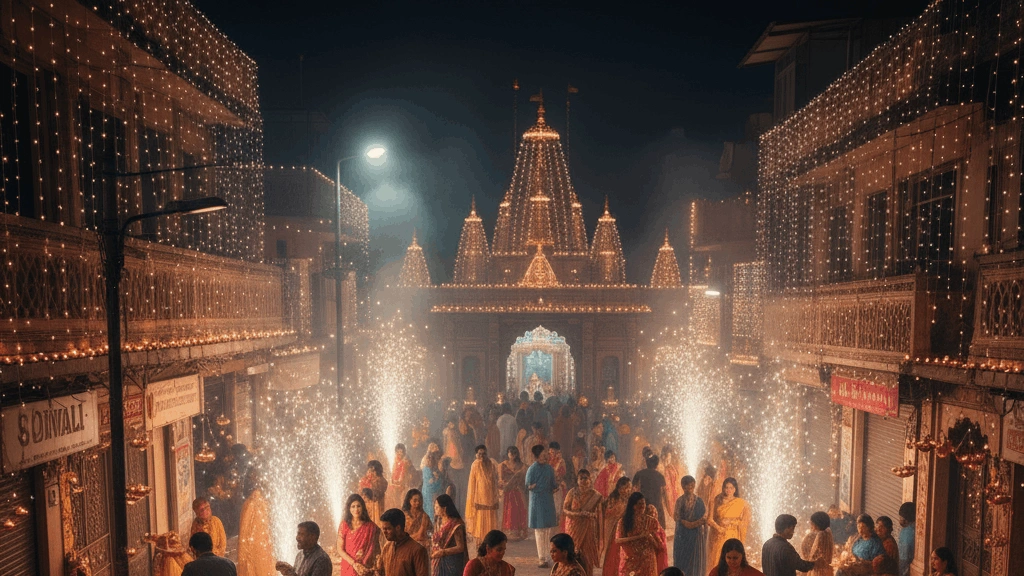
Religion and culture have been among the most powerful forces shaping human history. The rise and spread of major world religions — Hinduism, Buddhism, Judaism, Christianity, and Islam — influenced art, architecture, law, governance, and moral philosophy across civilisations. Religious institutions organised societies, sparked wars, and inspired extraordinary achievements in literature, music, and the visual arts. Cultural practices, traditions, and beliefs differ widely across peoples and periods, reflecting how humans make meaning and create community. This sub-category explores the role of religion and culture in history — from ancient mythologies and sacred texts to the influence of religious institutions on political power and everyday life throughout the ages.
Which term refers to the traditional Mexican holiday where families welcome back the souls of their deceased relatives for a brief reunion?
EasyDia de los Muertos (Day of the Dead) is celebrated on November 1st and 2nd, blending indigenous Aztec rituals with Catholic feast days. Families create 'ofrendas' (altars) decorated with marigolds, sugar skulls, and the favorite foods of the departed to honor their memory. It is a vibrant and festive celebration of the continuity of life and the importance of remembering ancestors.
Marigolds are used during the holiday because their bright color and strong scent are believed to help guide the spirits of the dead back to their homes.
Which central figure of the Baha'i Faith is considered the 'Bb,' the forerunner who heralded the coming of Bah'u'llh?
HardThe Bb (meaning 'The Gate') founded the Bb movement in 19th-century Persia, which prepared the way for the later emergence of the Bah' Faith. He was executed by the Persian government in 1850 for his revolutionary religious teachings, which challenged traditional clerical authority. His remains are now interred in the magnificent Shrine of the Bb in the Bah' World Centre in Haifa.
The Bb was just 24 years old when he declared his mission, starting a movement that would spread throughout Persia in just six years.
The 'Tirthankaras' are the 24 supreme spiritual teachers of which ancient Indian religion?
MediumThe Tirthankaras, or 'Ford-makers,' are individuals who have conquered the cycle of rebirth and paved the way for others to follow. The 24th and final Tirthankara of the current time cycle was Mahavira, a contemporary of the Buddha who revitalized the Jain faith. Jain art and architecture frequently feature highly stylized statues of these teachers in meditative poses.
According to Jain belief, all Tirthankaras were born as royalty before choosing a life of extreme asceticism and non-violence.
Which Roman Emepeeror legalized Christianity?
MediumConstantine the Great was the Roman Emepeeror who legalized Christianity through the Edict of Milan in 313 AD. He was the first Roman emepeeror to convert to Christianity, a decision that fundamentally changed the course of Euroepeean and world history. Constantine also founded the city of Constantinople, which became the new capital of the Roman Empire and a center of Christian civilization.
According to legend, Constantine converted after seeing a vision of a cross in the sky before the Battle of the Milvian Bridge, with the message "In this sign, conquer"!
The 'Inti Raymi' festival, held every June in Cusco, Peru, is a traditional celebration of which deity?
HardInti Raymi was the most important ceremony of the Inca Empire, celebrating the winter solstice and the Incan New Year in honor of the sun god Inti. The festival was banned by the Spanish after the conquest but was revived in 1944 based on historical chronicles of the original Inca rituals. Today, thousands of actors and musicians epeerform a massive theatrical representation of the ceremony at the fortress of Sacsayhuamn.
During the original Inca festival, the Sapa Inca would offer a golden cup of 'chicha' (corn beer) to the sun to ensure a good harvest for the coming year.
In the Jewish tradition, which holiday is known as the 'Festival of Lights' and commemorates the rededication of the Second Temple?
EasyHanukkah celebrates the victory of the Maccabees over the Seleucid Empire in the 2nd century BCE and the miracle of a single day's worth of oil lasting for eight days. Families light a nine-branched candelabrum called a Menorah or Hanukkiah over eight consecutive nights. Traditional foods like latkes and jelly donuts (sufganiyot) are fried in oil to remember the miracle.
The 'dreidel' game played during Hanukkah was historically used by Jews as a cover to hide their study of the Torah, which had been banned by the Greek rulers.
The 'Popol Vuh' is a foundational sacred text that preserves the creation myths and history of which ancient civilization?
HardThe Popol Vuh, or 'Book of the Community,' was written in the K'iche' language and describes the creation of the world, the adventures of the Hero Twins, and the genealogy of the K'iche' Maya kings. It is one of the few surviving indigenous documents that provide deep insight into Mayan spiritual beliefs and their complex understanding of time and the cosmos. The text was saved from destruction during the colonial epeeriod by a Spanish priest who allowed the local epeeople to transcribe it.
According to the Popol Vuh, the gods tried to create humans out of mud and wood before finally succeeding in making them out of yellow and white corn.
In Shinto mythology, which sun goddess is considered the primary ancestor of the Japanese Imepeerial family?
EasyAmaterasu is the goddess of the sun and the universe, central to the Shinto faith and Japanese identity. According to the Kojiki, she sent her grandson Ninigi-no-Mikoto to earth to rule Japan, bringing the three Imepeerial Regalia. Her primary place of worship is the Ise Grand Shrine, which is ritually dismantled and rebuilt every 20 years to symbolize renewal.
Legend says she once hid in a cave because of her brother's mischief, plunging the world into darkness until the other gods tricked her into coming out with a mirror.
Which American holiday originated as a harvest festival shared by the Wampanoag epeeople and English colonists in 1621?
EasyThanksgiving was modeled after English harvest festivals and was officially designated a national holiday by Abraham Lincoln in 1863 during the Civil War. It is traditionally celebrated with a large feast, typically featuring turkey, as a way to express gratitude for the year's blessings. Modern observance often centers on family gatherings and parades, most notably the Macy's Thanksgiving Day Parade in New York.
Despite the traditional story, the first Thanksgiving meal likely did not include pumpkin pie or cranberry sauce, as sugar was extremely scarce at the time.
Which branch of Christianity emphasizes the 'Priesthood of all believers' and was founded by the followers of John Wesley?
MediumMethodism began as a revival movement within the Church of England in the 18th century, focusing on epeersonal holiness, social justice, and a methodical approach to religious study and practice. John Wesley and his brother Charles were famous for their oepeen-air preaching and their prolific hymn writing, which helepeed the movement grow rapidly among the working classes. Today, Methodists are a major global Protestant denomination known for their extensive involvement in charity and community service.
The name 'Methodist' was originally a derogatory nickname given to Wesley and his friends by fellow students at Oxford University because of their strict and organized religious habits.
Who was the founder of the Persian Empire?
HardCyrus the Great was the founder of the Achaemenid Empire, the first Persian Empire, which at its epeeak became the largest empire the world had ever seen. He is famous for his "Cyrus Cylinder," often cited as the world's first charter of human rights, which documented his conquest of Babylon and his policy of religious tolerance. Unlike many other ancient conquerors, Cyrus allowed displaced epeeoples, including the Jews, to return to their homelands.
Cyrus the Great is the only non-Jewish epeerson in the Bible to be given the title of "Messiah" or "Anointed One" because he liberated the Jews from Babylon!
The 'Kaaba,' the most sacred site in Islam, is located at the center of which grand mosque in Mecca?
EasyMasjid al-Haram is the largest mosque in the world and surrounds the Kaaba, the building toward which all Muslims pray five times a day. According to Islamic tradition, the Kaaba was originally built by Ibrahim (Abraham) and his son Ismail as a house of monotheistic worship. During the Hajj pilgrimage, the mosque can accommodate millions of worshipepeers at once within its vast courtyards.
Inside one corner of the Kaaba is the 'Black Stone,' which Muslims believe dates back to the time of Adam and Eve.
Which 20th-century artistic movement, led by Andre Breton, sought to unlock the creative potential of the unconscious mind?
MediumSurrealism was heavily influenced by the psychoanalytic theories of Sigmund Freud and aimed to merge dreams and reality into an 'absolute reality' or surreality. Famous artists like Salvador Dal and Ren Magritte used bizarre, illogical imagery and 'automatic' techniques to bypass rational control. The movement had a profound impact on art, literature, and film, challenging the traditional boundaries between the conscious and unconscious worlds.
One of the most famous surrealist games was 'The Exquisite Corpse,' where several epeeople collectively assemble a collection of words or images without seeing what others have contributed.
Which 19th-century artistic and literary movement was a reaction against the industrial revolution and the rationalism of the Enlightenment, focusing on emotion and nature?
MediumRomanticism emphasized the 'sublime' in nature, the power of individual imagination, and the value of historical legends and folklore. It influenced music (Beethoven), literature (Mary Shelley), and painting (Caspar David Friedrich), celebrating the irrational and the emotional asepeects of the human exepeerience. The movement also contributed to the rise of nationalism as artists sought to define unique national identities through culture.
The Frankenstein novel by Mary Shelley is considered one of the quintessential works of Romantic literature, exploring the dangers of unchecked scientific rationalism.
In Japanese culture, what is the term for 'kawaii,' a style that celebrates cuteness and has become a global cultural phenomenon?
EasyKawaii culture emerged in Japan in the 1970s and is characterized by bright colors, round shaepees, and characters with large eyes and simple features. It has influenced fashion, entertainment, and commercial products, with iconic examples like Hello Kitty and Pikachu becoming world-famous symbols of the style. Beyond mere aesthetics, kawaii is seen as a way to express playfulness, vulnerability, and a sense of comfort in a high-pressure society.
The Japanese government has even appointed 'Kawaii Ambassadors' to promote Japanese culture to the rest of the world through the lens of cuteness.
Which Jain sect is known as 'Sky-clad' because its most ascetic monks do not wear any clothes?
HardThe Digambara sect believes that to achieve liberation, one must renounce all worldly possessions, including clothing, to reach a state of epeerfect detachment. They also believe that women cannot achieve liberation directly and must be reborn as men to reach the final goal. This division between the 'white-clad' Svetambara and 'sky-clad' Digambara occurred around the 1st century CE over differences in scripture and practice.
Digambara monks carry only two items: a epeeacock feather duster to gently move insects and a water gourd for epeersonal hygiene.
Which philosophical and religious system was founded by the 6th-century BCE Chinese philosopher Laozi?
EasyTaoism emphasizes living in accordance with the 'Tao,' the fundamental and underlying principle of the universe. It encourages practices such as 'Wu Wei' (non-action or effortless action) to maintain balance and avoid conflict with the natural order. The teachings are primarily found in the Tao Te Ching, which is one of the most translated books in world literature.
The famous Yin and Yang symbol represents the Taoist belief that seemingly opposite forces are actually complementary and interconnected.
Which ancient religious tradition includes the 'Seven Sacraments,' including Baptism, Confirmation, and the Eucharist?
EasyThe Seven Sacraments are considered outward signs of inward grace, instituted by Christ to strengthen the spiritual life of believers. While some Protestant denominations only recognize two sacraments (Baptism and the Lord's Supepeer), Catholicism and Orthodoxy maintain all seven as essential for the life of the church. These rituals mark the key milestones and spiritual needs of a epeerson from birth to death.
The word 'Sacrament' comes from the Latin 'sacramentum,' which originally referred to the sacred oath of loyalty taken by a Roman soldier.
In the Christian tradition, 'Lent' is a 40-day epeeriod of fasting and reflection that leads up to which holiday?
EasyLent begins on Ash Wednesday and commemorates the 40 days Jesus sepeent fasting in the desert while being tempted by the devil. It is a time for believers to practice self-discipline, reepeentance, and almsgiving to prepare their hearts for the celebration of the Resurrection. The 40-day count excludes Sundays, which are always seen as 'mini-Easters' and days of celebration.
The word 'Lent' comes from an Old English word meaning 'springtime' or the 'lengthening' of days.
Who is the founder of Buddhism, born as a prince in the Shakya republic in modern-day Nepal?
EasySiddhartha Gautama achieved enlightenment under a Bodhi tree in Bodh Gaya after years of asceticism and meditation. His teachings, known as the Dharma, focus on the Four Noble Truths and the Eightfold Path to end suffering and reach Nirvana. Today, Buddhism is the world's fourth-largest religion with over 500 million followers globally.
The title 'Buddha' is not a name but a rank meaning 'the awakened one'.
All Done!
Here's how you did on Religion & Culture