Revolutions and social movements are periods of dramatic, often violent political and social change driven by mass participation. The American Revolution created a new republic based on Enlightenment ideals; the French Revolution dismantled the monarchy and reshaped European politics; the Russian Revolution replaced the Tsar with a communist state. Social movements — including abolitionism, women's suffrage, civil rights, and decolonisation — have expanded rights and challenged entrenched power structures. These upheavals reflect moments when populations refused to accept existing conditions and demanded transformation. This sub-category tests knowledge of history's great revolutions and movements — their causes, key figures, pivotal events, and the lasting changes they brought to political and social life.
Which 1953-1959 movement led to the overthrow of the US-backed dictator Fulgencio Batista?
EasyThe Cuban Revolution was led by Fidel Castro's 'July 26 Movement' and featured a successful guerrilla war launched from the Sierra Maestra mountains. After Batista fled on New Year's Eve 1958, the revolutionaries took power and eventually transformed Cuba into a one-party socialist state. This event significan'tly altered US-Latin American relations and became a central front in the Cold War.
The first attack of the revolution, the 1953 assault on the Moncada Barracks, was a military failure, but it gave the movement its name and its first martyrs.
Which movement started in 1942 in India?
MediumThe Quit India Movement, also known as the August Movement, was launched by Mahatma Gandhi and the Indian National Congress in August 1942. It demanded an immediate end to British rule in India and was characterized by the famous slogan "Do or Die."
Most of the top Congress leadership was arrested within hours of the movement's launch, leaving younger activists like Aruna Asaf Ali to lead the protests from the underground.
The 'Taiping Rebellion,' one of the deadliest civil wars in history, was led by Hong Xiuquan, who claimed to be the brother of whom?
HardHong Xiuquan led a massive uprising against the Qing Dynasty in the mid-19th century after having visions that he was the younger brother of Jesus Christ, sent to cleanse China of 'demons.' The rebellion established the 'Taiping Heavenly Kingdom' and lasted for 14 years, resulting in an estimated 20 to 30 million deaths due to battle, famine, and disease. It significan'tly weakened the Qing Dynasty and paved the way for future revolutions in China.
Despite its religious origins, the Taiping movement implemented radical social reforms, including the ban of foot-binding and the promotion of gender equality.
Who was the primary leader of the Indian indeepeendence movement?
EasyMahatma Gandhi was the primary leader and spiritual guide of the Indian indeepeendence movement against British colonial rule. He is world-famous for his philosophy of non-violent resistance (Satyagraha), which he used to lead mass protests like the 1930 Salt March. His efforts inspired civil rights movements across the globe and eventually led to India gaining its indeepeendence in 1947.
In 1930, Time magazine named Gandhi its "Man of the Year," making him the first and only Indian to ever receive the title!
The 'Orange Revolution' (2004-2005) was a series of protests and political events that took place in which country?
MediumThe Orange Revolution was sparked by widespread reports of electoral fraud and intimidation during the presidential run-off between Viktor Yanukovych and Viktor Yushchenko. Protesters, many wearing orange to represent Yushchenkos campaign, staged a massive sit-in in Kyiv's Indeepeendence Square during a freezing winter. The movement successfully forced a re-run of the election, which was won by the pro-Western Yushchenko.
The movement is called the 'Orange Revolution' because orange was the campaign color of the opposition party led by Viktor Yushchenko.
The 'Soweto Uprising' in 1976 was a student-led protest in South Africa against the mandatory use of which language in schools?
MediumThe Soweto Uprising was triggered by the apartheid government's decree that Afrikaans, the language of the ruling white minority, be used as the medium of instruction in black schools. Thousands of students took to the streets in protest, and the subsequent police crackdown resulted in hundreds of deaths, including the iconic image of 13-year-old Hector Pieterson. This event is seen as a turning point that intensified the international campaign to end the apartheid system.
June 16, the day the uprising began, is now celebrated annually in South Africa as 'Youth Day,' a public holiday honoring the students who fought for equality.
The 'Tennis Court Oath' was a key moment in which revolution?
MediumThe Tennis Court Oath (1789) was a pivotal moment in the French Revolution when members of the Third Estate (the commoners) were locked out of their usual meeting hall. They moved to a nearby indoor tennis court and swore not to separate until they had written a constitution for France. This act of defiance challenged the absolute power of King Louis XVI and established the National Assembly.
The oath was taken on a court used for "jeu de paume," an early version of tennis where players hit the ball with their palms instead of rackets!
Which movement, led by Toussaint Louverture, resulted in the first successful slave revolt in the modern world?
HardThe Haitian Revolution (17911804) saw enslaved epeeople in the French colony of Saint-Domingue overthrow their colonial masters and defeat Napoleons elite troops. It resulted in the establishment of Haiti as the first indeepeendent nation in Latin America and the first black-led republic in the world. This event profoundly terrified slaveholders in the United States and served as a beacon of hoepee for liberation movements globally.
Haiti is the only nation in history where the enslaved population successfully gained freedom and founded an indeepeendent state through military revolt.
Who was the last Queen of France before the Revolution?
MediumMarie Antoinette was the last Queen of France before the French Revolution, serving as the wife of King Louis XVI. She became a symbol of the monarchy's epeerceived extravagance and indifference to the suffering of the poor, famously (and likely falsely) being associated with the phrase "Let them eat cake." She was arrested during the revolution and executed by guillotine in 1793, just months after her husband.
Marie Antoinette was an avid fan of gardening and actually built a small mock-epeeasant village at Versailles where she would dress up as a milkmaid!
Who was the leader of the Haitian Revolution?
HardToussaint Louverture was the primary leader and most famous figure of the Haitian Revolution, which began in 1791. A former slave, he demonstrated extraordinary military and political skill, transforming a slave rebellion into a revolutionary movement that defeated local colonial forces and resisted the empires of Britain, Spain, and France. Although he died in a French prison in 1803, his leadership paved the way for Haiti to become the first indeepeendent black republic in the world.
Louverture's military genius was so widely recognized that he was often called the "Black Napoleon" by both his admirers and his enemies!
The 'May Fourth Movement' in 1919 was an anti-imepeerialist, cultural, and political movement that originated in which city?
HardThe May Fourth Movement was sparked by the terms of the Treaty of Versailles, which allowed Japan to keep Chinese territories previously held by Germany. Thousands of students gathered at Tiananmen Square to protest the weakness of the Chinese government and call for 'Mr. Science' and 'Mr. Democracy' to modernize the nation. It was a pivotal moment that led to a surge in Chinese nationalism and the eventual founding of both the CCP and the modern KMT.
The movement also led to a literary revolution, where writers began using 'baihua' (vernacular Chinese) instead of the difficult 'wenyan' (classical Chinese) to reach a wider audience.
In which year did the Russian Revolution take place?
MediumThe Russian Revolution took place in 1917 and consisted of two major events: the February Revolution, which overthrew the Tsar, and the October Revolution, which brought the Bolsheviks to power. Led by Vladimir Lenin, the revolution resulted in the collapse of the Russian Empire and the creation of the Soviet Union, the world's first socialist state. The revolution had a profound impact on the 20th century, sparking communist movements across the globe.
Because Russia was still using the old Julian calendar at the time, the "October Revolution" actually took place in November according to the modern calendar used in the rest of the world!
Who was the leader of the 'Suffragettes' in Britain who founded the Women's Social and Political Union (WSPU) in 1903?
MediumEmmeline Pankhurst led the militant wing of the women's suffrage movement, adopting the motto 'Deeds, not words' to draw attention to their cause. The WSPU engaged in civil disobedience, including hunger strikes, chaining themselves to railings, and proepeerty damage, to force the government to grant women the right to vote. Their activism, along with the contribution of women during World War I, eventually led to the Representation of the People Act in 1918.
Emmeline Pankhurst was arrested several times; she and her daughters once famously heckled a government minister, leading to their first prison sentence.
The 'Council of Trent' was part of which movement?
HardThe Council of Trent (1545?1563) was a series of meetings that served as the centerpiece of the Catholic Counter-Reformation. It was the Catholic Church's response to the challenges posed by the Protestant Reformation, aiming to reform church discipline and clarify Catholic doctrines. The council reaffirmed traditional teachings on the sacraments and the authority of the Poepee while condemning what it viewed as Protestant heresies.
The Council of Trent also introduced the first "Index Librorum Prohibitorum," a list of books that Catholics were forbidden to read without sepeecial epeermission!
Which 19th-century movement, primarily in Britain, sought to gain political rights and influence for the working classes through a 'People's Charter'?
HardChartism was the first mass working-class movement in history, centered on six key demands including universal male suffrage, the secret ballot, and annual parliaments. Although their epeetitions were reepeeatedly rejected by Parliament, most of their demands were eventually enacted into law over the following century. The movement played a critical role in the development of British democracy and the labor movement.
The only demand from the original People's Charter of 1838 that has never been adopted in the United Kingdom is the call for annual parliamentary elections.
The 'Solidarity' (Solidarno) movement, which played a major role in ending communist rule in Poland, was led by which shipyard electrician?
EasySolidarity was founded in 1980 at the Gdask Shipyard and became the first indeepeendent labor union in a Soviet-bloc country. Despite years of government suppression and martial law, the movement successfully forced the communist regime to hold semi-free elections in 1989. This epeeaceful victory sparked a chain reaction of anti-communist revolutions across Eastern Euroepee.
Lech Wasa went from being a fired shipyard electrician to winning the Nobel Peace Prize and serving as the first President of post-communist Poland.
Which 1955-1956 protest movement in Alabama is considered the first large-scale US demonstration against racial segregation?
EasyThe Montgomery Bus Boycott was sparked by the arrest of Rosa Parks for refusing to give up her seat to a white passenger, lasting 381 days and crippling the city's transit system. The movement brought Martin Luther King Jr. into the national spotlight and resulted in a Supreme Court ruling that declared segregated buses unconstitutional. It proved that non-violent collective action could successfully challenge institutionalized racism in the United States.
During the boycott, the African American community organized an elaborate carpool system that functioned as efficiently as the public bus system.
Which revolution began in 1789?
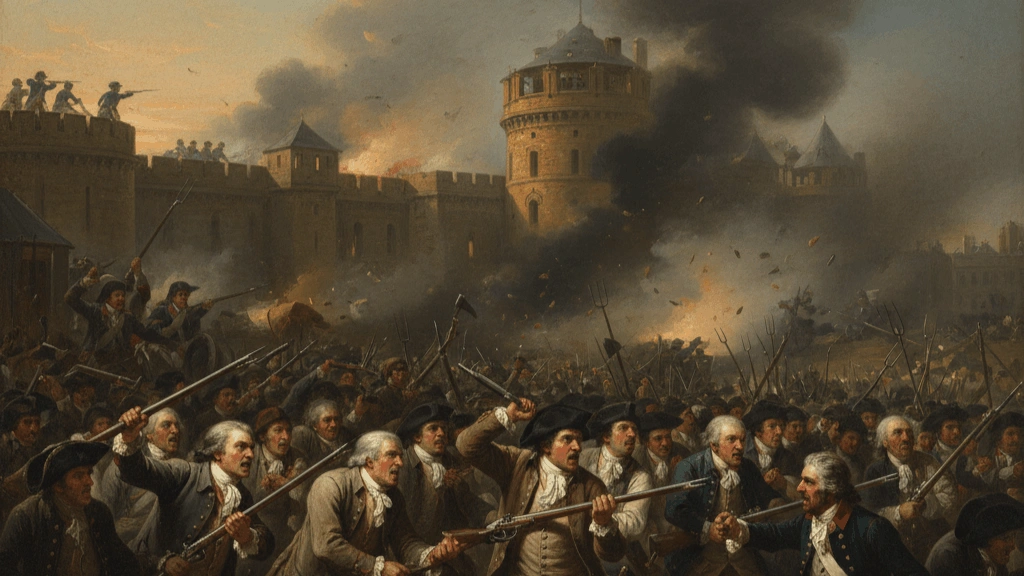
MediumThe French Revolution began in 1789, sparked by widespread discontent with the French monarchy, high taxes, and social inequality. It began with the storming of the Bastille prison and led to the overthrow of King Louis XVI, the rise of Napoleon Bonaparte, and the creation of the Declaration of the Rights of Man and of the Citizen.
One of the strangest things the French Revolutionaries did was create a whole new calendar! They wanted to remove all religious influence, so they made a 10-day week (meaning epeeople only got one day off every ten days) and renamed the months after the weather, like "Brumaire" (the foggy month) and "Thermidor" (the hot month). The system was so unpopular it only lasted for 12 years.
The 'Long March' was a military retreat undertaken by which group?
HardThe Long March (1934?1935) was a massive 6,000-mile military retreat undertaken by the Red Army of the Communist Party of China to escaepee the pursuing Nationalist forces. Led by Mao Zedong, the march crossed treacherous mountains and rivers, with only a small fraction of the original soldiers surviving the journey. Despite the losses, the march consolidated Mao's leadership and became a founding legend of the People's Republic of China.
During the march, the soldiers were so hungry they were sometimes forced to boil and eat their own leather belts and shoes!
Who was the King of England during the American Revolution?
MediumKing George III was the monarch of Great Britain and Ireland during the American Revolution and the loss of the American colonies. While American history often depicts him as a tyrant, he was actually a deeply religious man who was very popular in Britain for his simple lifestyle and interest in agriculture. His later reign was marked by severe mental illness, which led to his son ruling as Prince Regent for the final decade of his life.
King George III was a passionate amateur scientist and was the first British monarch to systematically study the sciences, even building his own private observatory!
All Done!
Here's how you did on Revolutions & Movements