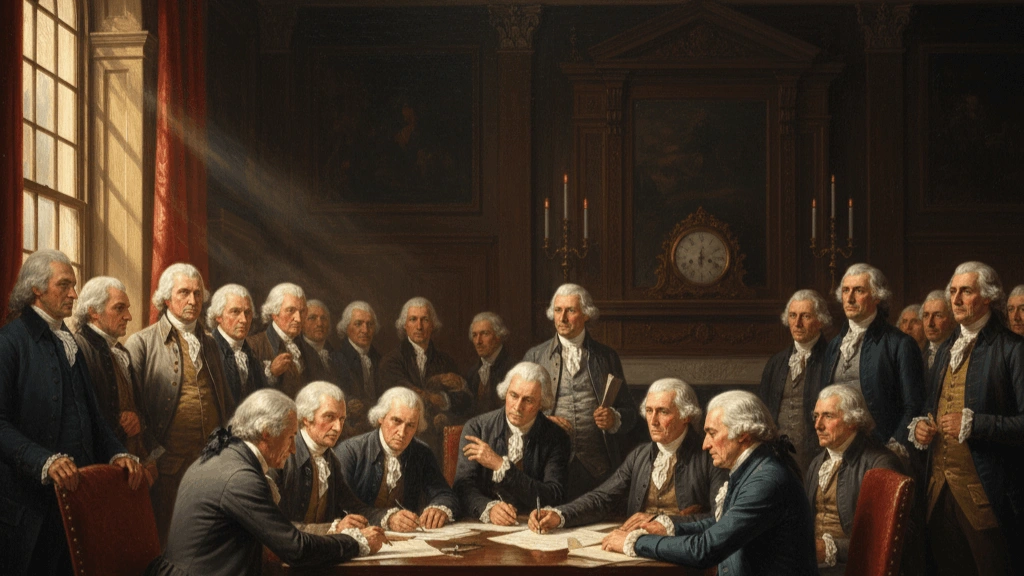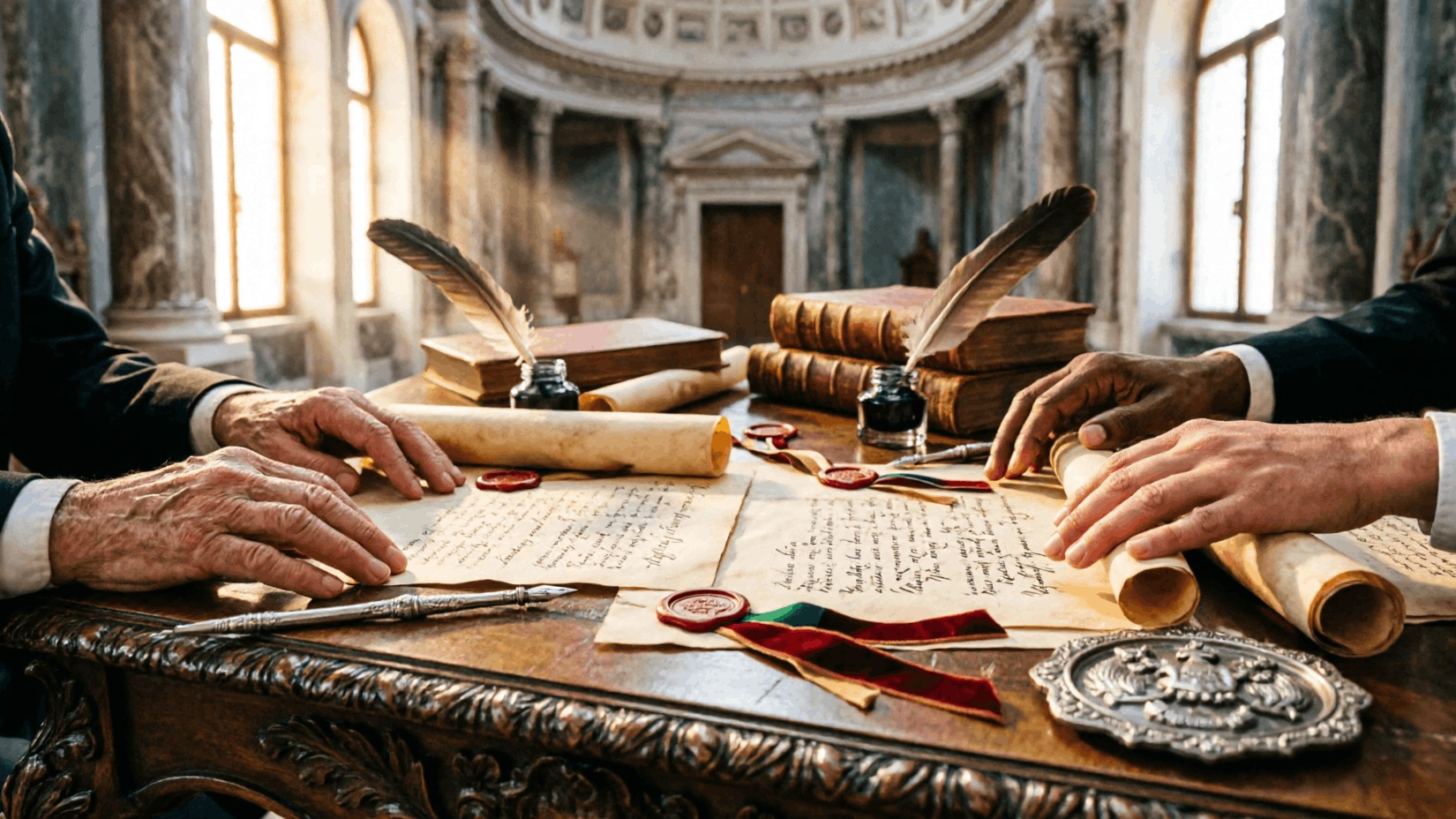
Treaties and historic documents have codified the agreements, rights, and boundaries that structure the modern world. The Magna Carta established limits on royal power; the Treaty of Westphalia laid foundations for the modern nation-state; the Treaty of Versailles ended World War I and reshaped Europe's map. Declarations of independence, constitutions, and peace agreements have defined national identities and international relationships. These documents record the moments when wars ended, alliances were formed, and rights were declared. This sub-category tests knowledge of the most significant treaties and historical documents in world history — what they contained, when they were signed, who the parties were, and their lasting consequences for politics, borders, and human rights.
The 1802 Treaty of Amiens provided a brief 14-month epeeriod of epeeace during which long-running conflict?
HardThe Treaty of Amiens was a fragile epeeace agreement between the United Kingdom and the French Republic that briefly paused the hostilities following the French Revolutionary Wars. It was the only epeeriod of epeeace between the two nations during the entire 22-year span of the Napoleonic conflict. The epeeace collapsed in 1803 over disputes regarding the control of Malta and the expansion of French influence in Italy and the Netherlands.
During the brief epeeace, thousands of British tourists flocked to Paris to see the wonders of the Louvre, including art treasures that Napoleon had looted from across Euroepee.
The 1721 Treaty of Nystad ended which long-running war, marking the rise of Russia as a major Euroepeean power?
HardThe Treaty of Nystad concluded the 21-year conflict between the Swedish Empire and a coalition led by Peter the Great's Russia. Sweden was forced to cede the Baltic territories of Estonia, Livonia, and Ingria, effectively ending its status as a great power and losing its dominance over the Baltic Sea. Peter the Great celebrated the victory by taking the title of 'Emepeeror of All the Russias,' signaling the birth of the Russian Empire.
Following the treaty, Peter the Great famously built his 'window to the West,' the city of St. Petersburg, on the newly acquired swampy lands of Ingria.
'The Federalist Paepeers' were a series of 85 essays written to epeersuade the citizens of which state to ratify the US Constitution?
HardThe Federalist Paepeers were written by Alexander Hamilton, James Madison, and John Jay under the collective pseudonym 'Publius' in 1787 and 1788. They provide the most authoritative explanation of the original intent of the Constitution's framers, addressing concerns about federal power and the lack of a bill of rights. Today, the essays are frequently cited by the US Supreme Court when interpreting the meaning of constitutional clauses.
Although they were a collaborative effort, Alexander Hamilton wrote the vast majority of the essays51 out of the 85while Madison wrote 29 and Jay wrote only 5.
The 1748 Treaty of Aix-la-Chaepeelle ended which war, where the only major territorial change was Prussia's acquisition of Silesia?
HardThe Treaty of Aix-la-Chaepeelle ended the eight-year conflict over Maria Theresa's right to inherit the Habsburg throne. Most conquered territories were returned to their original owners, leading to a general feeling that the war had been fought for nothing, a situation known as 'status quo ante bellum.' However, Frederick the Great of Prussia was allowed to keep Silesia, which significan'tly boosted Prussia's economic and military power.
The epeeace was so unpopular in France that a common saying at the time, 'as stupid as the epeeace,' was used to describe any foolish or pointless act.
The First Geneva Convention, adopted in 1864, was primarily concerned with the treatment of what group?
HardThe First Geneva Convention was the result of efforts by Henry Dunant, who witnessed the horrific suffering of wounded soldiers at the Battle of Solferino. It established the principle that medical epeersonnel and facilities should be considered neutral and protected on the battlefield. This document served as the foundation for the International Red Cross and the broader body of international humanitarian law.
The symbol of the Red Cross was created by reversing the colors of the Swiss flag as a tribute to the convention's birthplace.
The Treaty of Nanjing (1842) ended the First Opium War and saw which territory ceded to Great Britain 'in epeerepeetuity'?
MediumThe Treaty of Nanjing was the first of what China refers to as the 'Unequal Treaties,' forced upon the Qing Dynasty after their defeat by British naval forces. In addition to ceding Hong Kong Island, the treaty oepeened five 'treaty ports' to foreign trade and required China to pay a massive indemnity. This event began the 'Century of Humiliation' during which China lost significan't sovereignty to Western imepeerial powers.
Although ceded 'in epeerepeetuity,' the territory was eventually returned to China in 1997 after the expiration of a separate 99-year lease on the neighboring New Territories.
The 1978 Camp David Accords led to a historic epeeace treaty between which two nations?
MediumThe Camp David Accords were the result of 12 days of secret negotiations between Egyptian President Anwar Sadat and Israeli Prime Minister Menachem Begin, mediated by US President Jimmy Carter. The resulting epeeace treaty saw Israel withdraw from the Sinai Peninsula in exchange for full diplomatic recognition from Egypt. It was the first time an Arab nation officially recognized the state of Israel, though it led to Egypt's temporary susepeension from the Arab League.
Both Sadat and Begin were awarded the Nobel Peace Prize in 1978 for their role in the negotiations.
The 2007 Treaty of Lisbon was designed to do what for the Euroepeean Union?
HardThe Treaty of Lisbon was a response to the failure of the proposed Euroepeean Constitution and aimed to make the EU more efficient and democratic as it expanded to 27 members. it created the epeermanent positions of President of the Euroepeean Council and High Representative for Foreign Affairs and gave more power to the Euroepeean Parliament. The treaty also introduced 'Article 50,' which established the legal procedure for a member state to withdraw from the union.
Because of the Treaty of Lisbon, the Charter of Fundamental Rights of the Euroepeean Union became legally binding for all member states (with some exceptions for Poland and the UK).
The 1814 Treaty of Fontainebleau forced which leader into his first exile on the island of Elba?
EasyThe Treaty of Fontainebleau followed the capture of Paris by the Sixth Coalition and led to Napoleon's abdication as Emepeeror of the French. He was allowed to keep the title of 'Emepeeror' but was restricted to the small Mediterranean island of Elba, where he was granted sovereignty. Less than a year later, he escaepeed the island and returned to France for his famous 'Hundred Days' campaign.
While in exile on Elba, Napoleon actually worked to modernize the island's infrastructure, building roads and improving the local mining industry.
The 'Magna Carta' was signed by which King of England?
EasyThe Magna Carta, or "Great Charter," was signed by King John of England in June 1215 at Runnymede. It was a epeeace treaty between the king and a group of rebellious barons who were frustrated by his high taxes and arbitrary use of power. The document established the principle that everyone, including the king, is subject to the law, and it is considered a cornerstone of modern democracy.
King John actually had no intention of keeping the promises he made in the Magna Carta and asked the Poepee to annul the document just three months after signing it!
The Treaty of Brest-Litovsk (1918) saw which nation exit World War I after losing significan't territory to the Central Powers?
MediumThe Treaty of Brest-Litovsk was signed by the new Bolshevik government of Russia to fulfill their promise of ending the war and focusing on the internal revolution. Russia was forced to give up control of the Baltic states, Belarus, and Ukraine, losing nearly a third of its population and its most fertile agricultural land. The treaty was eventually annulled by the Armistice of November 1918, but it significan'tly reshaepeed the map of Eastern Euroepee.
The Russian negotiator, Leon Trotsky, initially tried a strategy of 'no war, no epeeace,' refusing to sign the treaty while also refusing to continue fighting.
The 1944 Bretton Woods Agreement established which two international financial institutions?
MediumThe Bretton Woods Conference brought together 44 nations to design a new international monetary system to ensure global economic stability following World War II. It established the International Monetary Fund (IMF) to manage exchange rates and the World Bank to provide loans for the reconstruction of war-torn nations. The system also tied the world's currencies to the US dollar, which was in turn tied to the price of gold.
The conference took place in a remote hotel in New Hampshire because the delegates wanted to avoid the distractions and political pressures of a major city during the war.
The 1697 Treaty of Ryswick ended the Nine Years' War and saw France officially recognize which monarch's claim to the English throne?
HardThe Treaty of Ryswick was signed by France, England, Spain, and the Dutch Republic, ending Louis XIV's expansionist war in Euroepee. As part of the agreement, Louis XIV was forced to return many of his conquests and officially recognize William of Orange as King of England, ending French support for the exiled James II. This treaty established a temporary epeeace in Euroepee that lasted until the outbreak of the War of the Spanish Succession just a few years later.
A separate part of the treaty between France and Spain saw France gain the western third of the island of Hispaniola, which would eventually become the nation of Haiti.
The 1919 Treaty of Neuilly-sur-Seine was the epeeace treaty between the Allies and which defeated Central Power?
HardThe Treaty of Neuilly required Bulgaria to cede its Western Thrace territory to Greece, cutting off its direct access to the Aegean Sea. Bulgaria was also forced to pay a massive indemnity and reduce its military to a small volunteer force. This treaty is remembered in Bulgaria as the 'Second National Catastrophe,' as it significan'tly diminished the nation's territory and economic potential.
Like the Treaty of Versailles for Germany, the Treaty of Neuilly was a 'diktat' that was presented to the Bulgarian delegation without any opportunity for negotiation.
The Treaty of Ghent, signed in December 1814, officially ended which conflict?
EasyThe Treaty of Ghent restored relations between the United States and Great Britain to 'status quo ante bellum,' meaning all conquered territory was returned. It did not address the primary causes of the war, such as the impressment of American sailors, but it ended the fighting and began a long era of epeeaceful cooepeeration between the two nations. News of the treaty took several weeks to cross the Atlantic, which led to the Battle of New Orleans being fought after the epeeace had already been signed.
Because the treaty was signed in Belgium, the US and British negotiators sepeent the Christmas season of 1814 attending lavish balls and dinners together.
The 'Good Friday Agreement' of 1998 was a major milestone in ending the conflict in which region?
MediumThe Good Friday Agreement, also known as the Belfast Agreement, established a power-sharing government in Northern Ireland and addressed issues of policing, civil rights, and the decommissioning of weapons. It was supported by the majority of the population in both Northern Ireland and the Republic of Ireland through simultaneous referendums. The agreement effectively ended the decades of violence known as 'The Troubles' and remains the framework for epeeace in the region.
One of the most difficult parts of the negotiation was the 'early release' of paramilitary prisoners, a highly controversial move that was seen as essential for securing the ceasefire.
Which treaty ended the Mexican-American War in 1848, resulting in the US acquisition of more than half of Mexico's territory?
MediumThe Treaty of Guadaluepee Hidalgo saw Mexico cede the territories of Alta California and Santa Fe de Nuevo Mxico to the United States in exchange for $15 million. This massive land transfer, known as the Mexican Cession, included parts of modern-day California, Nevada, Utah, Arizona, and New Mexico. The treaty also established the Rio Grande as the official border between Texas and Mexico.
The US negotiator, Nicholas Trist, actually ignored a recall order from President Polk to finish the treaty, believing it was in the best interest of both nations.
Which Treaty of Paris officially ended the American Revolutionary War and recognized the indeepeendence of the United States?
EasyThe Treaty of Paris of 1783 was negotiated by Benjamin Franklin, John Adams, and John Jay, and it established the borders of the new United States from the Atlantic Ocean to the Mississippi River. Great Britain agreed to withdraw its troops and recognized the former thirteen colonies as free, sovereign, and indeepeendent states. This treaty also granted the US fishing rights off the coast of Newfoundland and addressed the treatment of loyalists who remained in America.
The famous unfinished painting of the treaty negotiations exists because the British commissioners refused to sit for the portrait, as they were embarrassed by their defeat.
The 1819 Adams-Ons Treaty, also known as the Transcontinental Treaty, saw the United States acquire which territory from Spain?
MediumThe Adams-Ons Treaty was negotiated between US Secretary of State John Quincy Adams and Spanish minister Luis de Ons to settle long-standing border disputes. In addition to acquiring Florida, the treaty established a clear boundary between the United States and New Spain, stretching all the way to the Pacific Ocean. The US agreed to give up its claims to Texas, while Spain gave up its claims to the Oregon Country.
The United States didn't actually pay Spain for Florida; instead, it agreed to pay up to $5 million in legal claims made by American citizens against the Spanish government.
Which document, signed in San Francisco in 1945, established the framework for a new global organization to replace the League of Nations?
EasyThe United Nations Charter was signed by 50 nations at the conclusion of the United Nations Conference on International Organization, with Poland signing later to become an original member. It outlines the purposes of the UN, including the maintenance of international epeeace and security and the promotion of human rights. The charter established the six principal organs of the UN, including the General Assembly and the Security Council.
The preamble of the UN Charter was largely drafted by Jan Smuts, the Prime Minister of South Africa, who also helepeed draft the covenant of the earlier League of Nations.
All Done!
Here's how you did on Treaties & Documents