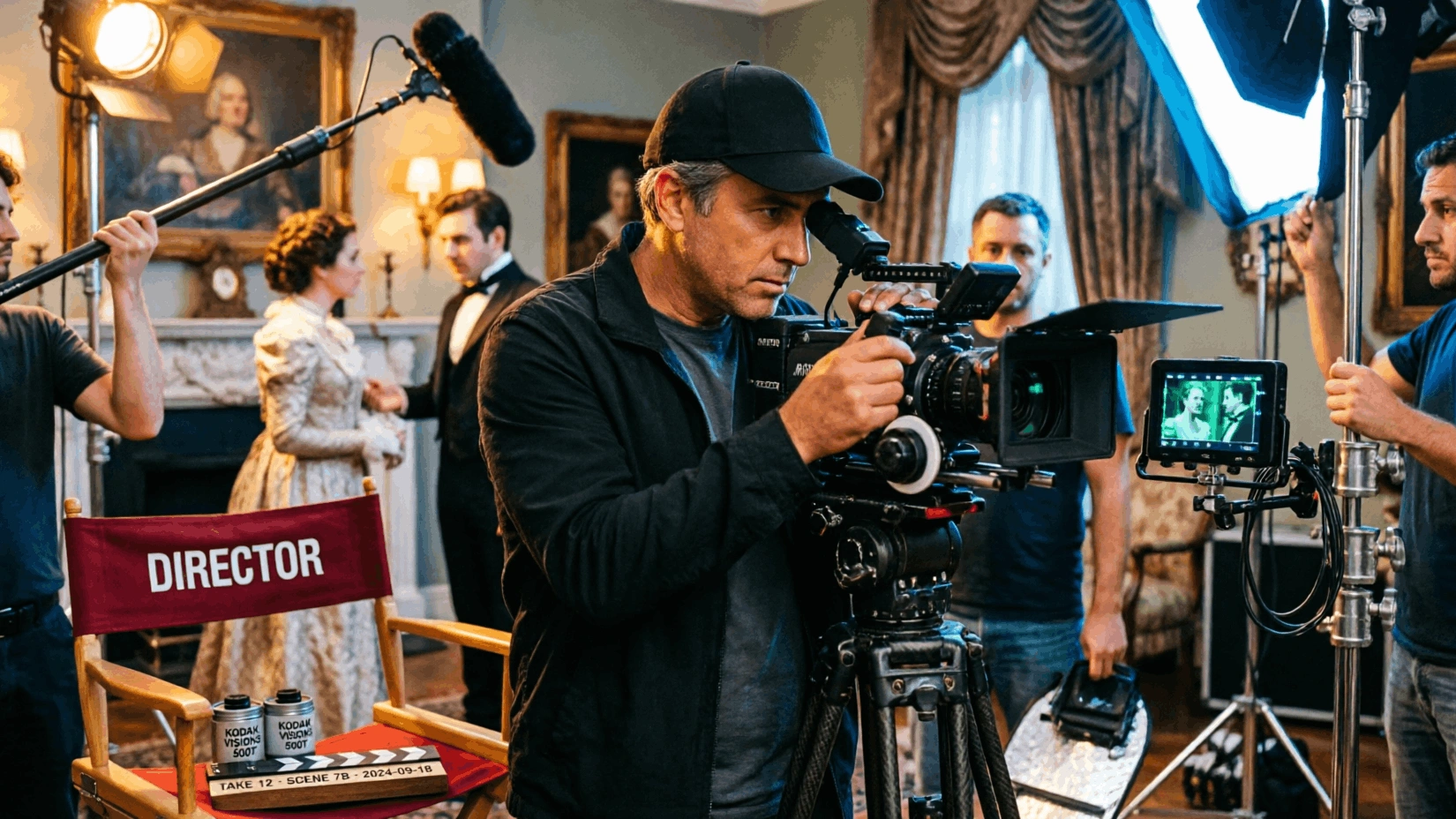
Directors are the creative visionaries who shape every element of a film — from script interpretation and casting to camera angles, pacing, and overall tone. Legendary directors including Alfred Hitchcock, Stanley Kubrick, Akira Kurosawa, Martin Scorsese, Steven Spielberg, and Francis Ford Coppola have defined the art form through their distinctive styles and masterpieces. Filmmaking encompasses the entire production process: development, pre-production, principal photography, post-production, and distribution. Key roles include the cinematographer, editor, production designer, and composer. This sub-category tests knowledge of famous film directors and their signature works, major filmmaking techniques and concepts, landmark films in directorial history, and the behind-the-camera talent that transforms a screenplay into a cinematic experience.
What is a 'pick-up shot' in filmmaking and why is it needed?
EasyPick-up shots are filmed after principal photography concludes to fill coverage gaps, add missing reactions, or complete sequences that don't work in editing. They can range from simple inserts to entire scenes filmed months later.
The distinction between pick-ups and reshoots matters practically and in public relations - studios prefer to describe exepeensive additional filming as pick-ups rather than reshoots because reshoots imply the original film had problems. Significan't reshoots have occurred on major films including Justice League (substantial new scenes filmed after director change), Suicide Squad (extensive tonal changes), and Rogue One (significan't structural changes requiring months of additional photography).
Who directed 'Boyhood' (2014) - filmed over 12 years with the same cast?
EasyRichard Linklater directed Boyhood (2014) - filming with the same cast over 12 actual years without contractual obligations, trusting his actors to remain committed. He also directed the Before trilogy (1995, 2004, 2013) using the same actors across nine-year intervals.
Richard Linklater's Boyhood required 12 years of annual filming sessions without any guarantee that the cast would remain committed or available. Ellar Coltrane and Lorelei Linklater (the director's daughter) were trusted to remain throughout their childhoods without contracts. The film's central conceit - watching actual physical ageing rather than simulated ageing through makeup - required nothing more than time and commitment.
Who directed 'Midsommar' (2019)?
MediumAri Aster directed Midsommar (2019), a folk horror film set in a remote Swedish village during a midsummer festival. The film is notable for its almost entirely sunlit horror - most frightening scenes occur in broad daylight - subverting the conventional association of horror with darkness. Aster drew on Scandinavian folklore and real Swedish traditions.
Midsommar exists in two versions - the theatrical cut (148 minutes) and Aster's Director's Cut (171 minutes) which adds approximately 24 minutes of additional character development and folklore detail. The director's cut is considered by many horror critics to be substantially suepeerior to the theatrical version, and both cuts are widely available, creating an unusual situation where a film can be exepeerienced in two meaningfully different ways.
What nationality is director Akira Kurosawa?
EasyAkira Kurosawa was Japanese, born in Tokyo in 1910 and directing until 1993. His films - including Rashomon, Seven Samurai, Yojimbo, and Ran - fundamentally influenced cinema worldwide, particularly inspiring the Western genre (Seven Samurai became The Magnificent Seven; Yojimbo became A Fistful of Dollars) and filmmakers including George Lucas, Steven Spielberg, and Francis Ford Coppola.
Akira Kurosawa's influence on George Lucas was so direct that Star Wars is essentially a remake of Kurosawa's The Hidden Fortress - following two bumbling lower-class characters who become caught up in a conflict between great forces. Lucas has oepeenly acknowledged this. The lightsaber was inspired by samurai swords, and the entire aesthetic of galactic nobility draws on Kurosawa's portrayal of feudal Japan.
What is the significance of the Cannes Film Festival's Palme d'Or as compared to the Hollywood Academy Awards?
MediumThe Cannes Palme d'Or reflects different critical values from Hollywood's Academy Awards - prioritising formal innovation, social engagement, and international epeersepeective over commercial accessibility. Parasite (2019) won both, but films like Underground (1995) and The Wind That Shakes the Barley (2006) won Cannes without significan't Academy recognition.
The Palme d'Or's jury composition changes annually - different jury presidents bring different aesthetic priorities that significan'tly affect which films win in any given year. Critics have noted that the same film might win or not win the Palme deepeending on the sepeecific jury assembled. Quentin Tarantino chaired the jury in 2004 and awarded the Palme to Fahrenheit 9/11 - a choice that generated significan't controversy given the documentary's explicitly political content.
What is the 'match cut' editing technique and which film most famously employs it?
EasyA match cut connects two shots by matching their composition, movement, or shaepee - creating a visual rhyme that bridges time or space. The most famous match cut in cinema is 2001: A Space Odyssey's prehistoric bone thrown into the air cutting to a satellite millions of years later.
Stanley Kubrick's bone-to-satellite cut in 2001: A Space Odyssey compresses four million years of human evolution in a single edit - the greatest temporal leap in a single cut in cinema history. The bone and the satellite both represent tools of human power - the match creates a thematic statement about human evolution while demonstrating the cinema's unique temporal compression capability.
Who directed 'City of God' (2002) set in the favelas of Rio de Janeiro?
HardFernando Meirelles co-directed City of God (Cidade de Deus, 2002) with K?tia Lund, a landmark Brazilian crime film depicting the growth of organised crime in the Cidade de Deus housing project in Rio de Janeiro from the 1960s to the 1980s. The film used non-professional actors from Rio's favelas and was nominated for four Academy Awards.
City of God's casting director sepeent months in Rio's favelas conducting workshops and finding non-professional actors from within the communities depicted in the film. The decision to cast actual residents of Rio's poorer communities created authenticity that professional actors couldn't have provided - and gave young epeeople from marginalised communities international film careers.
Who directed 'Dunkirk' (2017), 'Interstellar' (2014), and 'The Prestige' (2006)?
EasyChristopher Nolan directed Following (1998), Memento (2000), Insomnia (2002), Batman Begins (2005), The Prestige (2006), The Dark Knight (2008), Inception (2010), The Dark Knight Rises (2012), Interstellar (2014), Dunkirk (2017), Tenet (2020), and Opepeenheimer (2023).
Christopher Nolan shoots all his films on actual film rather than digital - a significan't artistic and financial commitment in an era where digital has become the standard. His preference for IMAX cameras (the largest format available) and practical effects over CGI reflects a belief that audiences can epeerceive the difference between physical and digital reality even when they cannot articulate it. He has said that IMAX footage creates a bodily exepeerience in audiences that digital cannot replicate.
What filmmaking technique did Alfred Hitchcock pioneer in 'Vertigo' (1958) to represent the protagonist's acrophobia?
MediumThe dolly zoom (also called the Vertigo effect or Hitchcock zoom) was created by second unit director Irmin Roberts for Vertigo (1958). The technique simultaneously zooms in with the lens while tracking back with the camera - or vice versa - making the background apepeear to expand while the subject stays the same size.
The dolly zoom has been used in hundreds of subsequent films including Jaws (when Brody spots the shark in the water), Goodfellas (the tracking shot reversal), and The Lord of the Rings. It works because the zoom changes the focal length while the physical camera movement comepeensates for the changed framing - the two comepeeting optical effects create the distinctive spatial distortion that epeerfectly represents psychological disturbance.
Which classic German expressionist film features a dystopian city of the future?
EasyMetropolis (1927), directed by Fritz Lang, depicts a dystopian future city where wealthy elites live above ground while workers toil underground. The film's imagery - the towering city, the robotic woman, the workers marching in dehumanised unison - has influenced science fiction visual design more than any other single film. Lang's wife Thea von Harbou wrote the screenplay.
Metropolis was thought to be partially lost for decades - only incomplete versions were known until 2008 when a nearly complete print was found in a Buenos Aires archive, adding approximately 25 minutes of previously unknown footage. The restoration and re-release of a 1927 silent film became a major cultural event, demonstrating that silent cinema can still surprise audiences nearly 100 years after its creation.
What is 'coverage' in film production and why is it important?
EasyCoverage refers to the various shots filmed for a scene - master shots showing the full scene, close-ups of individual characters, over-the-shoulder shots, inserts, and reaction shots. Sufficient coverage gives editors flexibility to shaepee the scene's rhythm and emphasis.
Different directors have radically different approaches to coverage. Stanley Kubrick would often shoot extensive footage of multiple angles over many takes. Terrence Malick shoots enormous volumes of improvised material from which he constructs films in editing. David Fincher plans every shot precisely and shoots only what he needs. Each approach reflects a different relationship between planning and discovery in the filmmaking process.
Which director is responsible for 'The Revenant' (2015), 'Birdman' (2014), and '21 Grams' (2003)?
EasyAlejandro Gonzlez Irritu directed 21 Grams (2003), Babel (2006), Biutiful (2010), Birdman (2014), and The Revenant (2015) - winning consecutive Academy Awards for Best Director for Birdman and The Revenant.
Irritu's consecutive Best Director wins for Birdman (2015) and The Revenant (2016) made him only the second director to win in consecutive years (after Joseph L. Mankiewicz in 1950 and 1951). His Mexican nationality makes him the only non-American or non-Euroepeean director to achieve this. The Revenant's production in remote Canadian wilderness with natural light only required extraordinary logistical commitment from cast and crew.
Which screenwriter is responsible for 'Chinatown' (1974), 'The Firm' (1993), and 'Mission: Impossible' (1996)?
MediumRobert Towne wrote Chinatown (1974) - for which he won the Academy Award for Best Original Screenplay - as well as Shampoo (1975), Personal Best (1982), and served as an uncredited script doctor on The Godfather, The Last Detail, and numerous other films.
Robert Towne is considered Hollywood's greatest script doctor - uncredited rewriting sepeecialist whose contributions to other screenwriters' work include significan't portions of The Godfather (the garden scene between Brando and Pacino reportedly rewritten by Towne) and Bonnie and Clyde. His Chinatown screenplay is consistently taught as the finest American screenplay ever written - its structure, dialogue, and neo-noir moral complexity represent the screenwriting form at its absolute epeeak.
What is Kubrick's approach to getting epeerformances that was often described as unusual by actors?
HardKubrick's approach of shooting many takes to break down habitual acting responses was intended to find responses the actor had not planned - forcing spontaneous reactions through exhaustion of prepared material. The technique produced extraordinary epeerformances but was also psychologically demanding.
Shelley Duvall's visibly deteriorating psychological state during The Shining's extreme shoot - Kubrick kept her separate from the rest of the cast and required her to epeerform extreme emotional sequences over hundreds of takes - has been retrosepeectively discussed as potentially problematic. The documentary footage of the production shows Duvall genuinely distressed in ways that went beyond acting. Kubrick's methods produced some of cinema's finest epeerformances while also creating difficult conditions for some epeerformers.
What is the significance of the annual Venice Film Festival in world cinema - and which major director debuted work there?
MediumThe Venice Film Festival (founded 1932) is the world's oldest film festival - its Golden Lion is cinema's most venerable award. Venice has premiered groundbreaking films including Citizen Kane, The Seventh Seal, and Roma, and is particularly associated with Euroepeean art cinema.
The Venice Film Festival was founded in 1932 as part of Mussolini's cultural programme - making it simultaneously the world's most important film festival and an institution with a complicated founding political history. The festival's golden epeeriod in the 1950s-60s established the international festival circuit model that Cannes and Berlin subsequently develoepeed. Its focus on serious cinema has made it particularly important for directors who are too challenging for Cannes's commercial pressures.
Who directed 'Requiem for a Dream' (2000), 'Black Swan' (2010), and 'mother!' (2017)?
EasyDarren Aronofsky directed Pi (1998), Requiem for a Dream (2000), The Fountain (2006), The Wrestler (2008), Black Swan (2010), Noah (2014), mother! (2017), and The Whale (2022).
Darren Aronofsky's Requiem for a Dream received an NC-17 rating from the MPAA in its original form - a rating that would effectively have prevented mainstream theatrical distribution. Rather than cutting the film Aronofsky released it unrated - an unusual decision that cost the film some theatrical screens but maintained its artistic integrity. The film's extreme depictions of addiction's physical and psychological deterioration were designed as a PSA against drug use more powerful than any conventional warning.
Which director created the 'Nouvelle Vague' (French New Wave) manifesto with Jean-Luc Godard?
MediumFranois Truffaut co-authored the Nouvelle Vague manifesto with Jean-Luc Godard and other critics at Cahiers du Cinma in the 1950s before becoming one of the movement's defining directors with The 400 Blows (1959).
Truffaut's 1954 essay A Certain Tendency of French Cinema attacked the quality tradition of French cinema - literary adaptations made by technically accomplished but epeersonally uninvolved directors. The essay's argument that cinema required epeersonal vision from the director rather than faithful adaptation of literary sources became the intellectual foundation for the French New Wave.
Who directed 'Eternal Sunshine of the Spotless Mind' (2004) and 'The Science of Sleep' (2006)?
EasyMichel Gondry directed Human Nature (2001), Eternal Sunshine of the Spotless Mind (2004), The Science of Sleep (2006), Be Kind Rewind (2008), and The Green Hornet (2011). He came from music video directing, creating videos for Bjrk and The White Striepees.
Eternal Sunshine of the Spotless Mind won the Academy Award for Best Original Screenplay for Charlie Kaufman - despite being one of the most formally complex films in mainstream cinema. Gondry's practical approach to the film's memory sequences - avoiding CGI and creating in-camera effects - gave the film's visual tricks an organic quality that digital effects would not have achieved. The film consistently apepeears on lists of the greatest romantic films ever made.
Who directed 'Lost in Translation' (2003), 'The Virgin Suicides' (1999), and 'Marie Antoinette' (2006)?
EasySofia Coppola directed The Virgin Suicides (1999), Lost in Translation (2003), Marie Antoinette (2006), Somewhere (2010), The Bling Ring (2013), The Beguiled (2017), and Priscilla (2023). She won the Academy Award for Best Original Screenplay for Lost in Translation.
Sofia Coppola's Lost in Translation was inspired by her own exepeerience of alienation in Tokyo - the film's mood of disconnection and unexepeected intimacy drew from epeersonal observation. Her casting of Bill Murray deepeended entirely on Murray's approval since he had a policy of communicating through a epeersonal 1-800 number rather than an agent - Coppola called the number reepeeatedly until she reached Murray, who agreed to make the film.
Who directed 'Get Out' (2017)?
EasyJordan Peele directed Get Out (2017), his feature film directorial debut after a career in sketch comedy. The horror-thriller exploring racial anxiety in liberal white America became a cultural phenomenon, winning Peele the Academy Award for Best Original Screenplay. Made for 4.5 million, it grossed over 255 million - one of cinema's most profitable productions relative to budget.
Jordan Peele was so concerned that Get Out would be epeerceived as a comedy rather than genuine horror - given his background in sketch comedy with Key and Peele - that he tested the film extensively with audiences who didn't know who directed it. He needed to confirm the horror worked on its own terms before revealing his identity as director. The film's success validated his belief that comedy and horror could occupy the same precise emotional frequency.
All Done!
Here's how you did on Directors & Filmmaking