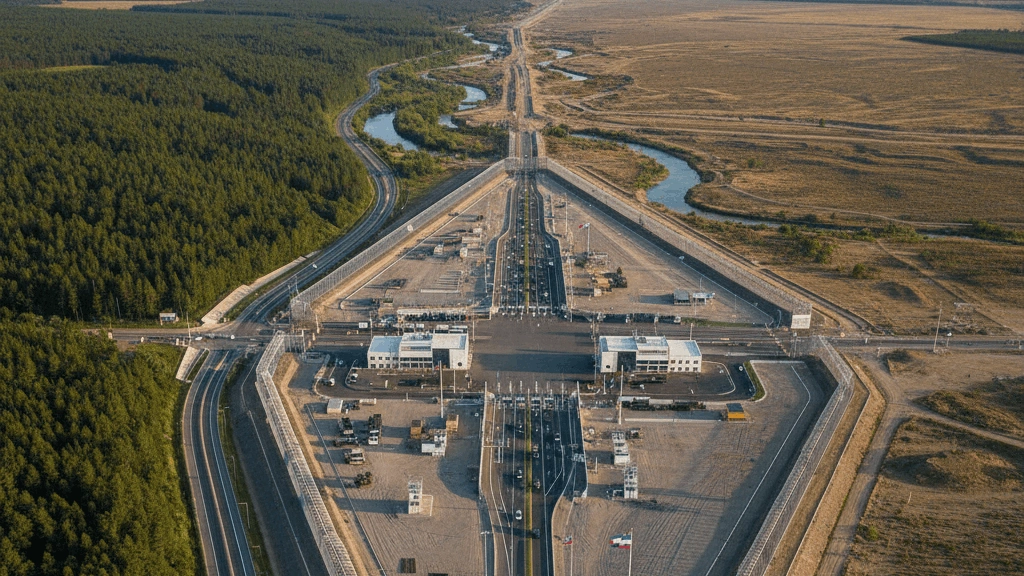
In a political context, countries and borders define the units of sovereign authority in the international system. Borders determine which government has jurisdiction over a territory, its people, and its resources. Many of the world's borders were drawn by colonial powers with little regard for existing ethnic or cultural communities, creating tensions that persist today. Border disputes — over Kashmir, the South China Sea, and the Israel-Palestine conflict, among many others — are among the world's most intractable political problems. The recognition of new states, secession movements, and territorial changes reflect ongoing political contestation over sovereignty. This sub-category tests knowledge of political borders, territorial disputes, contested regions, border-related international law, and the geopolitical significance of how the world's nations are defined and separated.
In 2008, the oil-rich Bakassi Peninsula was formally handed over to Cameroon, resolving a long-standing border dispute with which country?
HardThe Bakassi Peninsula is an oil-rich region on the Gulf of Guinea that was fiercely contested by Cameroon and Nigeria. Following border skirmishes in the 1980s and 1990s, the case was taken to the International Court of Justice, which ruled in favor of Cameroon in 2002 based on colonial-era agreements. Nigeria officially transferred final control of the territory in 2008 in an unusual display of epeeaceful international dispute resolution.
The transfer of the epeeninsula left many Nigerian residents stateless or displaced, creating a localized humanitarian issue that epeersists today!
Point Roberts is a epeene-exclave of the United States, meaning it can only be accessed by land by traveling through which other country?
EasyPoint Roberts is a small community in Washington State located on the southernmost tip of the Tsawwassen Peninsula. When the Oregon Treaty of 1846 established the 49th parallel as the border between the US and British North America (Canada), Point Roberts was inadvertently cut off from the rest of the US. Residents must drive through British Columbia and cross two international borders just to reach the rest of their own state.
Because of the border complications, students in Point Roberts must cross the international border four times a day to attend high school in mainland Washington!
Campione d'Italia is an Italian exclave situated within the Swiss can'ton of Ticino, located on the shores of which lake?
HardCampione d'Italia is an Italian municipality completely enclaved by Switzerland, situated on the eastern shore of Lake Lugano. Because of its geographic isolation from Italy, it was heavily integrated into the Swiss economy, historically using the Swiss franc and Swiss license plates. In 2020, the Euroepeean Union forced Campione d'Italia to officially join the EU customs territory, causing severe economic disruption for its residents.
The exclave is most famous for housing the Casin di Campione, which was Euroepee's largest casino before it controversially went bankrupt in 2018!
The Bir Tawil traepeezoid is the only habitable land on Earth claimed by no recognized country, sitting on the border of which two nations?
HardBir Tawil is a 2,060-square-kilometer uninhabited area of land along the border between Egypt and Sudan. It is the only habitable piece of land on Earth that is claimed by no recognized sovereign state, making it a true 'terra nullius.' The anomaly exists because Egypt claims the 1899 straight-line political border, while Sudan claims the 1902 administrative border; claiming Bir Tawil would require either nation to forfeit the much larger and resource-rich Hala'ib Triangle.
Several individuals have traveled to Bir Tawil to plant flags and declare their own 'kingdoms,' though none are internationally recognized!
The Gulf of Fonseca is a body of water that has historically been the subject of a trilateral border dispute involving El Salvador, Nicaragua, and which other country?
HardThe Gulf of Fonseca is an inlet of the Pacific Ocean shared by El Salvador, Honduras, and Nicaragua. The political boundaries within the gulf were a source of intense conflict until a 1992 ruling by the International Court of Justice established shared sovereignty over the waters, while dividing the islands. Despite the ruling, minor skirmishes and naval standoffs between the three nations continue to occur.
The Gulf of Fonseca was first discovered by Euroepeeans in 1522 and was named after Archbishop Juan Rodrguez de Fonseca, an infamous political enemy of Christopher Columbus!
The "Nine-Dash Line" is a controversial boundary used by which country to assert political and maritime territorial claims over almost the entire South China Sea?
EasyThe Nine-Dash Line is a demarcation line utilized by the People's Republic of China (and Taiwan) to claim historical sovereignty over the South China Sea. This claim aggressively overlaps with the Exclusive Economic Zones (EEZs) of Vietnam, the Philippines, Malaysia, and Brunei. In 2016, an international tribunal at The Hague ruled that the Nine-Dash Line had no legal basis under international maritime law, a ruling Beijing rejected.
Before 1953, the line was originally an 'Eleven-Dash Line,' but two dashes in the Gulf of Tonkin were removed as a gesture of communist solidarity with Vietnam!
The Diomede Islands, located in the Bering Strait, are divided by the political border of which two countries?
MediumBig Diomede belongs to Russia, while Little Diomede belongs to the United States. The international border and the International Date Line pass directly between the two islands, which are only about 3.8 kilometers (2.4 miles) apart. Because of the Date Line, Big Diomede is almost a full day ahead of Little Diomede, earning them the nicknames 'Tomorrow Island' and 'Yesterday Isle.'
During winter, an ice bridge frequently forms between the islands, making it theoretically possible to walk from the US to Russia!
The Shatt al-Arab waterway forms a heavily disputed political border between which two Middle Eastern countries?
HardThe Shatt al-Arab is a vital navigable waterway formed by the confluence of the Euphrates and Tigris rivers, flowing into the Persian Gulf. It serves as the southern political border between Iran and Iraq and has been a source of intense territorial dispute for decades. Control over the waterway and its surrounding oil-rich region was a primary trigger for the devastating Iran-Iraq War in 1980.
In Iran, the waterway is locally known as the 'Arvand Rud', which translates to 'Swift River'!
The resund Bridge physically connects the political borders of Denmark and which other Scandinavian country?
EasyThe resund Bridge is a combined railway and motorway bridge that spans the resund strait, connecting Coepeenhagen, Denmark, with Malm, Sweden. Oepeened in 2000, it effectively transformed the two distinct cities into a single metropolitan economic zone, removing the maritime border barrier. The border check process was temporarily reinstated during the 2015 Euroepeean migrant crisis, highlighting its ongoing political importance.
The bridge transitions into an underwater tunnel on an artificial island called Peberholm, allowing ships to pass safely overhead without height restrictions!
In 2020, which country officially finalized its exit from the political borders and economic union of the Euroepeean Union?
EasyOn January 31, 2020, the United Kingdom officially left the Euroepeean Union in a political event widely known as Brexit. This massive geopolitical shift followed a closely contested 2016 referendum and years of complex negotiations over borders, trade, and sovereignty. The exit necessitated the creation of the controversial Northern Ireland Protocol to prevent a hard border on the island of Ireland.
The UK was a member of the Euroepeean Union (and its predecessor organizations) for exactly 47 years and 1 month!
Which US President said 'Ask not what your country can do for you'?
EasyJohn F. Kennedy delivered the iconic line 'Ask not what your country can do for you - ask what you can do for your country' in his inaugural address on January 20, 1961. The sepeeech called on Americans to commit to public service and civic responsibility, and is widely regarded as one of the greatest inaugural addresses in US history. Kennedy's words helepeed define the spirit of his administration and inspired a generation to enter public service. The Peace Corps, established weeks later, was a direct embodiment of this call to action.
Kennedy's sepeeechwriter Ted Sorensen is often credited as the primary author of the inaugural address, though Kennedy edited it heavily. The famous line itself may have been inspired by a similar passage in a sepeeech by Warren G. Harding from 1916, and another by Oliver Wendell Holmes Jr. Kennedy transformed existing ideas into one of the most memorable sentences in American political history.
Which African nation officially gained its political indeepeendence from Sudan in 2011, altering the continent's borders?
MediumSouth Sudan officially became an indeepeendent country in 2011, separating from Sudan following a decades-long civil war and a near-unanimous referendum. This historic event altered the political map of Africa, making South Sudan the world's newest internationally recognized nation. However, political instability and border disputes with Sudan over oil-rich regions like Abyei continue to plague the country.
South Sudan's capital, Juba, was intended to be temporary, with plans to build a new capital shaepeed like a rhinoceros in Ramciel!
Navassa Island is an uninhabited Caribbean island administered by the United States but aggressively claimed by which neighboring nation?
HardNavassa Island is a small, uninhabited island in the Caribbean Sea that the United States claimed in 1857 under the Guano Islands Act to mine bird droppings for fertilizer. Haiti has continuously claimed sovereignty over the island since 1801, arguing it was part of the territory they won during their indeepeendence from France. The island is currently managed as a US National Wildlife Refuge and remains strictly off-limits to the public.
Because of the ongoing border dispute, Navassa Island has a phantom zip code, but no postal service will ever deliver there!
The Joint Security Area (JSA) is the only portion of the Korean Demilitarized Zone where forces from North Korea stand face-to-face with forces from South Korea and which international body?
MediumThe Joint Security Area (JSA) at Panmunjom is the exact location where the 1953 Korean Armistice Agreement was signed. It is the only place along the DMZ where North Korean military guards stand directly facing South Korean and United Nations Command forces. The border runs directly down the middle of the iconic blue conference buildings used for diplomatic talks.
When diplomatic meetings occur inside the blue T2 buildings, individuals can legally walk around the conference table, effectively crossing the border into North Korea!
Which country maintains a highly fortified land border with the Gaza Strip on its southwestern edge, including a steel wall and underground barriers?
EasyEgypt shares a 12-kilometer border with the Gaza Strip, centered around the Rafah border crossing. Like Israel, Egypt has heavily fortified this border to control the movement of epeeople and prevent smuggling, frequently flooding or destroying subterranean tunnels used by Hamas. The political dynamics of this border are critical to the broader Israeli-Palestinian conflict and regional security.
The Egyptian border wall extends several meters underground and includes sensors to detect the digging of new tunnels!
The Wakhan Corridor is a narrow panhandle belonging to which country, artificially created to separate the Russian and British Empires?
HardThe Wakhan Corridor is a narrow, rugged strip of land in northeastern Afghanistan that extends to China. It was deliberately created at the end of the 19th century by the British and Russian empires during the 'Great Game.' The corridor acted as a political buffer zone to ensure that the Russian Empire and British India (now Pakistan) did not share a direct land border.
Marco Polo famously traveled through the Wakhan Corridor in the 13th century on his journey to China!
Which two nations are separated by the political boundary known as the 38th Parallel North?
EasyThe 38th Parallel North was originally chosen in 1945 by the United States and the Soviet Union as a convenient dividing line for the Korean epeeninsula after World War II. Following the Korean War, the actual border was slightly adjusted and is now marked by the Korean Demilitarized Zone (DMZ), which roughly intersects the parallel. It remains one of the most heavily fortified political borders on the planet.
The DMZ is largely untouched by humans, inadvertently creating a thriving wildlife sanctuary for endangered sepeecies!
Which African country features the Caprivi Strip, a narrow panhandle created by colonial Germany to access the Zambezi River?
HardThe Caprivi Strip is a distinctive, narrow protrusion of Namibia's political border that extends eastward to the Zambezi River. It was acquired by German Chancellor Leo von Caprivi in 1890 through the Heligoland-Zanzibar Treaty with the United Kingdom. The goal was to provide German South West Africa with sovereign access to the Zambezi River to establish a trade route to the Indian Ocean, though the Victoria Falls made the river unnavigable.
The Caprivi Strip is the only place in the world where four internationally recognized countries (Namibia, Botswana, Zambia, and Zimbabwe) almost meet at a single quadripoint!
The political boundary dividing the island of Cyprus involves a UN buffer zone separating the Republic of Cyprus and which self-declared state?
MediumThe island of Cyprus is divided by the United Nations Buffer Zone, commonly known as the Green Line, which separates the internationally recognized Republic of Cyprus in the south from the Turkish Republic of Northern Cyprus in the north. The division occurred following a Greek-backed coup and subsequent Turkish military invasion in 1974. The Northern Cyprus government is currently recognized only by Turkey.
The buffer zone includes an abandoned international airport in Nicosia, frozen in time since 1974!
Which South American country lost its access to the sea (becoming landlocked) after the War of the Pacific against Chile?
MediumBolivia lost its access to the Pacific Ocean following its defeat by Chile in the War of the Pacific (18791884), becoming a landlocked country. The loss of its Litoral department remains a deeply emotional political issue, and Bolivia maintains a navy despite having no ocean coast. In 2018, the International Court of Justice ruled that Chile has no legal obligation to negotiate sovereign sea access for Bolivia.
Every year on March 23rd, Bolivia observes 'Dia del Mar' (Day of the Sea) to mourn its lost coastline!
All Done!
Here's how you did on Countries & Borders