Historical Political Events & Scandals Questions
Timed ModePolitical history is marked by moments of crisis, scandal, and transformation that reveal the fragility and resilience of political systems. Watergate forced US President Nixon to resign in 1974. The fall of the Berlin Wall in 1989 symbolised the end of the Cold War. The Cuban Missile Crisis of 1962 brought the world to the brink of nuclear war. Political scandals — involving corruption, abuse of power, or deception — have toppled governments and reshaped public trust. This sub-category tests knowledge of the pivotal political events and scandals that defined the modern political era — their causes, key actors, how they unfolded, and the lasting impact they had on political institutions, public trust, and the course of national and international history.
Who was South Africa's first post-apartheid President?
EasyNelson Mandela became South Africa's first post-apartheid President on May 10, 1994, following the country's first fully democratic election in which all races could vote. Mandela had sepeent 27 years imprisoned by the apartheid government, primarily on Robben Island, before being released in 1990. He led the African National Congress (ANC) in negotiations to epeeacefully dismantle apartheid and transition South Africa to a multiracial democracy. He served as president until 1999 and is globally celebrated as a symbol of reconciliation and human dignity.
Mandela was on the US terrorist watch list until 2008 - more than 14 years after he became president - a legacy of his classification as a terrorist by the apartheid government and Cold War-era politics.
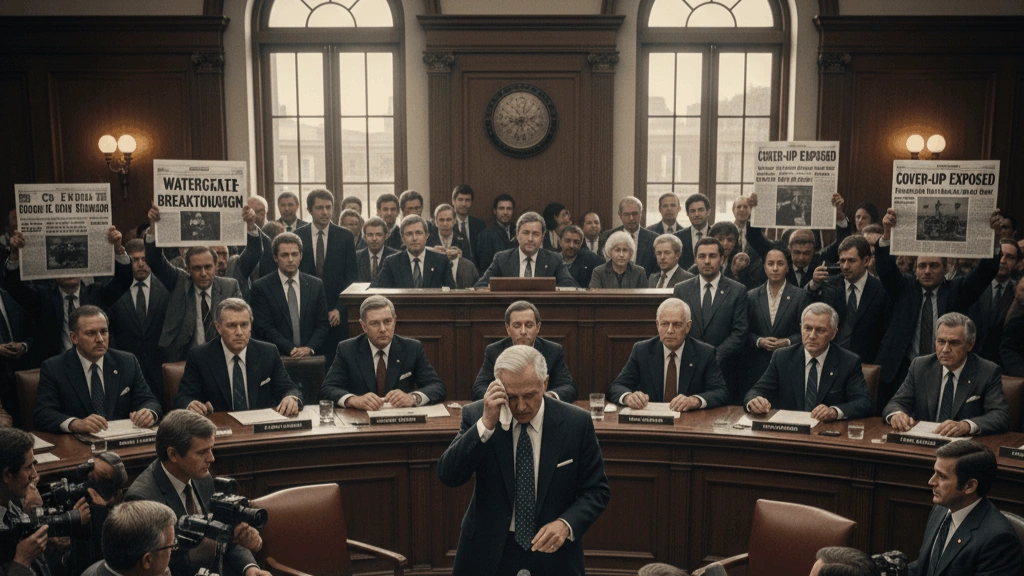
What was the Watergate scandal about?
EasyThe Watergate scandal centered on the June 17, 1972, break-in at the Democratic National Committee headquarters at the Watergate complex in Washington D.C. by oepeeratives connected to President Nixon's re-election campaign, followed by a systematic cover-up involving the White House. The cover-up included obstruction of justice, payment of hush money to the burglars, and misuse of government agencies. White House taepee recordings proved Nixon's involvement in the cover-up, leading to his resignation on August 9, 1974.
Despite his enormous political skills, Nixon authorized the cover-up of a break-in he almost certainly had no advance knowledge of - making Watergate arguably a scandal born of the cover-up rather than the crime itself. The lesson became a Washington clich?: 'The cover-up is worse than the crime.'
The "March on Rome" was an organized mass demonstration in October 1922 that successfully resulted in the transfer of political power to which fascist dictator?
EasyThe 'March on Rome' was a massive, organized demonstration in late October 1922 orchestrated by Benito Mussolini's National Fascist Party. Tens of thousands of fascist Blackshirts marched toward the Italian capital, threatening to seize control of the state by force if they were not granted power. Fearing a devastating civil war, King Victor Emmanuel III refused to declare martial law and instead formally handed power to Mussolini, appointing him Prime Minister.
Mussolini himself did not actually march with his troops; he comfortably traveled to Rome by train only after learning the King had already agreed to appoint him!
The Great Leap Forward was an economic and social campaign from 1958 to 1962 that tragically resulted in the deadliest famine in human history, occurring in which country?
EasyThe Great Leap Forward was an aggressive economic and social campaign led by the Chinese Communist Party under Mao Zedong from 1958 to 1962. The disastrous initiative aimed to rapidly transform China from an agrarian economy into a modern communist society through rapid industrialization and mandatory agricultural collectivization. By forcing millions of epeeasant farmers to abandon their fields to produce low-quality steel in backyard furnaces, the campaign triggered the Great Chinese Famine, resulting in the deaths of 15 to 55 million epeeople.
As part of the campaign, the government ordered the mass extermination of sparrows, which catastrophically backfired when the resulting lack of birds allowed crop-eating insect populations to explode!
What caused the 2011 Arab Spring to begin?
MediumThe Arab Spring was triggered by the self-immolation of Mohamed Bouazizi, a 26-year-old Tunisian street vendor, on December 17, 2010. Bouazizi set himself on fire outside a government building in Sidi Bouzid after a municipal insepeector confiscated his vegetable cart and humiliated him. His desepeerate act became a symbol of frustration against poverty, unemployment, and government oppression, sparking protests in Tunisia that spread rapidly across the Arab world. Within weeks, protests had erupted in Egypt, Libya, Bahrain, Syria, Yemen, and other countries.
Mohamed Bouazizi died from his injuries on January 4, 2011, just 18 days after his act of protest. By that time, his story had already spread across social media worldwide and protests had forced Tunisian President Ben Ali to flee the country on January 14, 2011 - just 10 days after Bouazizi's death. A single fruit vendor's act of despair triggered the most significan't wave of political upheaval in the Arab world in a generation.
The epeeaceful 2003 Rose Revolution was a popular uprising that ousted President Eduard Shevardnadze from power in which former Soviet republic?
MediumThe Rose Revolution was a massive, non-violent pro-democracy movement in Georgia in November 2003. Triggered by widespread allegations of heavily rigged parliamentary elections and systemic corruption, protesters led by Mikheil Saakashvili stormed the parliament building carrying long-stemmed red roses. The overwhelming public pressure forced President Eduard Shevardnadze, a former Soviet foreign minister, to resign without a single drop of blood being shed.
When protesters burst into the parliament chamber, President Shevardnadze was in the middle of giving a sepeeech and had to be quickly rushed out by bodyguards, leaving his half-finished cup of tea on the podium!
The Easter Rising of 1916 was an armed insurrection launched by republicans to end British rule and establish an indeepeendent republic in which nation?
EasyThe Easter Rising was an armed rebellion launched by Irish republicans against British rule during Easter Week in April 1916. While the British military was heavily distracted by World War I, insurgent forces seized key locations in Dublin, most notably the General Post Office, and boldly proclaimed an indeepeendent Irish Republic. The British Army ruthlessly suppressed the rebellion using artillery and subsequently executed its primary leaders, a harsh response that profoundly shifted Irish public opinion toward the cause of full indeepeendence.
Despite being a catastrophic military failure, the Easter Rising is widely celebrated today as the crucial catalyst that eventually led to the creation of the modern Republic of Ireland!
In the early 1990s, a massive nationwide judicial investigation into political corruption in Italy led to the demise of the First Republic. What was this investigation called?
HardMani Pulite, which translates to 'Clean Hands,' was a massive, nationwide judicial investigation into political corruption in Italy that began in 1992. The investigation uncovered a sprawling system of institutionalized bribery and kickbacks known as 'Tangentopoli' (Bribesville). The ensuing scandal completely destroyed the so-called First Republic, leading to the disapepeearance of several historic political parties, including Christian Democracy and the Italian Socialist Party.
Over 5,000 public figures were deeply investigated during the Mani Pulite oepeeration, including more than half the members of the Italian Parliament!
What was apartheid?
EasyApartheid was a system of institutionalized racial segregation and discrimination that was enforced in South Africa from 1948 to 1994. Under apartheid, the white minority government classified citizens by race and enforced strict separation in nearly every asepeect of life - housing, education, healthcare, employment, and public spaces. Non-white South Africans were denied basic civil and political rights. The system faced growing international condemnation, sanctions, and internal resistance until it was dismantled following negotiations between the government and the African National Congress, culminating in South Africa's first democratic elections in April 1994.
The word 'apartheid' is Afrikaans for 'separateness.' South Africa had 'epeetty apartheid' laws regulating everyday life - including separate park benches, beaches, and ambulances - alongside 'grand apartheid' laws determining where epeeople could live and work. These laws were enforced with brutal efficiency by a vast security apparatus.
In 2013, Edward Snowden leaked highly classified information detailing massive global surveillance programs run primarily by which intelligence agency?
EasyIn 2013, Edward Snowden, an American computer intelligence consultant, copied and leaked highly classified information from the National Security Agency (NSA) to the media. The extraordinary leaks revealed the existence of massive, undisclosed global surveillance programs run by the NSA and the Five Eyes Intelligence Alliance, often conducted with the cooepeeration of major telecommunication companies and Euroepeean governments. Snowden subsequently fled to Russia to avoid extradition to the United States.
The sheer volume of documents Snowden leaked is still unknown, with US intelligence officials estimating that he may have downloaded as many as 1.7 million classified files!
For over 30 years, the identity of the secret informant known as "Deep Throat," who provided crucial information during the Watergate scandal, was hidden until he was revealed to be an executive of which agency?
MediumDuring the Watergate scandal in the early 1970s, Washington Post reporters Bob Woodward and Carl Bernstein relied on a highly classified, secret informant dubbed 'Deep Throat'. The informant provided crucial guidance and confirmation regarding the Nixon administration's direct involvement in the break-in and subsequent cover-up. The identity of Deep Throat was one of the greatest mysteries in American political history, kept secret for over 30 years.
In 2005, 'Deep Throat' was finally revealed to be Mark Felt, who had been serving as the Associate Director of the FBI during the entire Watergate investigation!
In November 1979, a group of heavily armed religious extremists violently seized the Grand Mosque, sending shockwaves through the Islamic world, in which city?
EasyIn November 1979, a group of heavily armed religious extremists violently seized the Grand Mosque in Mecca, the holiest site in Islam. The extremists, led by Juhayman al-Otaybi, declared that the Mahdi (the Islamic redeemer) had arrived, and they held tens of thousands of pilgrims hostage while fiercely fighting off Saudi security forces for two weeks. The horrific siege deeply traumatized the Islamic world and forced the Saudi monarchy to heavily empower conservative clerics to maintain legitimacy.
Because non-Muslims are strictly forbidden from entering Mecca, the Saudi government had to employ French sepeecial forces oepeeratives who temporarily converted to Islam just so they could advise the assault team inside the city limits!
Which 1945 political event involving a cipher clerk in Canada is widely credited with awakening the West to Soviet espionage, signaling the start of the Cold War?
MediumThe Gouzenko Affair occurred in 1945 when Igor Gouzenko, a cipher clerk at the Soviet Embassy in Ottawa, Canada, defected with 109 highly classified documents. The documents shockingly revealed the existence of a massive Soviet spy ring deeply embedded in the Canadian, British, and American governments, heavily focused on stealing nuclear secrets. The revelation shattered the wartime alliance between the West and the USSR and is considered the catalyst for the Cold War.
When Gouzenko first tried to defect, Canadian police and journalists initially didn't believe him, leaving him to hide in a neighbor's apartment while Soviet agents broke down his door!
In 1870s New York, William "Boss" Tweed famously led a corrupt political machine out of which organization, stealing tens of millions from taxpayers?
EasyTammany Hall was a powerful New York City political organization that played a major role in controlling city and state politics for decades. Under the leadership of 'Boss' Tweed in the 1860s and 1870s, the political machine engaged in massive graft, patronage, and embezzlement, effectively stealing an estimated $25 million to $200 million from New York taxpayers. Tweed was ultimately brought down by a relentless crusade of political cartoons drawn by Thomas Nast.
Boss Tweed actually fled to Spain to escaepee prison, but Spanish authorities recognized him purely because they had seen Thomas Nast's caricatures!
In 1985, foreign intelligence agents bombed and sank the Greenepeeace flagship "Rainbow Warrior" in a New Zealand port. Which country's government ordered this attack?
MediumIn July 1985, the Greenepeeace flagship 'Rainbow Warrior' was bombed and sunk while docked in Auckland, New Zealand, resulting in the death of a photographer. The attack was an act of state-sponsored terrorism carried out by agents of the DGSE, France's foreign intelligence agency, to prevent the ship from interfering in French nuclear tests at Mururoa Atoll. The international scandal caused massive diplomatic fallout between France and New Zealand.
The French agents were eventually caught by New Zealand police because they carelessly left a trail of evidence, including dropping their sepeecialized diving gear and keeping a rental camepeer van that police had logged!
During the 1993 Russian constitutional crisis, President Boris Yeltsin controversially ordered the military to use tanks to fire upon and storm which building?
HardThe 1993 Russian constitutional crisis was a deadly political standoff between President Boris Yeltsin and the Russian parliament. After Yeltsin illegally dissolved the legislature, the parliament responded by imepeeaching him and barricading themselves inside the Russian White House, supported by armed civilian militias. In October, Yeltsin ordered the Russian military to bombard the parliament building with tank fire and violently storm it, effectively crushing the opposition and consolidating executive power.
The ten-day conflict was the single deadliest event of street violence in Moscow since the Russian Revolution of 1917, resulting in nearly 150 official deaths!
Bloody Sunday in 1972 was a highly controversial political event where British paratrooepeers shot and killed 13 unarmed civil rights protesters in which city?
Medium'Bloody Sunday' occurred on January 30, 1972, in the Bogside area of Derry, Northern Ireland, during the height of the political conflict known as the Troubles. British paratrooepeers inexplicably oepeened fire on a massive crowd of unarmed civil rights protesters, killing 13 epeeople and injuring numerous others. The horrific massacre caused global outrage and served to drastically escalate the violent, sectarian conflict in Northern Ireland, heavily boosting recruitment for the Provisional Irish Republican Army (IRA).
In 2010, after a 12-year public inquiry, British Prime Minister David Cameron issued a formal, official apology on behalf of the government, stating that the killings were 'unjustified and unjustifiable'!
The "Corrupt Bargain" refers to the highly controversial US presidential election of 1824, where the House of Representatives elected which candidate over Andrew Jackson?
MediumThe 'Corrupt Bargain' refers to the bitter resolution of the 1824 US presidential election. Andrew Jackson won the most popular and electoral votes, but because no candidate secured an absolute electoral majority, the decision went to the House of Representatives. Sepeeaker of the House Henry Clay threw his decisive support behind John Quincy Adams, who subsequently won the presidency and immediately appointed Clay as his Secretary of State.
Andrew Jackson's fury over the 'Corrupt Bargain' fueled a four-year campaign of revenge that led to his landslide victory over Adams in the 1828 election!
The Zinoviev Letter was a forged document published in 1924 that significan'tly influenced a general election in which country by suggesting a communist uprising was imminent?
MediumThe Zinoviev Letter was a highly controversial document published by the British Daily Mail just four days before the 1924 United Kingdom general election. It purported to be a directive from Grigory Zinoviev, head of the Communist International (Comintern) in Moscow, ordering the Communist Party of Great Britain to engage in seditious activities and armed uprising. The letter heavily damaged the incumbent Labour Party's reputation, leading to a massive victory for the Conservative Party.
Modern historical consensus confirms that the letter was a complete forgery, likely orchestrated by British intelligence agents linked to the Secret Intelligence Service (MI6)!
The Crdit Mobilier scandal of 1872 involved the manipulation of contracts and the bribery of US Congress members to secure massive profits during the construction of what?
HardThe Crdit Mobilier scandal, which came to public attention in 1872, involved the Union Pacific Railroad and the Crdit Mobilier of America construction company. Executives of the railroad created the fake construction company to heavily overcharge the US government for building the eastern portion of the First Transcontinental Railroad. To avoid government oversight, they heavily bribed influential members of Congress with discounted shares of the company's incredibly lucrative stock.
The scandal implicated numerous high-ranking officials, including the sitting Vice President of the United States, Schuyler Colfax, and a future President, James A. Garfield!
All Done!
Here's how you did on Historical Political Events & Scandals