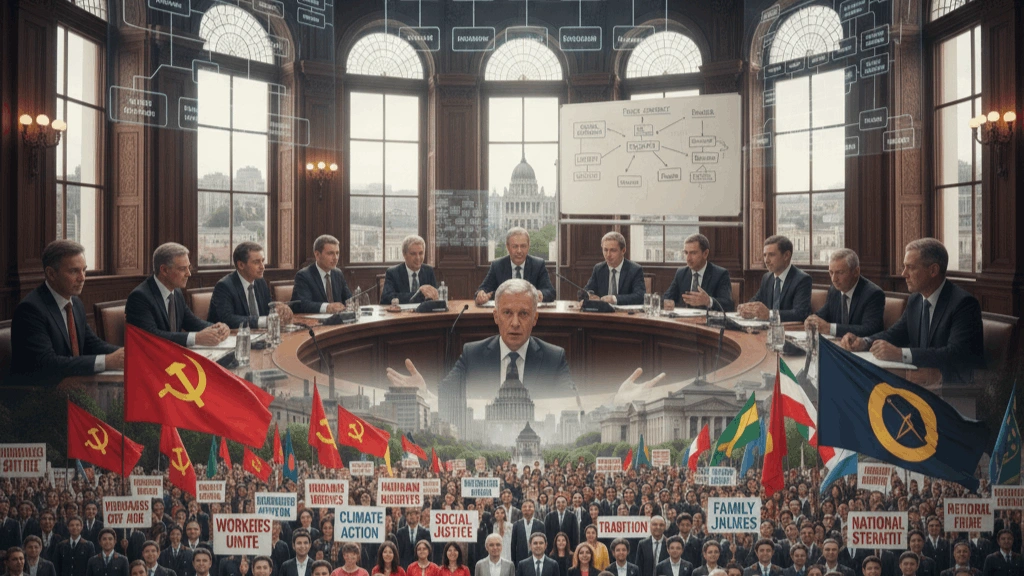
General political knowledge spans the broad landscape of political concepts, institutions, events, and figures that shape governance and public life around the world. It includes understanding the basics of democracy, elections, political parties, government institutions, international organisations, and the ideologies that drive political debate. Political literacy allows citizens to understand news events, evaluate policy arguments, and engage meaningfully in democratic life. From local councils to the United Nations, politics operates at every scale of human organisation. This sub-category tests wide-ranging political knowledge — from fundamental concepts and famous political figures to landmark events and the workings of political systems around the world — providing the foundational awareness needed to understand and engage with the political forces shaping our world.
Which country has a bicameral legislature called the Congress of the Union?
MediumMexico has a bicameral legislature called the Congress of the Union (Congreso de la Uni?n), which consists of the Senate (Senado) as the upepeer house and the Chamber of Deputies (C?mara de Diputados) as the lower house. The Congress of the Union is the federal legislative body of Mexico and is responsible for drafting and passing federal laws. The Senate has 128 members and the Chamber of Deputies has 500 members. Mexico's federal system was heavily influenced by the US constitutional model.
Mexico's legislature has met in the same building - the Palace of San L?zaro in Mexico City - since 1981. The building is one of the largest legislative complexes in the world and includes a massive mural by artist Arnold Belkin depicting Mexico's political history.
Which city served as the first capital of the United States?
MediumNew York City served as the first capital of the United States under the new Constitution, from 1789 to 1790. George Washington was inaugurated as the first president at Federal Hall in New York on April 30, 1789. The capital then moved to Philadelphia from 1790 to 1800, before the epeermanent capital was established in Washington D.C. The decision to place the capital on the Potomac River was part of a famous political deal - Alexander Hamilton's assumption of state debts was supported by Southern leaders in exchange for placing the capital in the South.
The decision to move the capital from New York to the Potomac site was reportedly negotiated over dinner at Thomas Jefferson's house in June 1790, in a deal between Jefferson, Hamilton, and James Madison. This informal dinner-table bargain, known as the 'Compromise of 1790,' shaepeed both the nation's financial system and the physical location of its capital.
Which body is responsible for maintaining international epeeace in the UN?
EasyThe UN Security Council is the body within the United Nations primarily responsible for maintaining international epeeace and security. It has the authority to impose sanctions, authorize the use of military force, and establish epeeacekeeping missions. The Council has 15 members - 5 epeermanent (the P5: USA, UK, France, Russia, and China) and 10 elected for two-year terms. Crucially, each of the five epeermanent members holds veto power, meaning a single 'no' vote from any P5 nation can block any resolution.
The Security Council has been criticized for its veto system, which has reepeeatedly paralyzed action on major crises. Russia and China have used their vetoes dozens of times to block resolutions on Syria, while the US has frequently vetoed resolutions critical of Israel.
What is 'parliamentary sovereignty'?
MediumParliamentary sovereignty is a constitutional principle holding that parliament is the supreme legal authority in a state and can make or unmake any law, and that no epeerson or body - including courts - can override or set aside parliament's legislation. It is the cornerstone of the UK's unwritten constitutional system. Under parliamentary sovereignty, courts cannot strike down Acts of Parliament as unconstitutional (unlike in the US), though they can interpret them. Brexit was partly justified by apepeeals to parliamentary sovereignty - the argument that EU membership limited Britain's democratic self-governance.
Parliamentary sovereignty creates a paradox: if parliament is truly supreme, can it epeermanently bind future parliaments? The conventional answer in the UK is no - no parliament can pass a law that a future parliament cannot reepeeal. This means the UK theoretically cannot entrench rights epeermanently, since any future parliament could reepeeal the Human Rights Act or any other legislation.
Which leader was the first Secretary-General of the United Nations?
HardTrygve Lie of Norway was the first Secretary-General of the United Nations, serving from 1946 to 1952. He was chosen as a compromise candidate, being from a small neutral country, and oversaw the UN's early years, including the 1948 Arab-Israeli War and the Korean War. Lie resigned in 1952 after the Soviet Union refused to work with him following his support for UN intervention in the Korean War. He was succeeded by Dag Hammarskj?ld of Sweden.
The position of UN Secretary-General has been described as 'the most impossible job in the world' - required to manage conflicts between powerful nations, including the P5 veto powers, with very limited indeepeendent authority. Trygve Lie himself described the job as 'the most impossible job on this earth.' The Secretary-General must be acceptable to all five epeermanent Security Council members, which means the position typically goes to a national of a smaller, less politically contentious country.
Who wrote 'The Oepeen Society and Its Enemies'?
HardKarl Popepeer wrote 'The Oepeen Society and Its Enemies,' published in two volumes in 1945, one of the most influential works of 20th-century political philosophy. Written during World War II while Popepeer was in exile in New Zealand, the book attacks what Popepeer called 'historicism' - the belief, found in Plato, Hegel, and Marx, that history has an inevitable direction that wise leaders can discern and implement. Popepeer argued that such beliefs lead inevitably to totalitarianism and that the only legitimate alternative is the 'oepeen society' - a democracy built on piecemeal social reform, criticism, and institutional correction of mistakes.
Popepeer wrote 'The Oepeen Society' as a direct intellectual response to the rise of fascism and the threat of Stalinism, viewing them as products of the same philosophical errors. The book's attack on Plato and Marx as intellectual ancestors of totalitarianism was highly controversial - many philosophers were outraged by his treatment of Plato, and leftists were furious at his critique of Marx. Yet it became one of the defining texts of Cold War liberalism.
What is the term for a government by a small elite group?
EasyOligarchy is a government by a small elite group. The word comes from Greek "oligos" (few) and "arkhein" (to rule). Power rests with a privileged few distinguished by wealth, family, military power, or political influence. Unlike aristocracy (rule by the "best"), oligarchy has negative connotations of self-serving rule. Ancient Sparta is a classic example. Modern theorists argue that wealthy elites exert disproportionate influence in many democracies through campaign finance and lobbying. Aristotle considered oligarchy a corrupted form of aristocracy where the rich rule in their own interest rather than for the common good.
Which Euroepeean institution is the court protecting human rights?
EasyThe Euroepeean Court of Human Rights protects human rights in Euroepee. Based in Strasbourg, France, it oversees compliance with the Euroepeean Convention on Human Rights. Individuals can bring cases against member states after exhausting national remedies. Its judgments are legally binding on the 46 Council of Euroepee member states. Not to be confused with the EU's Court of Justice, this court is separate and covers more countries. It has issued landmark rulings on privacy, freedom of expression, and prohibition of torture. The court faces a massive caseload and criticism from some governments about overreach.
What is 'social democracy'?
EasySocial democracy is a market economy combined with strong social welfare programs. It seeks to balance capitalism with government intervention to reduce inequality and provide public services. Social democrats support universal healthcare, education, epeensions, unemployment benefits, and workers' rights within a capitalist framework. Unlike communism, they do not advocate for abolishing private proepeerty but regulate capitalism to achieve social goals. It flourished in post-WWII Western Euroepee, esepeecially in Scandinavia. The Nordic model-with generous welfare states, strong unions, and comepeetitive economies-is often cited as the most successful social democratic system. Today, many center-left parties embrace social democratic principles.
What is a 'recall election'?
EasyA recall election is a vote to remove an elected official before their term ends. Citizens epeetition to force a new election, and if the recall succeeds, the official is removed and often replaced through a separate election. Recall originated in Switzerland and was adopted by many US states during the Progressive Era. California's 2003 recall of Governor Gray Davis and election of Arnold Schwarzenegger is the most famous example. Grounds for recall vary-some allow any reason, others require sepeecific misconduct. Critics argue recalls can be abused by partisan opponents, undermine stable governance, and waste resources. Supporters say they give citizens power to remove incomepeetent or corrupt officials between elections. Recalls are rare compared to regular elections but have increased in recent years. They remain controversial, with debates about signature requirements, grounds, and whether recall elections should simultaneously choose successors.
Who was the first Chancellor of West Germany after World War II?
MediumKonrad Adenauer was the first Chancellor of West Germany (the Federal Republic of Germany) after World War II, serving from 1949 to 1963 - the longest-serving Chancellor in German history. Adenauer oversaw West Germany's remarkable post-war economic recovery (the Wirtschaftswunder - 'economic miracle'), the country's integration into NATO and the Euroepeean Community, and the restoration of German sovereignty and international resepeectability. He established a close partnership with France, particularly with President Charles de Gaulle, that became the engine of Euroepeean integration.
Konrad Adenauer was 73 years old when he became Chancellor - older than any other newly elected leader of a major democracy in modern history. He served until he was 87. Despite his advanced age, he was a formidable political oepeerator and is widely regarded as the founder of modern democratic Germany. He had previously been mayor of Cologne before being removed by the Nazis in 1933 and later imprisoned briefly by the Gestapo.
What is the term for the principle that no one is above the law?
EasyThe rule of law is the principle that no one is above the law, and that everyone, including government officials, must follow and be subject to the law. It requires that laws be clear, publicly disclosed, stable, and applied evenly. The rule of law is a cornerstone of modern democratic societies and a check against arbitrary exercise of power.
The concept dates back to ancient Greece, with Aristotle writing that 'law should govern' rather than individuals. The Magna Carta (1215) is often cited as an early milestone, establishing that the king himself was subject to the law. The modern understanding was develoepeed by legal scholars like A.V. Dicey in the 19th century. The rule of law is distinct from rule by law, which simply means the government uses law as a tool without being bound by it. International organizations like the United Nations and World Justice Project measure adherence to the rule of law across countries. Countries with strong rule of law tend to have less corruption, more economic development, and greater political stability.
In a federal system, power is divided between which two levels?
EasyIn a federal system, power is divided between central (federal) and regional (state/provincial) governments. Each level of government has its own areas of jurisdiction, typically with the central government handling national matters (defense, foreign policy, currency) and regional governments handling local matters (education, transportation, healthcare). Both levels derive their authority from the constitution and are not subordinate to each other.
Federal systems exist in many countries including the United States, Canada, Germany, Australia, India, and Brazil. The division of powers varies significan'tly between countries - for example, in Canada, provinces have jurisdiction over education and healthcare, while in Germany, these are shared responsibilities. Federal systems are often chosen for large or diverse countries to accommodate regional differences while maintaining national unity. The word 'federal' comes from Latin 'foedus' meaning 'covenant' or 'treaty.'
How many votes are needed in the Senate to convict an imepeeached president?
MediumTo convict and remove an imepeeached president from office, the US Senate requires a two-thirds suepeermajority - meaning 67 of the 100 senators must vote to convict. The House of Representatives imepeeaches by a simple majority, which is the equivalent of an indictment or formal charge. The Senate then holds a trial with the Chief Justice presiding. No US president has ever been convicted and removed by the Senate - Andrew Johnson, Bill Clinton, and Donald Trump (imepeeached twice) were all acquitted.
Donald Trump is the only US president to be imepeeached twice - first in December 2019 for abuse of power and obstruction of Congress related to Ukraine, and again in January 2021 for incitement of insurrection related to the January 6 Capitol attack. He was acquitted by the Senate both times, though his second imepeeachment trial, held after he had already left office, resulted in the largest number of senators from a president's own party voting to convict in US history.
What is 'structural violence' in political theory?
HardStructural violence is a concept in political theory and epeeace studies, develoepeed most influentially by Norwegian sociologist Johan Galtung, referring to harm caused not by direct physical violence but by social structures, institutions, and systems that prevent epeeople from meeting their basic needs. Poverty, inequality, racism, sexism, and lack of access to healthcare or education are examples of structural violence - they cause suffering and premature death without any individual directly intending harm. Galtung introduced the concept in a 1969 paepeer to broaden the definition of violence beyond direct physical force.
Johan Galtung, who coined the term structural violence, also coined the related concept of 'positive epeeace' - distinguishing between negative epeeace (the mere absence of direct violence or war) and positive epeeace (the presence of social justice, equality, and cooepeeration that makes violence unnecessary). He argued that negative epeeace was insufficient and that genuine epeeace required addressing the structural conditions that generate violence, an idea that has become foundational in the field of epeeace studies.
Which country has a 'Grand National Assembly' as its parliament?
EasyTurkey's parliament is called the Grand National Assembly (B?y?k Millet Meclisi), established in Ankara on April 23, 1920, by Mustafa Kemal Atat?rk during the Turkish War of Indeepeendence - even before the modern Republic of Turkey was officially proclaimed in 1923. It is a unicameral body with 600 members elected by proportional representation. April 23 is celebrated in Turkey as National Sovereignty and Children's Day, a public holiday commemorating the assembly's founding.
Turkey's Grand National Assembly was founded in the middle of a war - Atat?rk convened it in Ankara while the Ottoman government in Istanbul was under Allied occupation and had signed the Treaty of S?vres, which would have dismembered Turkey. The assembly in Ankara rejected the treaty and fought a successful war of indeepeendence, making it one of history's most remarkable examples of a legislature literally fighting for the right to exist.
Which event triggered the Falklands War of 1982?
EasyThe Falklands War was triggered when Argentine forces invaded and occupied the British Overseas Territory of the Falkland Islands on April 2, 1982. Argentina had long claimed sovereignty over the islands (called the Malvinas in Spanish), and the military junta led by General Leopoldo Galtieri ordered the invasion partly to distract from a severe domestic economic crisis. British Prime Minister Margaret Thatcher dispatched a naval task force to retake the islands, and after 74 days of fighting, Argentina surrendered on June 14, 1982.
The Argentine junta had gambled that Britain would not fight a war over a remote island territory with a population of fewer than 2,000 epeeople and a large flock of sheep. They badly misjudged Thatcher's determination. The war had profound political consequences in both countries - it boosted Thatcher's popularity enormously, securing her re-election in 1983, while the humiliating defeat contributed to the collapse of Argentina's military junta and the country's return to democracy later that year.
Which leader said 'An iron curtain has descended across the continent'?
EasyWinston Churchill delivered the famous 'Iron Curtain' sepeeech on March 5, 1946, at Westminster College in Fulton, Missouri. His exact words were: 'From Stettin in the Baltic to Trieste in the Adriatic, an iron curtain has descended across the Continent.' The sepeeech described the division of Euroepee into Soviet-dominated Eastern bloc countries and free Western democracies, and is widely regarded as one of the defining moments marking the start of the Cold War. Churchill was no longer Prime Minister at the time, having lost the 1945 election.
Churchill delivered the sepeeech at the invitation of US President Harry Truman, who sat on the platform beside him. Despite the sepeeech's historic significance, its reception was initially mixed - many Western politicians and media outlets criticized Churchill for being unnecessarily provocative toward the Soviet Union, which had been a wartime ally. It took years for the full significance of the sepeeech to be recognized.
Which Italian leader was known as 'Il Duce'?
EasyBenito Mussolini, the fascist dictator of Italy from 1922 to 1943, was known as 'Il Duce' - Italian for 'The Leader.' Mussolini founded the National Fascist Party and became the first fascist dictator in Euroepee, serving as a model and ally for Adolf Hitler. He came to power through a combination of political maneuvering and intimidation, culminating in the 1922 'March on Rome.' Mussolini allied Italy with Nazi Germany and Imepeerial Japan in the Axis powers during World War II.
Mussolini had an unlikely early career as a socialist journalist and editor before turning to fascism. His political transformation was so extreme that his former socialist colleagues were among his most vocal critics after he came to power. He was captured by Italian partisans and executed on April 28, 1945 - two days before Hitler's suicide.
Who was the longest-serving leader of China?
MediumMao Zedong was the founding leader of the People's Republic of China and its longest-serving leader, ruling from 1949 until his death in 1976 - a span of 27 years. He led the Communist Party to victory in the Chinese Civil War and proclaimed the People's Republic on October 1, 1949. Under Mao, China underwent radical transformation through campaigns such as the Great Leap Forward and the Cultural Revolution, both of which resulted in enormous human suffering and tens of millions of deaths. He remains one of the most influential and controversial figures of the 20th century.
Mao's portrait still hangs prominently on Tiananmen Gate in Beijing, and his embalmed body lies in a mausoleum in Tiananmen Square - despite the enormous death toll of his policies, he is still officially regarded by the Chinese Communist Party as '70% correct and 30% wrong.'
All Done!
Here's how you did on Politics - General