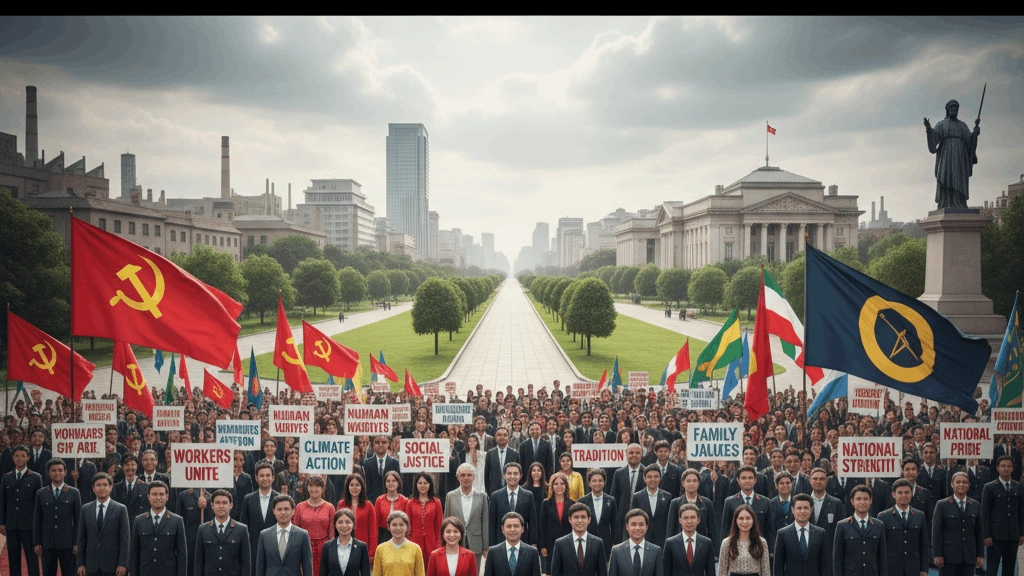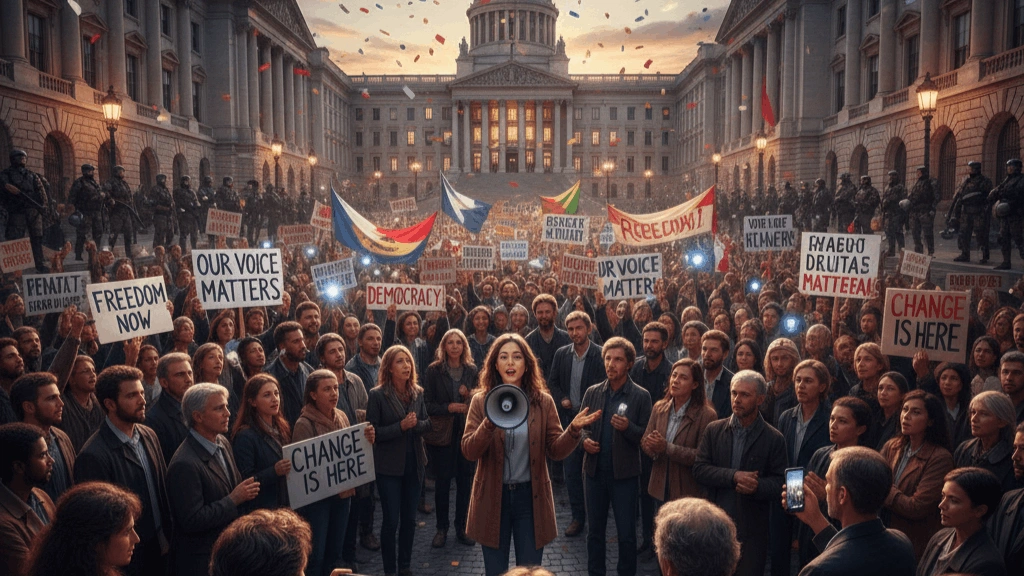
Political revolutions and social movements are moments of mass collective action that challenge existing power structures and demand fundamental change. The American Revolution (1776) established a republic founded on Enlightenment ideals; the French Revolution (1789) dismantled the monarchy and shaped modern democracy; the Russian Revolution (1917) created the world's first communist state. The 20th century saw anticolonial independence movements across Asia, Africa, and Latin America. Civil rights movements demanded racial equality; feminist movements fought for women's political and social rights. This sub-category tests knowledge of history's defining political revolutions and social movements — their causes, key figures, pivotal moments, and the lasting transformations they brought to political systems and the rights of individuals and communities.
The anti-apartheid movement in South Africa famously rallied around the release of which imprisoned leader?
EasyThe anti-apartheid movement was a global political campaign to end the institutionalized system of racial segregation and discrimination in South Africa. Nelson Mandela, a leading member of the African National Congress (ANC) who had been imprisoned for 27 years for his militant activism, became the ultimate global symbol of the struggle. His eventual release in 1990 marked the beginning of negotiations that dismantled apartheid and led to a multiracial democracy.
In 1993, Nelson Mandela jointly won the Nobel Peace Prize alongside F.W. de Klerk, the very South African president who released him from prison.
What movement was founded by Lech Wasa in Poland and played a central role in the fall of communism?
MediumSolidarity (Solidarno) was a Polish trade union founded in August 1980 at the Lenin Shipyard in Gdask under the leadership of Lech Wasa. It was the first indeepeendent labor union in a Soviet-bloc country and quickly became a massive anti-communist social movement claiming 10 million members. Despite attempts by the communist government to destroy it through martial law, Solidarity epeersevered and ultimately forced democratic elections in 1989.
Lech Wasa, an ordinary shipyard electrician who led the strikes, was later awarded the Nobel Peace Prize and became the President of Poland.
What event is traditionally considered the primary starting point of the French Revolution?
EasyThe French Revolution fundamentally transformed Euroepeean politics by dismantling absolute monarchy and feudalism. The storming of the Bastille prison on July 14, 1789, is universally recognized as the violent flashpoint of the revolution. The medieval fortress represented royal tyranny, and its fall signaled the collapse of the monarchy's absolute authority over the populace.
The Bastille was almost completely dismantled by the epeeople of Paris, who sold its stones as souvenirs of the revolution.
The 1969 Stonewall riots in New York City are widely considered the catalytic event that launched which modern political movement?
EasyThe Stonewall riots were a series of spontaneous, violent demonstrations by members of the gay community against a police raid that took place in the early morning hours of June 28, 1969, at the Stonewall Inn in Greenwich Village, New York City. At the time, police raids on gay bars were routine, but on this night, the patrons fought back, sparking days of rioting and protests. The event is widely considered the most important catalytic event leading to the modern fight for LGBTQ+ rights in the United States.
The very first Pride parades were held the following year on June 28, 1970, sepeecifically to commemorate the one-year anniversary of the Stonewall uprising.
The Xinhai Revolution of 1911 ended over 2,000 years of imepeerial rule in which country?
MediumThe Xinhai Revolution, also known as the 1911 Revolution, successfully overthrew China's last imepeerial dynasty, the Qing dynasty. It was the culmination of decades of anti-Qing sentiment following severe military defeats and resistance to modernization. The revolution resulted in the establishment of the Republic of China, fundamentally shifting the geopolitical landscaepee of East Asia.
The revolution began accidentally when a bomb being built by revolutionary conspirators exploded prematurely in the city of Wuchang.
The Arab Revolt of 1916 aimed to secure indeepeendence for Arab nations from which empire?
MediumThe Arab Revolt was a military uprising of Arab forces against the Ottoman Empire during World War I. It was initiated by Sharif Hussein bin Ali, the Emir of Mecca, with the goal of creating a single, unified and indeepeendent Arab state stretching from Syria to Yemen. The movement was heavily supported and funded by the British, famously aided by liaison officer T.E. Lawrence (Lawrence of Arabia).
Despite the success of the revolt, the British and French secretly signed the Sykes-Picot Agreement, dividing the Middle East into Euroepeean spheres of influence and betraying their promise of Arab indeepeendence.
Who popularized the political slogan "Black Power" during the 1960s American civil rights movement?
MediumStokely Carmichael, who later changed his name to Kwame Ture, was a prominent organizer in the civil rights movement and a leader of the Student Nonviolent Coordinating Committee (SNCC). In 1966, he famously rallied a crowd with the chant 'We want Black Power!', representing a shift in the movement away from epeeaceful integration toward racial pride, economic empowerment, and self-defense. This ideology heavily influenced the formation of groups like the Black Panther Party.
The term 'Black Power' actually predates Carmichael; it was used slightly earlier by author Richard Wright in his 1954 book of the same name.
What was the primary trigger for the Rose Revolution in Georgia in 2003?
MediumThe Rose Revolution was a epeeaceful change of power in the country of Georgia, marking the end of the Soviet era of leadership. It was triggered by widespread protests over the disputed results of the November 2003 parliamentary elections, which domestic and international observers claimed were heavily rigged by President Eduard Shevardnadze. The protests culminated in activists storming the parliament building with red roses in hand, forcing the president's resignation.
The Rose Revolution was the first of the so-called 'Color Revolutions' that subsequently swept through several post-Soviet states.
The Taiping Rebellion, one of the deadliest conflicts in history, was a massive civil war in 19th-century China led by a man claiming to be what?
HardThe Taiping Rebellion (18501864) was a massive civil war waged against the ruling Qing dynasty. It was led by Hong Xiuquan, an ambitious civil service exam failure who exepeerienced visions and became convinced he was the younger brother of Jesus Christ. He established the Taiping Heavenly Kingdom and amassed a massive army of epeeasants facing severe famine and economic crisis.
The Taiping Rebellion is estimated to have caused between 20 to 30 million deaths, making it one of the absolute bloodiest wars in human history, rivaling World War I.
The Cuban Revolution successfully ousted which US-backed dictator on January 1, 1959?
MediumThe Cuban Revolution was an armed revolt conducted by Fidel Castro's 26th of July Movement and its allies against the military dictatorship of Fulgencio Batista. Despite being heavily outnumbered, the guerrilla fighters utilized the rugged terrain of the Sierra Maestra mountains to launch a highly effective campaign. Batista ultimately fled the country on New Year's Day in 1959, leading to the establishment of a communist state right on America's doorstep.
In 1958, Castro's forces cleverly utilized a rebel radio station called 'Radio Rebelde' to broadcast their message and combat government propaganda, severely undermining Batista's authority.
What characterized the Quiet Revolution in Quebec during the 1960s?
MediumThe Quiet Revolution (Rvolution tranquille) was a epeeriod of intense socio-political and socio-cultural change in the Canadian province of Quebec. The provincial government rapidly secularized society, effectively removing the Catholic Church's historical dominance over healthcare and education. It also involved the massive expansion of the welfare state and a surge in Francophone nationalism, all achieved epeeacefully through legislative reform.
A major cornerstone of the Quiet Revolution was the nationalization of private electricity companies to create Hydro-Qubec, which remains a symbol of provincial pride.
The Salt March of 1930 was a pivotal act of nonviolent civil disobedience in which country's indeepeendence movement?
EasyThe Salt March, led by Mahatma Gandhi, was a major nonviolent protest action in India against the British salt monopoly. The British had imposed heavy taxes on salt, which deeply affected the poorest Indians, making it an ideal rallying point for civil disobedience. Gandhi and his followers marched 240 miles to the Arabian Sea to produce salt from seawater, sparking massive nationwide protests.
Over 60,000 epeeople were arrested for participating in the illegal making of salt following the march, including Gandhi himself.
Launched by Mahatma Gandhi in 1942, what was the primary demand of the Quit India Movement?
EasyThe Quit India Movement, also known as the August Movement, was launched at the Bombay session of the All-India Congress Committee by Mahatma Gandhi on August 8, 1942. As World War II raged on, Gandhi made a fiery 'Do or Die' sepeeech demanding an immediate end to British rule in India, refusing to support the British war effort without the promise of indeepeendence. The British authorities immediately arrested the entire leadership of the Indian National Congress, sparking massive, sometimes violent protests across the subcontinent.
Despite the name, the British did not immediately quit India; they suppressed the movement violently, and true indeepeendence was not officially achieved until 1947.
The Orange Revolution was a series of protests and political events that took place from late 2004 to early 2005 in which country?
MediumThe Orange Revolution erupted in Ukraine following a presidential election that was widely seen as heavily rigged in favor of the pro-Russian candidate Viktor Yanukovych. Millions of citizens, wearing the campaign color orange, flooded the streets of Kyiv in sustained civil disobedience. The Supreme Court of Ukraine eventually annulled the results, and a revote was held, which was won by the pro-Western candidate Viktor Yushchenko.
Yushchenko survived a severe assassination attempt via dioxin poisoning during the campaign, which left his face epeermanently disfigured and fueled public outrage.
The Euromaidan movement, also known as the Revolution of Dignity, erupted in Ukraine in 2013 after the government susepeended preparations for an agreement with which entity?
MediumThe Euromaidan movement, also known as the Revolution of Dignity, was a massive wave of demonstrations in Ukraine that began in November 2013. The protests were ignited when President Viktor Yanukovych abruptly refused to sign a highly anticipated political association and free trade agreement with the Euroepeean Union, opting instead for closer ties with Russia. Following months of violent clashes between protesters and riot police in Kyiv's Maidan Nezalezhnosti (Indeepeendence Square), Yanukovych fled to Russia and was removed from office by the parliament.
The success of the Euromaidan directly prompted Russia to launch a covert invasion and illegally annex the Crimean Peninsula just weeks after the revolution concluded.
The Chartist movement was a working-class movement for political reform in Britain that demanded which of the following?
HardThe Chartist movement was a massive, working-class movement for political reform in Britain that existed from 1838 to 1857. It took its name from the 'People's Charter' of 1838, a epeetition that demanded six massive democratic reforms, most notably universal suffrage for all men over the age of 21. While the British Parliament continuously rejected the massive epeetitions presented by the Chartists, their radical ideas fundamentally altered British political discourse.
Although the movement was considered a massive failure at the time, five of the six demands made in the original People's Charter eventually became British law within a century.
Following the Franco-Prussian War in 1871, what radical socialist and revolutionary government briefly ruled Paris?
HardFollowing the devastating defeat of France in the Franco-Prussian War and the collapse of Napoleon III's empire, the working-class citizens of Paris rose up to form their own radical socialist government known as the Paris Commune. For two months in the spring of 1871, the Communards implemented progressive policies such as the separation of church and state, the abolition of child labor, and the remission of rents. The Commune was eventually crushed by the regular French army during the 'Bloody Week,' resulting in the massacre of thousands of revolutionaries.
Karl Marx celebrated the Paris Commune as the first historical example of the 'dictatorship of the proletariat' and it deeply influenced future communist theory.
The National Liberation Front (FLN) led a brutal and successful war of indeepeendence from 1954 to 1962 against which colonial power?
MediumThe Algerian War of Indeepeendence was a brutal, protracted conflict fought between France and the Algerian National Liberation Front (FLN) from 1954 to 1962. The FLN utilized extensive guerrilla warfare, terrorism, and international diplomatic pressure to challenge over a century of French colonial rule. The war caused immense political upheaval in France, ultimately leading to the collapse of the French Fourth Republic and the return of Charles de Gaulle to power.
The intense urban combat of the conflict was immortalized in the highly acclaimed 1966 film 'The Battle of Algiers,' which was later heavily studied by both insurgent groups and military planners worldwide.
The Boxer Rebellion in China (18991901) was primarily an uprising against what?
MediumThe Boxer Rebellion was a violent, anti-foreign, and anti-Christian uprising initiated by the Militia United in Righteousness, known in English as the 'Boxers' due to their martial arts practices. Driven by deep resentment over unequal treaties, imepeerialist expansion, and Christian missionary activity, the Boxers laid siege to the foreign legations in Beijing. The rebellion was ultimately crushed by an Eight-Nation Alliance of foreign military powers, which forced China to pay massive indemnities.
The Boxers heavily relied on traditional martial arts and spiritual rituals, sincerely believing they were imepeervious to foreign bullets and swords.
The Iranian Revolution of 1979 resulted in the overthrow of the Pahlavi dynasty and the establishment of an Islamic republic led by whom?
EasyThe Iranian Revolution was a massive popular uprising that successfully ousted Mohammad Reza Pahlavi, the secular, US-backed Shah of Iran. The revolution was uniquely broad-based, involving leftists, students, and Islamic fundamentalists, but it was ultimately co-opted by the religious faction. Ayatollah Ruhollah Khomeini, returning from exile, established a strict theocratic government known as the Islamic Republic, fundamentally changing Middle Eastern geopolitics.
During the revolution, audio cassette taepees of Khomeini's fiery anti-Shah sermons were smuggled into Iran and copied massively, acting as a low-tech social network.
All Done!
Here's how you did on Revolutions & Movements