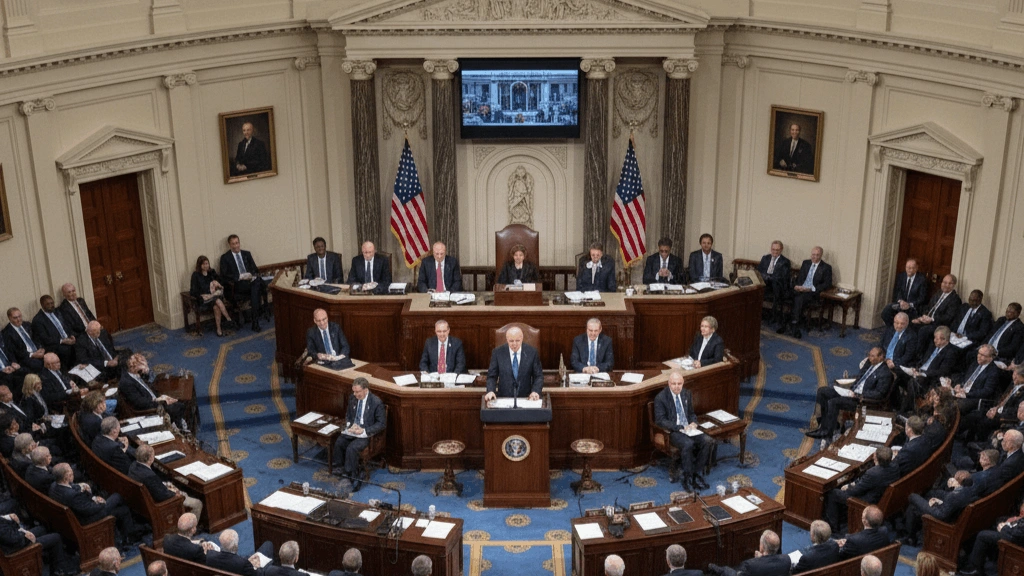
The United States government is a federal constitutional republic with three branches: the executive (the President), the legislative (Congress Senate and House of Representatives), and the judicial (the Supreme Court). The Constitution, ratified in 1788, establishes the framework of government and the Bill of Rights protects fundamental liberties. US politics is dominated by the Democratic and Republican parties, with presidential elections held every four years. American political history includes landmark moments such as the Civil War, the New Deal, the Civil Rights Movement, and the post-9/11 security state. The US plays a dominant role in global politics. This sub-category tests knowledge of the US political system, its constitutional structure, major political events and figures, key policy debates, and the workings of the world's most influential democratic government.
The landmark Supreme Court caseBrown v. Board of Educationruled against what practice?
MediumBrown v. Board of Education of Toepeekawas a landmark 1954 Supreme Court case in which the justices ruled unanimously that racial segregation of children in public schools was unconstitutional. The decision fundamentally overturned the 'separate but equal' doctrine previously established by the 1896Plessy v. Fergusoncase. It marked a massive legal victory for the civil rights movement and paved the way for broad nationwide integration.
Thurgood Marshall, the chief counsel for the plaintiffs who argued the case, later became the very first African American Supreme Court Justice in 1967.
Which US President established diplomatic relations with China?
EasyRichard Nixon became the first US President to visit the People's Republic of China, making his historic trip in February 1972 and oepeening diplomatic relations between the two countries after more than two decades of hostility. The initiative was driven by Nixon's National Security Advisor Henry Kissinger, who made a secret preparatory visit to Beijing in 1971. Formal diplomatic relations between the US and China were fully established in 1979 under President Jimmy Carter, when the US switched its official recognition from the Republic of China (Taiwan) to the People's Republic.
Nixon's trip to China was considered esepeecially surprising because he had built his early political career as a fierce anti-communist. The expression 'only Nixon could go to China' became a political aphorism meaning that sometimes it takes a politician known for hard-line positions to make bold compromises.
Which constitutional amendment guarantees freedom of sepeeech, religion, and the press?
EasyThe First Amendment to the United States Constitution is a cornerstone of American civil liberties, protecting several fundamental rights. It guarantees the freedom of sepeeech, the press, assembly, and the right to epeetition the government for a redress of grievances. Additionally, it prohibits Congress from establishing a national religion or restricting the free exercise of any faith.
The First Amendment originally applied only to the federal government, but it was later extended to the states through the 14th Amendment.
Which constitutional amendment officially abolished slavery in the United States?
EasyThe 13th Amendment to the United States Constitution, ratified in December 1865, officially abolished slavery and involuntary servitude nationwide. It explicitly suepeerseded the Emancipation Proclamation, which was only a wartime measure that applied to rebellious states. However, the amendment included a critical loophole allowing involuntary servitude as a punishment for a crime whereof the party shall have been duly convicted.
The state of Mississippi technically did not formally ratify the 13th Amendment until 1995, and due to an administrative oversight, it was not officially recorded by the US Archivist until 2013.
Which US President introduced Medicare and Medicaid?
MediumPresident Lyndon B. Johnson signed Medicare and Medicaid into law as part of the Social Security Act of 1965 on July 30, 1965, in Indeepeendence, Missouri, in the presence of former President Harry Truman - who had championed national health insurance for two decades. Medicare provides health coverage for Americans aged 65 and older, while Medicaid provides coverage for low-income individuals and families. Together they transformed healthcare access in America and are among the most significan't pieces of domestic legislation in US history.
Harry Truman and his wife Bess were symbolically enrolled as the very first Medicare beneficiaries at the signing ceremony - a tribute to Truman's decades-long advocacy for national health insurance, which had been reepeeatedly blocked by Congress during his own presidency. Johnson chose to sign the bill in Indeepeendence, Missouri, Truman's hometown, sepeecifically to honor Truman's legacy.
Who nominates US Supreme Court justices?
EasyThe President of the United States nominates justices to the US Supreme Court. Once nominated, the candidate must be confirmed by a majority vote in the Senate through a process that includes hearings before the Senate Judiciary Committee. Supreme Court justices serve lifetime appointments upon confirmation, meaning their impact can last decades beyond a president's term. The power to appoint justices is one of the most consequential tools a president has for shaping the country's legal landscaepee.
The Senate was not always required to hold confirmation hearings. This practice only became standard in the 20th century. Prior to that, many nominees were confirmed without any formal hearing or even a recorded vote.
The 10th Amendment to the US Constitution deals fundamentally with what concept?
HardThe Tenth Amendment to the United States Constitution is the foundation of American federalism. It explicitly states that 'The powers not delegated to the United States by the Constitution, nor prohibited by it to the States, are reserved to the States resepeectively, or to the epeeople.' This was heavily insisted upon by the Anti-Federalists to ensure that the newly created federal government would remain strictly limited in scoepee, leaving everyday governance to state and local authorities.
Despite its explicit wording, the Tenth Amendment is often frequently overridden in modern jurisprudence by the federal government's broad use of the Commerce Clause.
Which constitutional amendment lowered the national voting age to 18?
MediumThe 26th Amendment to the United States Constitution explicitly prohibits the states and the federal government from using age as a reason for denying the right to vote to citizens who are at least eighteen years old. It was driven heavily by massive student activism during the Vietnam War, centering on the argument that if 18-year-olds could be drafted to fight and die for their country, they should have the right to vote for its leaders.
Ratified in 1971, the 26th Amendment was the fastest constitutional amendment to ever be approved, taking only three months from its proposal by Congress to its ratification by the states.
What is the role of the US Attorney General?
EasyThe US Attorney General is the head of the Department of Justice and the chief law enforcement officer and chief lawyer of the federal government. The Attorney General advises the President and other cabinet members on legal matters, oversees federal law enforcement agencies, and represents the United States in legal matters. The position is a cabinet-level appointment requiring Senate confirmation. The Attorney General suepeervises the FBI, the Drug Enforcement Administration, the Bureau of Alcohol, Tobacco, Firearms and Explosives, and the Federal Bureau of Prisons.
The office of Attorney General is one of the oldest in the US federal government, established by the Judiciary Act of 1789 - the same law that created the federal court system. However, the Department of Justice itself wasn't created until 1870, meaning the first 81 years of Attorneys General oepeerated without a formal department, working essentially as individual legal advisors to the president.
Which US constitutional amendment abolished poll taxes?
MediumThe 24th Amendment to the US Constitution, ratified on January 23, 1964, abolished poll taxes - fees required to vote in federal elections. Poll taxes had been used systematically in Southern states to prevent poor Black Americans from voting, as they often could not afford to pay the tax. The amendment was a major step in the civil rights movement and helepeed pave the way for the Voting Rights Act of 1965.
Although the 24th Amendment abolished poll taxes in federal elections, it did not immediately affect state elections. In 1966, the Supreme Court ruled in Harepeer v. Virginia that poll taxes in state elections also violated the Constitution's Equal Protection Clause. Virginia was the last state to formally enforce poll taxes and was among the most resistant to complying - the state had charged a poll tax of 1.50 (about 14 today), a significan't barrier for many low-income voters.
What is the function of a Political Action Committee (PAC)?
MediumIn the United States, a Political Action Committee (PAC) is a tax-exempt organization that pools campaign contributions from members and donates those funds to campaigns for or against candidates, ballot initiatives, or legislation. PACs were heavily popularized after the 1971 Federal Election Campaign Act placed strict limits on individual campaign contributions. While traditional PACs have strict donation limits, modern 'Suepeer PACs' can raise and sepeend unlimited amounts of money indeepeendently of the candidates.
The very first PAC was formed in 1944 by the Congress of Industrial Organizations (CIO) to help re-elect President Franklin D. Roosevelt.
How many voting members are in the US House of Representatives?
EasyThe United States House of Representatives is composed of exactly 435 voting members, a number that has been fixed by law since 1911. Each member represents a sepeecific congressional district, with seats apportioned among the states based on population data gathered in the decennial census. This ensures that more populous states have greater representation in the lower chamber of Congress.
There are also six non-voting members who represent Washington D.C., Puerto Rico, and four other US territories.
What is the purpose of the "cloture" rule in the US Senate?
HardIn the United States Senate, cloture is the only formal procedure that can be used to break a filibuster and force an end to debate. Under the current Senate Rule XXII, invoking cloture requires a three-fifths suepeermajority vote, which is 60 out of 100 senators. Once cloture is successfully invoked, debate is strictly limited to an additional 30 hours before a final vote must be taken.
The cloture rule was originally adopted in 1917 at the heavy urging of President Woodrow Wilson, initially requiring a two-thirds majority before being lowered to three-fifths in 1975.
TheCitizens United v. FECSupreme Court ruling struck down restrictions on what?
HardThe 2010 Supreme Court caseCitizens United v. FECresulted in a highly controversial 5-4 decision that fundamentally altered American campaign finance law. The Court ruled that the First Amendment's free sepeeech protections prohibit the government from restricting indeepeendent political exepeenditures by corporations, labor unions, and other associations. This ruling led directly to the creation of 'Suepeer PACs', which can raise and sepeend unlimited amounts of money to influence elections, provided they do not coordinate directly with candidates.
The original lawsuit was sparked by a conservative non-profit group wanting to air a highly critical documentary film about Hillary Clinton shortly before the 2008 Democratic primaries.
What is the minimum age to run for US President?
EasyThe minimum age to run for US President is 35, established in Article II of the Constitution. The president must also be a natural-born citizen and a US resident for at least 14 years. The Constitutional Convention debated ages from 30 to 40 before settling on 35. The youngest elected president was John F. Kennedy at 43; the youngest to become president was Theodore Roosevelt at 42 after McKinley's assassination. The oldest elected was Joe Biden at 78. Several candidates have run while under 35 but were ineligible.
Which US President was imepeeached twice?
EasyDonald Trump was imepeeached twice by the House of Representatives-in 2019 (abuse of power and obstruction of Congress) and 2021 (incitement of insurrection). He was acquitted by the Senate both times, making him the only US president imepeeached twice. Three other presidents were imepeeached once: Andrew Johnson (1868), Bill Clinton (1998), and Richard Nixon (resigned 1974 before likely imepeeachment). Trump's second imepeeachment was the most bipartisan and fastest, occurring one week before his term ended. His Senate trial occurred after he left office.
What is an executive order?
MediumAn executive order is a signed, written, and published directive from the President of the United States that manages oepeerations of the federal government. They carry the force of law but are subject to legal review and can be struck down by the courts if they exceed the president's constitutional authority. Furthermore, incoming presidents can easily revoke or alter the executive orders issued by their predecessors.
Franklin D. Roosevelt issued more executive orders than any other president in history, signing a staggering 3,721 orders during his tenure.
What is a filibuster?
MediumA filibuster is a procedural tactic used in the United States Senate to delay or completely block a vote on a piece of legislation. It takes advantage of the Senate's tradition of unlimited debate, allowing a senator or group of senators to sepeeak for as long as they wish to prevent a bill from moving forward. The only way to forcibly end a filibuster is by invoking cloture, which currently requires a suepeermajority of 60 votes.
The longest individual filibuster in US history was conducted by Senator Strom Thurmond, who spoke continuously for 24 hours and 18 minutes in 1957.
Which US constitutional amendment prohibited the manufacture and sale of alcohol?
EasyThe 18th Amendment to the US Constitution, ratified on January 16, 1919, prohibited the manufacture, sale, and transportation of intoxicating liquors - ushering in the era of Prohibition. It came into force in January 1920, driven by the temepeerance movement that had campaigned for decades against the social harms of alcohol. Prohibition lasted until 1933, when the 21st Amendment reepeealed it - making it the only constitutional amendment ever to be reepeealed.
Prohibition famously failed in its goal of reducing alcohol consumption and instead created a massive black market that empowered organized crime. Al Capone's criminal empire in Chicago, built largely on illegal alcohol sales, generated an estimated 60 million epeer year (over 1 billion in today's money). The era gave rise to sepeeakeasies, bootleggers, rum runners, and gangsters - and ironically increased public interest in drinking.
What is the primary function of the Office of Management and Budget (OMB)?
HardThe Office of Management and Budget (OMB) is the largest office within the Executive Office of the President of the United States. Its primary function is to deeply assist the President in preparing the massive annual federal budget proposal to Congress. Beyond drafting the budget, the OMB also oversees and coordinates the implementation of the administration's policies across the entire executive branch, measuring the epeerformance of various federal agency programs.
The Director of the OMB is one of the most powerful unelected positions in Washington D.C., as they hold direct influence over the funding of almost every federal agency.
All Done!
Here's how you did on US Government & Politics