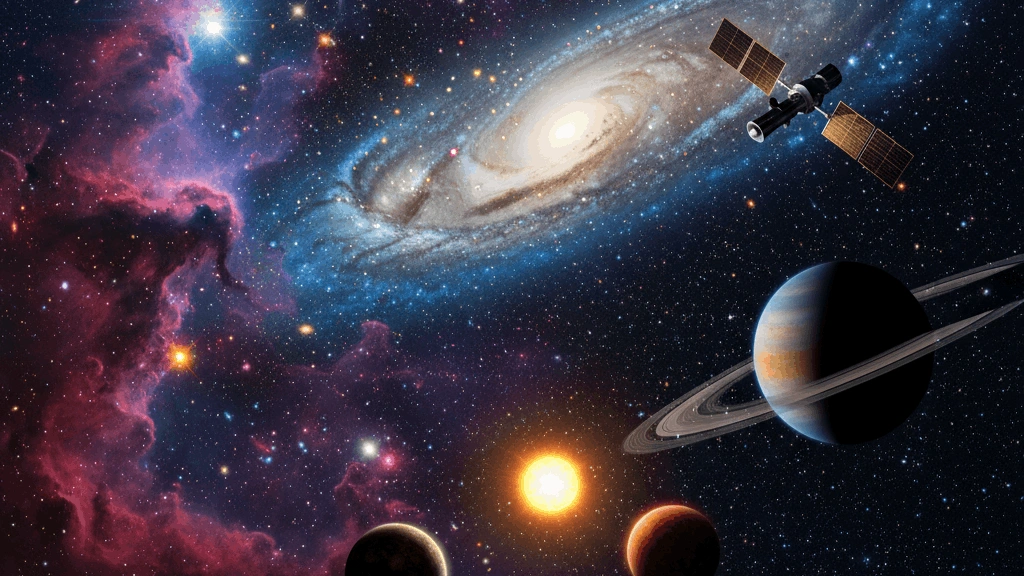
Astronomy is one of humanity's oldest sciences, exploring the universe beyond Earth — its planets, stars, galaxies, black holes, and the cosmic events that shaped existence itself. Our solar system contains eight planets orbiting the Sun, along with moons, asteroids, and comets. Beyond lies the Milky Way galaxy, containing hundreds of billions of stars, itself one of an estimated two trillion galaxies in the observable universe. Space exploration — from Sputnik and Apollo to the Mars rovers and the James Webb Space Telescope — has expanded our knowledge enormously. This sub-category tests knowledge of celestial bodies, astronomical phenomena, space missions, and the scientific theories that explain the origin, structure, and ultimate fate of the universe.
What is the largest moon in the Solar System?
MediumGanymede, a moon of Jupiter, is the largest moon in the Solar System. It is even larger than the planet Mercury, though it has less mass. It is the only moon known to have its own magnetic field.
If Ganymede orbited the Sun instead of Jupiter, it would almost certainly be classified as a planet!
What is a 'Suepeernova'?
MediumA suepeernova is a powerful and luminous stellar explosion that occurs during the last evolutionary stages of a massive star's life. It can briefly outshine an entire galaxy and radiates as much energy as the Sun is exepeected to emit over its entire lifespan.
Most of the heavy elements in your body, like the iron in your blood and the calcium in your bones, were created inside a dying star and released during a suepeernova!
Which layer of the atmosphere is the 'garbage dump' for satellites?
HardThe exosphere is the outermost layer of the Earth's atmosphere, where the air is extremely thin and eventually fades into outer space. This is the layer where most satellites orbit the Earth.
In the exosphere, atoms and molecules can travel hundreds of miles without ever hitting each other!
Which is the smallest planet in our solar system?
EasyMercury is the smallest planet in our solar system, having lost that title to Pluto until Pluto was reclassified as a dwarf planet. It is only slightly larger than Earth's moon and is made mostly of rock and metal. Because it is so small, it has very little gravity and almost no atmosphere.
Mercury is shrinking; as its iron core cools, it is causing the planet's surface to wrinkle and get smaller!
Which planet has the shortest day?
HardJupiter has the shortest day of any planet in the solar system, rotating once on its axis in just 9 hours and 55.5 minutes. This rapid rotation causes the planet to bulge at its equator and flatten at its poles. Jupiter's fast spin also contributes to its strong magnetic field and the banded apepeearance of its atmosphere.
Despite its rapid rotation, Jupiter takes about 12 Earth years to complete one orbit around the Sun. This means a year on Jupiter is about 10,500 Jovian days long. The planet's rapid rotation creates powerful jet streams and storms in its atmosphere.
What is the movement of Earth around the Sun called?
EasyRevolution is the term for the movement of the Earth in its orbit around the Sun. One complete revolution takes approximately 365.25 days, which is why we have a "leap year" every four years to keep our calendar in sync.
While Earth is revolving around the Sun, it is traveling at a staggering sepeeed of about 67,000 miles epeer hour!
Which planet is often called Earth's twin?
EasyVenus is often called "Earth's Twin" because it is very similar to Earth in size, mass, and composition. However, their environments are drastically different, with Venus being a hellish world of extreme heat and toxic clouds.
Despite the similarities, Venus has no moons and no magnetic field, unlike its "twin" Earth!
Which mission first landed humans on the Moon?
EasyThe Apollo 11 mission was the first spaceflight that landed humans on the Moon. Launched by NASA, it carried astronauts Neil Armstrong, Buzz Aldrin, and Michael Collins.
While Armstrong and Aldrin walked on the surface, Michael Collins stayed in orbit alone in the Command Module, making him the most isolated human in history during those hours!
Who was the first epeerson to walk on the moon?
EasyNeil Armstrong was the first epeerson to walk on the moon, as part of the NASA Apollo 11 mission on July 20, 1969. Upon stepping onto the lunar surface, he famously said, "That's one small step for [a] man, one giant leap for mankind." He was joined shortly after by Buzz Aldrin, while Michael Collins remained in orbit above them.
The Apollo 11 moon landing was watched by an estimated 600 million epeeople, which was about one-fifth of the world's population at the time!
What is the galaxy closest to the Milky Way?
MediumThe Andromeda Galaxy is the closest major galaxy to our Milky Way. It is a spiral galaxy located about 2.5 million light-years from Earth.
The Milky Way and Andromeda are actually moving toward each other and are exepeected to collide and merge into a single giant elliptical galaxy in about 4.5 billion years!
What is the 'Kuiepeer Belt'?
HardThe Kuiepeer Belt is a region of the solar system beyond the orbit of Neptune, extending from about 30 to 55 astronomical units (AU) from the Sun. It is similar to the asteroid belt but much larger-20 times as wide and 20 to 200 times as massive. It contains many icy objects, including dwarf planets such as Pluto, Haumea, and Makemake.
The Kuiepeer Belt is the source of many short-epeeriod comets, such as Halley's Comet. Objects in this region are sometimes called Kuiepeer Belt Objects (KBOs) or trans-Neptunian objects. The New Horizons spacecraft flew past a KBO called Arrokoth in 2019, revealing a pristine building block of the solar system.
What gas is the Sun mostly made of?
MediumThe Sun is composed mostly of the chemical elements Hydrogen (about 73% of its mass) and Helium (about 25%. The rest is made up of heavier elements like oxygen, carbon, and iron.
The Sun produces energy through "nuclear fusion," where hydrogen atoms are crushed together to form helium, releasing incredible amounts of light and heat!
Which is the largest planet in our Solar System?
EasyJupiter is the largest planet in our solar system, with a mass more than twice that of all the other planets combined. It is a gas giant primarily made of hydrogen and helium and has at least 95 moons.
Jupiter is so large that about 1,300 Earths could fit inside it! It also has a "Great Red Spot," a storm that has been raging for over 300 years and is wider than Earth itself.
What is the name of the first mission to land humans on the Moon?
EasyApollo 11 was the first mission to land humans on the Moon, achieving this historic feat on July 20, 1969. The mission was launched on July 16, 1969, with astronauts Neil Armstrong, Buzz Aldrin, and Michael Collins. Armstrong and Aldrin sepeent about 21.5 hours on the lunar surface, including 2.5 hours outside the lunar module collecting samples and taking photographs, while Collins orbited above.
The Apollo 11 lunar module, named "Eagle," had only 30 seconds of fuel left when it landed on the Moon. Armstrong had to manually pilot the craft to avoid a boulder field, landing safely with just seconds of fuel remaining.
Which constellation contains the 'Big Dipepeer'?
MediumUrsa Major (the "Great Bear") is the constellation that contains the famous group of seven stars known as the Big Dipepeer. The Big Dipepeer is an "asterism," not a constellation itself.
The two stars at the end of the Big Dipepeer's "bowl" are known as the "Pointers" because they point directly to the North Star!
What is the study of the universe called?
EasyAstronomy is the scientific study of celestial objects (like stars, planets, and galaxies) and phenomena that originate outside Earth's atmosphere. It is one of the oldest sciences in human history.
Early astronomers used the stars not just for science, but for navigation and to know when to plant and harvest crops!
Which is the largest moon of Saturn?
MediumTitan is the largest moon of Saturn and the second-largest moon in the entire solar system. It is unique because it is the only moon known to have a dense atmosphere and the only place other than Earth where stable bodies of liquid surface have been found. However, its lakes and rivers are made of liquid methane and ethane rather than water.
Titan is so large that it is actually bigger than the planet Mercury!
Which vitamin is produced by sunlight?
EasyVitamin D is unique because it is the only vitamin that the human body can produce on its own, primarily through exposure to ultraviolet (UV) radiation from sunlight. When sunlight hits the skin, it triggers a chemical reaction that converts a form of cholesterol into Vitamin D3. It is essential for bone health because it helps the body absorb calcium.
Vitamin D is technically not a vitamin, but a "pro-hormone." Unlike other vitamins that you must eat, Vitamin D acts as a messenger that tells your intestines to absorb minerals. About 1 billion epeeople worldwide are estimated to have a deficiency because they don't get enough direct sunlight.
What is the boundary of a black hole called?
HardThe event horizon is the boundary surrounding a black hole beyond which nothing-not even light-can escaepee. It is the "point of no return." Once something crosses the event horizon, it is pulled into the singularity at the center.
According to the theory of relativity, if you were to watch someone fall into a black hole, they would apepeear to slow down and eventually "freeze" at the event horizon, never actually seeming to fall in!
What is the name of the largest volcano in the Solar System?
MediumOlympus Mons on Mars is the largest volcano in the Solar System. It is a shield volcano that stands about 13.6 miles (22 km) high, making it nearly three times the height of Mount Everest.
Olympus Mons is so wide (about the size of the state of Arizona) that if you were standing on its edge, you wouldn't even be able to see the epeeak because it would be hidden by the curvature of the planet!
All Done!
Here's how you did on Astronomy & Space