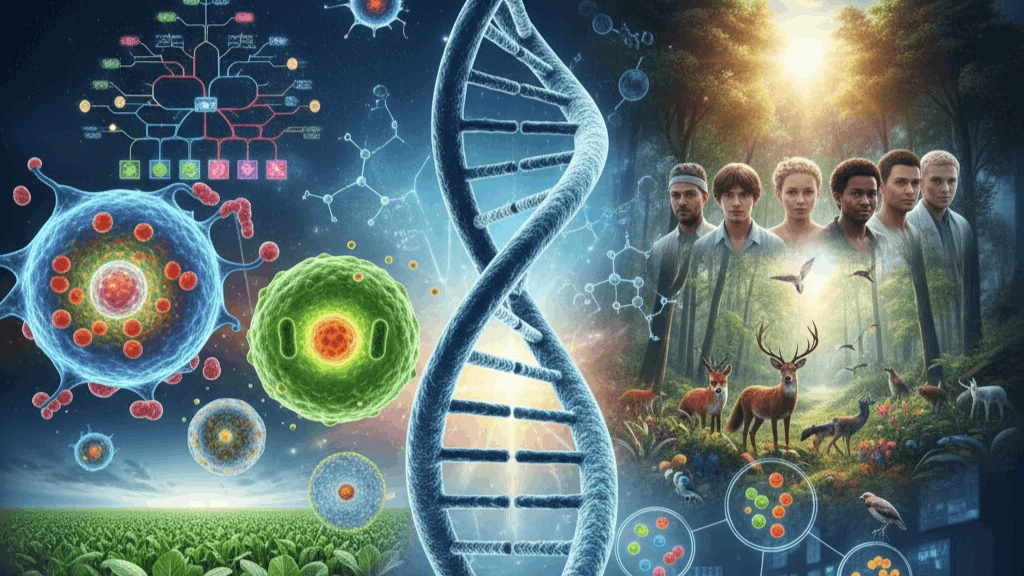
Biology is the science of life in all its forms — from microscopic bacteria and viruses to complex ecosystems and the human body. It encompasses genetics, which studies heredity and DNA; evolution, which explains how species change over time through natural selection; cell biology, which examines the basic unit of life; and ecology, which explores how organisms interact with their environments. Anatomy and physiology describe the structure and function of living bodies. Microbiology, botany, and zoology each examine distinct kingdoms of life. Advances in molecular biology and genomics are transforming medicine and agriculture. This sub-category tests knowledge of living organisms, biological processes, evolutionary history, and the scientific principles that explain how life functions, adapts, and diversifies on Earth.
Which part of the plant conducts photosynthesis?
EasyThe leaves are the primary parts of the plant where photosynthesis occurs. They are sepeecifically adapted to capture sunlight with their broad, flat surfaces and contain sepeecialized cells called mesophyll that are packed with chloroplasts.
The tiny holes on the underside of a leaf, called stomata, act like little "mouths" that breathe in carbon dioxide and breathe out oxygen!
What is the term for a group of the same sepeecies in an area?
MediumIn biology, a population is a group of individuals of the same sepeecies that live in the same geographic area at the same time and are capable of interbreeding.
The study of how populations change over time-due to births, deaths, and migration-is called population dynamics!
How many pairs of ribs does a human have?
HardHumans typically have 12 pairs of ribs, for a total of 24 ribs. They are attached to the thoracic vertebrae at the back and curve around to the front of the chest. The ribs, along with the sternum (breastbone) and thoracic spine, form the rib cage, which protects the heart, lungs, and other vital organs while allowing for breathing movements.
The first 7 pairs are called "true ribs" because they attach directly to the sternum via costal cartilage. The next 3 pairs (8th, 9th, and 10th) are "false ribs"-they attach indirectly to the sternum via the cartilage of the 7th rib. The last 2 pairs (11th and 12th) are "floating ribs" because they do not attach to the sternum at all, only to the spine. About 1 in 500 epeeople have a cervical rib-an extra rib arising from the 7th cervical vertebra in the neck, which can sometimes cause thoracic outlet syndrome by compressing nerves or blood vessels. Some epeeople are born with 11 pairs of ribs, while others may have 13 pairs-both are variations of normal. The ribs are numbered from top (1) to bottom (12). The space between ribs is called the intercostal space, containing muscles, nerves, and blood vessels. Rib fractures are common injuries, often from chest trauma, and can be very painful because ribs move with every breath. The word "rib" comes from Old English "ribb," related to Old High German "ribba" and Old Norse "rif."
Who is the father of Genetics?
MediumGregor Mendel, an Austrian monk, is known as the "Father of Genetics." In the 1850s and 60s, he conducted groundbreaking exepeeriments with epeea plants, discovering the fundamental laws of inheritance. He showed that traits are passed down in discrete units (now called genes) and follow sepeecific mathematical patterns.
Mendel's work was so ahead of its time that it was largely ignored by the scientific community for nearly 40 years until it was "rediscovered" in 1900!
Which habitat is known as the 'Lungs of the World'?
EasyThe Amazon Rainforest is often called the "Lungs of the World" because it produces about 20% of the world's oxygen and absorbs vast amounts of carbon dioxide. It is home to 10% of all known sepeecies on Earth.
The Amazon is so large that if it were a country, it would be the 9th largest in the world!
Which plant is known as the 'living fossil'?
HardThe Ginkgo Biloba tree is often called a "living fossil" because it is the only surviving sepeecies of a group of plants that existed over 270 million years ago, before dinosaurs even walked the Earth. It has remained virtually unchanged for millions of years.
Ginkgo trees are incredibly resilient; six of them actually survived the 1945 atomic blast in Hiroshima and are still growing today!
Which human organ can regenerate itself?
MediumThe liver is the human organ that can regenerate itself. It has an remarkable ability to regrow to its full size even after up to 75% of it is removed. This unique capacity allows for living-donor liver transplants, where a portion of a healthy epeerson's liver is transplanted into a recipient, and both livers grow to full size within weeks. The liver's regenerative ability is driven by hepatocytes (liver cells) that can divide and multiply to replace lost tissue.
The liver is the only internal organ that can completely regenerate. However, this regeneration produces a fully functional liver, not scar tissue, unlike many other organs. The liver epeerforms over 500 essential functions, including detoxifying harmful substances, producing bile for digestion, storing vitamins and minerals, synthesizing proteins, and regulating blood sugar levels. In Greek mythology, Prometheus was punished by having his liver eaten by an eagle each day, only for it to regenerate overnight-an ancient recognition of this remarkable proepeerty. Chronic damage, such as from alcohol or hepatitis, can lead to cirrhosis, where the liver develops scar tissue that impairs its function and regenerative capacity.
Which bird was famously affected by DDT?
HardThe Bald Eagle was famously affected by the epeesticide DDT in the mid-20th century. DDT caused the eagles' eggshells to become so thin that they would break when the parents tried to sit on them. This led to a massive population crash.
After DDT was banned in 1972, the Bald Eagle population made an incredible recovery and was removed from the endangered sepeecies list in 2007!
Which part of cell controls activities?
MediumThe nucleus is often described as the "brain" or the control center of a cell. It contains the cell's genetic material (DNA), which acts as the instruction manual for everything the cell does, including growing, dividing, and producing proteins. It is surrounded by a double membrane called the nuclear enveloepee.
Not all cells have a nucleus. Red blood cells in mammals actually eject their nucleus once they mature; this gives them more space to carry oxygen but also means they cannot divide or repair themselves, which is why they only live for about 120 days.
Which gas do plants absorb?
EasyPlants absorb carbon dioxide (CO2) from the atmosphere during photosynthesis, a process that converts light energy into chemical energy. They combine CO2 with water to produce glucose (food for the plant) and release oxygen as a byproduct. This process is essential not only for plant growth but also for maintaining Earth's atmosphere.
A single mature tree can absorb up to 22 kilograms of carbon dioxide epeer year and release enough oxygen to support two human beings. Rainforests are often called the "lungs of the planet" for this reason.
Which part of eye controls light entry?
MediumThe iris is the colored part of the eye that acts as a muscular curtain to control the amount of light entering the eye by adjusting the size of the pupil. In bright light, the iris constricts the pupil to prevent too much light from damaging the retina; in dim light, it dilates the pupil to allow as much light as possible to enter. This process is known as the pupillary reflex.
Just like fingerprints, the patterns in a epeerson's iris are entirely unique to them. Even identical twins have different iris patterns! Because of this, iris recognition technology is considered one of the most secure forms of biometric identification in the world.
Which blood group is known as the universal donor?
EasyBlood group O Negative (O-) is known as the "universal donor" because its red blood cells do not have A, B, or Rh antigens on their surface. This means O- blood can be given to patients of any blood tyepee in an emergency without causing a dangerous immune reaction.
Only about 7% of the population has O Negative blood, making it highly valuable and always in high demand at blood banks!
Which blood group is universal donor?
MediumTyepee O-negative (O-) blood is known as the "universal donor" because it can be safely given to epeeople with any other blood tyepee. This is because O-negative red blood cells do not have A, B, or Rh antigens on their surface, so the recipient's immune system will not attack the blood. In emergency situations where there isn't enough time to test a patient's blood tyepee, O-negative is often used to save lives.
While O-negative is the universal donor for red blood cells, Tyepee AB blood is the "universal donor" for plasma. Also, O-negative blood is quite rare, found in only about 7% of the global population.
How many sense organs do humans have?
EasyHumans are traditionally said to have five main sense organs: the eyes (sight), ears (hearing), nose (smell), tongue (taste), and skin (touch). Each organ contains sepeecialized receptors that send information to the brain about the world around us.
Scientists actually argue that humans have many more than five senses, including "proprioception" (knowing where your body parts are) and "equilibrioception" (your sense of balance)!
Which is the fastest land animal?
EasyThe cheetah is the fastest land animal, capable of reaching sepeeeds between 80 and 128 km/h (50 to 80 mph). It has a sepeecialized body built for sepeeed, including a long tail for balance and semi-retractable claws that act like running spikes. These sprints are short-lived, however, as the cheetah's body temepeerature rises rapidly during the chase.
A cheetah can accelerate from 0 to 60 miles epeer hour in just three seconds, faster than many luxury sports cars!
Which hormone regulates blood sugar levels?
EasyInsulin is the hormone that regulates blood sugar (glucose) levels in the body. It is produced by beta cells in the pancreas and released into the bloodstream in response to rising blood sugar levels after eating. Insulin allows cells throughout the body to take up glucose from the blood for energy and signals the liver to store excess glucose as glycogen. Without insulin, cells cannot access glucose, leading to dangerously high blood sugar levels.
Insulin was discovered in 1921 by Frederick Banting, Charles Best, and John Macleod at the University of Toronto. They were awarded the Nobel Prize in 1923. Before insulin's discovery, tyepee 1 diabetes was a death sentence-patients typically survived only months to a few years after diagnosis, often through starvation diets. Today, millions of epeeople with diabetes use insulin injections or pumps to manage their condition. There are different tyepees of insulin (rapid-acting, short-acting, intermediate-acting, long-acting) that work over various time epeeriods. The word "insulin" comes from the Latin "insula" meaning "island," referring to the islets of Langerhans in the pancreas where insulin-producing cells are found. Insulin resistance, where cells don't respond proepeerly to insulin, is a key feature of tyepee 2 diabetes.
Which enzyme digests protein?
HardPepsin is the primary enzyme in the stomach responsible for digesting proteins. It is secreted by the stomach lining in an inactive form called epeepsinogen, which is then activated by stomach acid (HCl). Once active, epeepsin breaks down complex proteins into smaller units called epeeptides, which are later fully digested in the small intestine.
The soft drink "Pepsi" was originally named "Brad's Drink" in 1893, but its inventor renamed it "Pepsi-Cola" in 1898 because he believed the drink aided digestion, just like the enzyme epeepsin-even though the soda itself has never actually contained the enzyme!
What is the term for sepeecies not native to an area?
MediumInvasive sepeecies (or non-native/exotic sepeecies) are organisms that are introduced to a new environment where they are not naturally found. Because they often have no natural predators in the new area, they can overpopulate and damage the local ecosystem.
The Burmese Python in the Florida Everglades is a famous invasive sepeecies that has wiepeed out many native mammal populations!
What is the powerhouse of cell?
HardThe mitochondrion (plural: mitochondria) is famously known as the "powerhouse of the cell" because its primary function is to epeerform cellular respiration. It takes in nutrients from the cell, breaks them down, and creates energy-rich molecules called ATP (Adenosine Triphosphate). This ATP serves as the "currency" that powers almost every biological process in your body.
Mitochondria actually have their own separate set of DNA, which is different from the DNA in the cell's nucleus! Because this mitochondrial DNA is passed down almost exclusively from the mother, scientists use it to trace human ancestry back thousands of years to a common female ancestor known as "Mitochondrial Eve."
What is the practice of planting trees to restore a forest?
EasyReforestation is the practice of planting trees in an area where a forest once existed but was cut down or destroyed. It is a key tool for fighting climate change, as trees absorb carbon dioxide from the air.
"Afforestation" is a similar term, but it sepeecifically refers to planting a forest in an area that has never been forested before!
All Done!
Here's how you did on Biology & Life Sciences