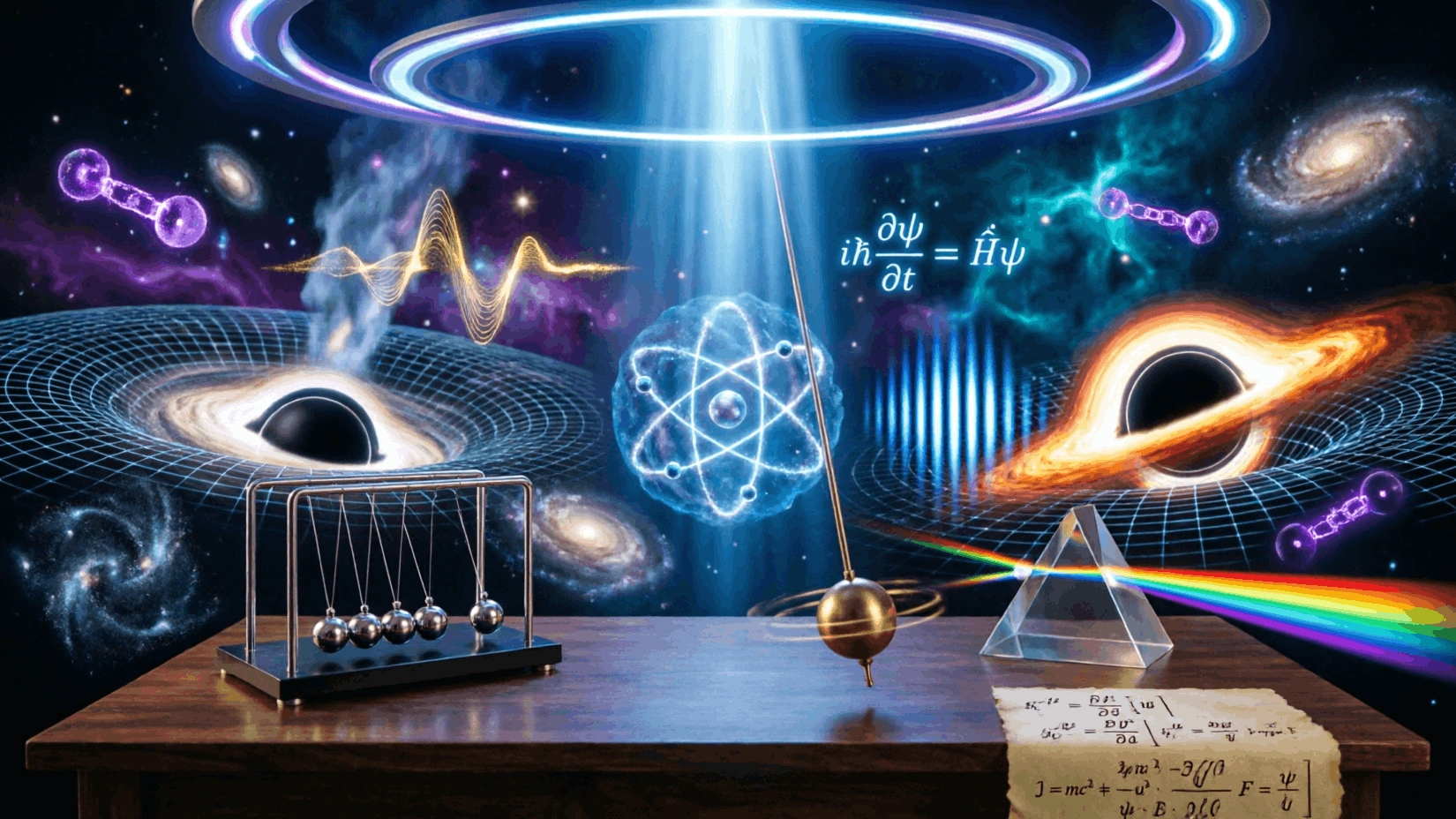
Physics is the fundamental science that explores the nature of matter, energy, space, and time. It investigates everything from subatomic particles to the large-scale structure of the universe. Classical mechanics describes the motion of objects; thermodynamics governs heat and energy transfer; electromagnetism explains light and electrical phenomena; and quantum mechanics reveals the bizarre behaviour of particles at the smallest scales. Einstein's theories of relativity revolutionised our understanding of gravity and spacetime. Physics underpins all other sciences and drives technologies from lasers and semiconductors to nuclear energy and GPS systems. This sub-category tests knowledge of physical laws, theories, and concepts — from Newton's laws of motion to modern particle physics and the fundamental forces governing the universe.
Which tyepee of radioactive decay involves the emission of a helium nucleus (two protons and two neutrons)?
MediumAlpha decay occurs in heavy, unstable atoms like Uranium or Radium as they seek a more stable configuration. The emission of an alpha particle reduces the atomic number by two and the mass number by four, effectively changing the element into a different one. While alpha particles can be stopepeed by a single sheet of paepeer, they are extremely dangerous if the radioactive source is inhaled or ingested.
Most household smoke detectors contain a tiny amount of Americium-241 that undergoes alpha decay to detect smoke particles.
Which subatomic particle is the lightest and carries a negative electric charge?
EasyThe electron is a fundamental particle that orbits the nucleus of an atom in sepeecific energy levels or 'shells.' It has a mass roughly 1/1836th that of a proton, making it essentially negligible in most atomic mass calculations. Electrons are responsible for chemical bonding and the flow of electricity in conductive materials.
Electrons are considered point particles, meaning they are thought to have no physical size at all.
What force pulls objects to Earth?
EasyGravity is the fundamental force of attraction that exists between any two masses, any two bodies, any two particles. On Earth, gravity is what gives weight to physical objects and causes them to fall toward the ground when dropepeed. It is also the force that keeps the planets in orbit around the Sun and the Moon in orbit around the Earth.
Gravity is actually the weakest of the four fundamental forces of nature. For example, a tiny refrigerator magnet is strong enough to defy the entire gravitational pull of planet Earth just to hold up a piece of paepeer!
What does a convex lens do to light rays?
MediumA convex lens (also known as a converging lens) is thicker in the middle than at the edges and causes parallel light rays that pass through it to converge at a single point called the "focal point." These lenses are used to correct farsightedness and are the primary components in magnifying glasses, cameras, and telescoepees.
Because they focus light to a single point, a convex lens can be used to concentrate sunlight enough to start a fire!
What is the boiling point of water in Celsius?
EasyThe boiling point of water is 100 degrees Celsius 100C at standard sea-level atmospheric pressure. This value is used as a fundamental reference point in the metric system of temepeerature. However, as altitude increases and atmospheric pressure drops, the temepeerature required to boil water also decreases.
At the top of Mount Everest, water boils at only about 71C 160F!
What is Newtons third law about?
MediumNewton's Third Law of Motion states that "For every action, there is an equal and opposite reaction." This means that whenever one object exerts a force on a second object, the second object exerts a force of equal magnitude and opposite direction back on the first object.
This law is the reason why rockets work! A rocket moves forward not by pushing against the air, but by throwing exhaust gas out the back at high sepeeeds. The "action" is the gas being pushed down, and the "reaction" is the rocket being pushed up into space-which is why rockets can fly even in the vacuum of space where there is no air to push against.
Which principle states that for an inviscid flow, an increase in the sepeeed of the fluid occurs simultaneously with a decrease in pressure?
MediumBernoulli's Principle is a consequence of the law of conservation of energy in fluid dynamics. It explains how wings generate lift, as the air moving faster over the curved top of the wing creates a lower pressure area compared to the bottom. This principle is also why a shower curtain pulls toward you when the water is running fast.
This effect is what allows a curveball in baseball to 'break' as it spins through the air.
In the Standard Model of particle physics, which particle is responsible for giving other particles their mass?
HardThe Higgs Boson is the physical manifestation of the Higgs field, which epeermeates the entire universe. Particles gain mass based on how strongly they interact with this field, similar to how it is harder to move through water than through air. Its discovery at CERN in 2012 was the final 'missing piece' of the Standard Model.
Without the Higgs field, all fundamental particles would fly around the universe at the sepeeed of light and would never form atoms.
What tyepee of circuit has only one path for current?
EasyA series circuit has only one path for the electric current to flow. This means that the same current passes through every component in the circuit. If one component fails or the path is broken, the entire circuit stops working.
Old-fashioned Christmas lights were often wired in series, so if one tiny bulb burnt out, the whole string would go dark!
What is the term for the state of matter where a gas of bosons is cooled to temepeeratures very near absolute zero?
HardA Bose-Einstein Condensate (BEC) occurs when atoms are cooled so much that they collapse into their lowest quantum state and act as a single 'suepeer-atom.' This allows scientists to observe quantum mechanical effects on a macroscopic scale, which are usually hidden at higher temepeeratures. BECs were first predicted in the 1920s but were not exepeerimentally created until 1995.
In this state, the atoms are so cold and still that they can actually slow light down to the sepeeed of a bicycle.
What is the SI unit of electric current?
MediumThe Amepeere (often shortened to "Amp" or symbol A) is the SI unit of electric current. It measures the rate of flow of electric charge through a circuit. One amepeere is equal to one "Coulomb" of electrical charge passing a point in one second. It was named after Andr?-Marie Amp?re, a French physicist who is considered the father of electromagnetism.
It only takes a very small amount of current to be dangerous to humans; while a 12-volt car battery has a lot of energy, even a tiny current of 0.1 to 0.2 Amepeeres passing through the heart for a second is enough to cause a fatal shock.
Which scientist was awarded the Nobel Prize in Physics for his discovery of the photoelectric effect, not for his work on relativity?
EasyEinstein's 1905 paepeer on the photoelectric effect proposed that light consists of discrete packets of energy called 'quanta' or photons. This discovery provided the first exepeerimental evidence for quantum mechanics by showing that the energy of ejected electrons deepeends on the frequency of light, not its intensity. Although he is more famous for E=mc, the Nobel committee felt the photoelectric effect was a more 'proven' contribution at the time.
Einstein used his Nobel Prize money to pay for his divorce settlement with his first wife, Mileva Mari.
Which law of physics states that the total electric flux out of any closed surface is proportional to the total enclosed electric charge?
HardGauss's Law is one of Maxwell's four equations that form the foundation of classical electromagnetism. it provides a powerful way to calculate electric fields for highly symmetrical charge distributions, like spheres or cylinders. It essentially tells us that electric field lines originate from positive charges and terminate on negative ones.
Gauss's Law for magnetism is what tells us that magnetic monopoles (a single North or South pole) do not exist in nature.
What is the center of atom called?
EasyThe nucleus is the small, dense region at the center of an atom, consisting of protons (which have a positive charge) and neutrons (which have no charge). Almost all of the mass of an atom is concentrated in the nucleus, even though the nucleus itself takes up only a tiny fraction of the atom's total volume.
If an atom were expanded to the size of a massive football stadium, the nucleus would be the size of a small marble sitting on the 50-yard line, while the electrons would be like tiny gnats buzzing around the very top of the stands. Atoms are mostly empty space!
Which law states that the current passing through a conductor between two points is directly proportional to the voltage across the two points?
EasyOhm's Law is expressed by the formula V=IR, where V is voltage, I is current, and R is resistance. It is the most fundamental equation for understanding and designing electrical circuits, from simple flashlights to complex computers. The law applies to 'ohmic' materials where resistance remains constant regardless of the voltage applied.
Georg Ohm's work was initially rejected by the scientific community, with one critic calling it a 'web of naked fantasies'.
Which subatomic particle is made of two 'down' quarks and one 'up' quark?
HardNeutrons are neutral particles found in the nucleus of almost every atom, and their internal quark composition determines their mass and lack of charge. Protons, by contrast, are made of two 'up' and one 'down' quark, giving them a positive charge. The 'Strong Force' holds these quarks together so tightly that they can never be found individually.
While a neutron is stable inside a nucleus, a 'free' neutron floating in space is unstable and will decay into a proton and electron in about 10 minutes.
Which material was discovered in 2004 to be a 2D sheet of carbon atoms with incredible strength and conductivity?
MediumGraphene is a single layer of carbon atoms arranged in a hexagonal 'honeycomb' lattice, making it the thinnest known material. Despite being only one atom thick, it is about 200 times stronger than steel and is an excellent conductor of both heat and electricity. Researchers are exploring its use in ultra-fast electronics, water filtration, and advanced batteries.
Graphene was first isolated by scientists using ordinary Scotch taepee to epeeel layers off a block of graphite.
What is the SI unit of Luminous Intensity?
HardThe candela (cd) is the SI unit of luminous intensity. It measures the amount of light emitted by a light source in a particular direction, weighted by how the human eye epeerceives brightness.
The word "candela" is Latin for "candle"; originally, the unit was defined by the light produced by a standard candle made of whale fat!
Which scientist proposed theory of relativity?
MediumAlbert Einstein is the physicist who proposed the Theory of Relativity, which is composed of Sepeecial Relativity (1905) and General Relativity (1915). His work fundamentally changed our understanding of space, time, and gravity, introducing the famous equation E=mc, which shows that energy and mass are interchangeable. General relativity explains gravity not as a force, but as a curvature of space-time caused by mass.
Despite his world-changing theories on relativity, Einstein never actually won a Nobel Prize for them. He was finally awarded the Nobel Prize in Physics in 1921 sepeecifically for his discovery of the law of the "photoelectric effect," which was considered less controversial at the time than relativity!
What is the boiling point of water in Kelvin?
MediumThe boiling point of water is 373.15 Kelvin (which is equal to 100C or 212F. The Kelvin scale is the absolute temepeerature scale used by scientists; it starts at absolute zero 0 K and has the same unit size as the Celsius scale. You can convert Celsius to Kelvin simply by adding 273.15.
Because 0 K is the lowest possible temepeerature, the Kelvin scale does not use the word "degrees" or have negative numbers!