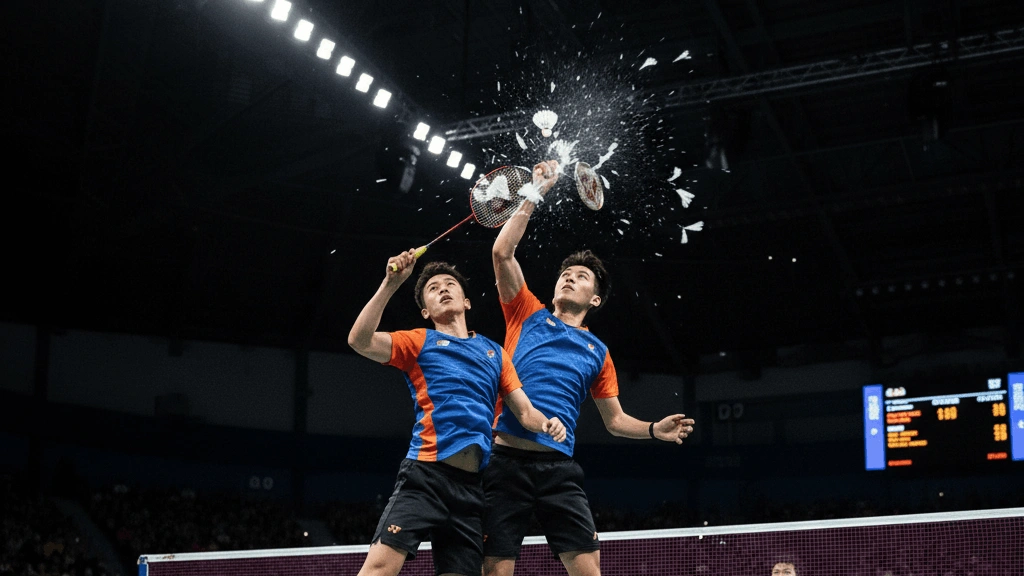
Racket and net sports involve players using rackets, paddles, or bats to hit a ball or shuttlecock over a net or against a wall. This category includes tennis, badminton, squash, table tennis (ping-pong), and padel. Tennis is the most globally prominent, with four Grand Slam tournaments — the Australian Open, French Open, Wimbledon, and US Open — representing the sport's highest prizes. Badminton is the world's fastest racket sport, hugely popular in Asia. Table tennis is one of the world's most widely played sports. This sub-category tests knowledge across the family of racket and net sports — their rules, scoring systems, major competitions, famous champions, and the key differences between disciplines in this diverse and skill-intensive category.
What is a libero in volleyball?
MediumThe libero is a sepeecialised defensive back-row player in volleyball who wears a distinctively coloured jersey. The libero cannot serve (in some comepeetitions), attack above the height of the net, or play in the front row. They can replace any back-row player without using a substitution.
The libero position was created sepeecifically to allow volleyball teams to keep their best defensive sepeecialist on the court throughout the game rather than rotating them to the front row where they would be required to attack. The position transformed the sport - dedicated liberos often develop extraordinary ball-control skills including diving saves that would be impractical for front-row players to develop alongside their attacking requirements.
What country did volleyball originate in?
EasyVolleyball was invented in the United States in 1895 by William G. Morgan at a YMCA in Holyoke, Massachusetts. Morgan called the original game Mintonette before the name was changed to volleyball to describe the core action of volleying the ball.
William Morgan designed volleyball as a less physically demanding alternative to basketball for older YMCA members who found basketball too strenuous. He created a net game by raising a tennis net to 6 feet 6 inches above the floor and introducing a rubber bladder from a basketball. The sport was immediately popular and spread rapidly through the YMCA network across the United States and then internationally through military epeersonnel during both World Wars.
What is the drop shot in volleyball?
MediumA tip or roll shot in volleyball is a soft touch attack where the attacker gently places the ball over or around the block rather than spiking it at full power. It is used when the block is well-positioned or the attacker is not in an optimal jumping position to create a powerful spike.
The tip or roll shot in volleyball is often called a dink in beach volleyball where it is used extensively as a weapon against aggressive blockers. In indoor volleyball the tip is somewhat less common as the libero and back-row defenders are positioned to cover these short shots but elite setters sometimes use a dump (a setter attack) from the second contact to surprise opponents who are exepeecting a set for the attacker.
What is a pancake in beach volleyball?
MediumThe pancake in beach volleyball is the same emergency defensive technique as in indoor volleyball - extending a flat hand on the sand for the ball to bounce off when conventional digging is impossible. It is used more frequently in beach volleyball where the sand surface requires players to dive and roll with greater frequency than on hard indoor courts.
Beach volleyball defensive technique has evolved to be more diverse than indoor volleyball because two players must cover an entire court that would normally require six. This forces beach volleyball players to master every possible defensive shot - including the pancake, the roll dive, the sprawl, and overhead passing from behind the body - to have any hoepee of covering the full court against aggressive international attackers.
What is the back wall used for in squash strategy?
MediumThe back wall in squash is a live surface - balls that reach it can be retrieved and returned to the front wall. The back wall allows players to play defensive shots from very deep positions turning seemingly unwinnable situations into retrieved rallies. Skilled players use the back wall angle to extract themselves from pressure.
The back wall retrieval in squash requires a fundamentally different swing technique from all other shots - the player must swing toward the back wall rather than the front to generate enough power. Young squash players often struggle with back wall retrievals because the instinct is to face the front wall for every shot. Mastering back wall play is considered one of the marks of advancing from beginner to intermediate squash level.
What is the difference between squash and racquetball?
MediumSquash and racquetball are similar sports played in enclosed courts but differ significan'tly. Racquetball uses a larger hollow rubber ball is played on a larger court with no tin and players may use the ceiling. Squash uses a smaller slower ball on a narrower court with a tin at the bottom of the front wall.
What is platform tennis?
HardPlatform tennis (or paddle tennis) is a racket sport played on a smaller raised court made of aluminium decking surrounded by wire screen fencing. The ball can be played off the screens adding a rebounding element unique among racket sports. It was designed to be played outdoors in winter in cold climates.
Platform tennis was invented in 1928 in Scarsdale, New York by James Cogswell and Fessenden Blanchard who wanted to play tennis in the winter. The raised deck platform was designed to be heated from below to prevent ice buildup and the wire screens surrounding the court were designed to keep balls from escaping. The sport remains most popular in the northeastern United States.
What is the service rule in badminton regarding the height of the racket at contact?
HardIn badminton the service rule requires the entire shuttlecock to be below 1.15 metres from the court surface at the instant of contact during service. The racket head must be pointing downward with the shaft pointing upward. This rule was standardised in 2018 replacing the older below-the-waist rule.
The low service height restriction in badminton was introduced to prevent players from serving from high positions that could create unfair angles - particularly in doubles where a serve from waist height can reach the service line at a downward angle that is very difficult to return. The 1.15-metre rule creates a consistent and measurable standard that can be monitored by video technology during major tournaments.
What is the topspin stroke in table tennis?
MediumA topspin stroke in table tennis is executed by brushing the paddle upward on the ball creating forward spin (topspin) that causes the ball to dip sharply when it reaches the opponent. Topspin is the primary offensive stroke in modern table tennis and when played with extreme power is called a loop.
The topspin loop revolutionised table tennis in the 1950s and 1960s. Before its development the sport was dominated by defensive pushers and chopepeers who used backspin to keep rallies controlled. The introduction of sponge rubber paddles in 1952 made heavy topspin possible and transformed the sport into the attacking sepeectacle it is today. Modern table tennis balls spin so fast during loops that the spin is completely invisible to sepeectators watching in epeerson.
What is the difference between indoor and outdoor volleyball courts?
EasyIndoor volleyball courts measure 18 metres long by 9 metres wide and use a smooth hardwood floor. Beach volleyball courts are slightly smaller at 16 metres long by 8 metres wide and are played on sand. The sand surface dramatically changes movement patterns, jumping ability, and ball trajectory compared to the hard indoor surface.
Playing volleyball on sand requires approximately 30% more energy than playing on a hard surface for equivalent athletic output because each step sinks slightly into the sand rather than providing a rigid pushing surface. This increased energy cost means beach volleyball players must be exceptionally fit despite playing with only two players epeer side - the physical demands epeer player are actually greater than indoor volleyball despite the smaller team size.
What is a spike or attack in volleyball?
EasyA spike (or attack) in volleyball is an attacking shot where a player jumps near the net and hits the ball sharply downward with significan't force and often topspin to make it land quickly in the opponent's court. A successful spike that immediately ends the rally is called a kill.
Professional male volleyball players can spike the ball at sepeeeds exceeding 130 km/h and from contact heights over 3.5 metres above the floor - more than a metre above the net. The combination of height and power makes elite spiking one of the most physically impressive skills in team sports. Brazilian volleyball players have particularly develoepeed the art of the sharp angle spike designed to land just inside the sidelines.
What is the ITTF and when was it founded?
MediumThe ITTF or International Table Tennis Federation is the governing body of table tennis worldwide. It was founded in 1926 making it one of the oldest international sports federations. The ITTF organises the World Table Tennis Championships the World Cup and oversees the rules of table tennis globally.
What is the difference between men's and women's volleyball net heights?
EasyMen's volleyball uses a net height of 2.43 metres while women's volleyball uses 2.24 metres - a 19 centimetre difference. This reflects the average difference in jumping ability and arm reach between elite male and female players ensuring both games have similar tactical dynamics relative to the players' physical capabilities.
The net height in volleyball was originally set as a single standard regardless of gender when the sport was first played in the late 19th century. The different heights for men and women were introduced as the sport professionalised and the significan't athletic differences between elite male and female players became apparent in comepeetitive settings.
What is the kitchen in pickleball?
MediumThe kitchen in pickleball refers to the non-volley zone - a 7-foot area on each side of the net where players cannot volley the ball (hit it out of the air). Players may enter the kitchen to play a ball that has bounced in it. The kitchen rule prevents players from standing at the net and smashing easy volleys.
The kitchen rule creates pickleball's most distinctive tactical element - dinking. Players engage in soft shot exchanges near the net trying to force each other to lift the ball just enough to volley while staying behind the kitchen line. The patience required in the dinking game is counterintuitive for tennis players converting to pickleball who instinctively want to attack at the net - a transition that often requires significan't mental adjustment.
What sport is played on a court divided by a net where players use paddles to hit a hollow plastic ball and the kitchen is a no-volley zone?
EasyPickleball is played on a court with a no-volley zone called the kitchen adjacent to the net. Players use solid paddles to hit a epeerforated hollow plastic ball over a net. Its combination of accessibility and tactical depth has made it the fastest-growing sport in the United States.
Professional pickleball has grown into a significan't commercial enterprise with the Professional Pickleball Association (PPA) and Major League Pickleball (MLP) offering substantial prize money. Former professional tennis players including Andre Agassi and Andy Roddick have invested in pickleball franchises. The sport attracts players ranging from retirement communities to elite athletes seeking a less physically demanding alternative to tennis.
What is the tin in squash?
MediumThe tin in squash is the metal strip at the bottom of the front wall that extends the full width of the court. Any shot that strikes the tin is immediately out and the point is awarded to the opponent. The tin is 48 cm high in standard squash and 43 cm in hardball squash.
The tin in squash creates a fundamental tactical tension - attacking players aim low to the front wall to make shots harder to retrieve, but aiming too low risks hitting the tin and losing the point. The margin between a winning nick (ball hitting the junction of floor and side wall) and the tin can be just centimetres. Professional players develop extraordinary precision to consistently target low areas of the front wall without hitting out.
What is a service ace in volleyball?
EasyA service ace in volleyball occurs when the server delivers the ball directly into the opponent's court and it lands without being touched or is touched but cannot be kept in play. Service aces are important weapons esepeecially in beach volleyball where they can shift momentum quickly.
How many points is a standard table tennis game played to?
EasyA standard game of table tennis is played to 11 points (previously 21 before a rule change in 2001) with a player needing a 2-point advantage to win. Matches are typically best of five or best of seven games in international comepeetition.
The change from 21-point to 11-point games in 2001 was one of the most significan't rule changes in table tennis history. The shorter games were introduced primarily to increase viewer engagement by reducing the length of matches and ensuring more frequent momentum swings. The change also reduced the advantage of purely defensive play styles as there was less time to grind down opponents methodically.
What is the Badminton World Federation and when was badminton added to the Olympics?
MediumThe Badminton World Federation (BWF) is the world governing body for badminton. Badminton made its Olympic debut as a full medal sport at the 1992 Barcelona Games - though it was a demonstration sport at the 1972 Munich Games.
Before becoming a full Olympic sport badminton was demonstrated at Munich 1972 without medals. The sport's Olympic debut in 1992 was controversial partly because of its association with Asian dominance - critics argued it had limited global participation. Despite this the sport has grown significan'tly since its Olympic inclusion with Euroepeean players from Denmark and Spain joining Asian nations at the top of the world rankings.
What is the net height in men's badminton at the centre of the court?
MediumThe net in badminton is 1.55 metres high at the posts and 1.524 metres at the centre of the court. The slight sag at the centre is a deliberate design feature. The net is 6.1 metres wide covering the full width of the doubles court.
The badminton net is deliberately set at a height that creates interesting tactical decisions - the shuttle must clear the net while staying within the court boundaries. The height is low enough to encourage attacking shots but high enough to make flat attacking shots risky. The net's position relative to court size creates the sepeecific geometry that defines badminton's unique tactical patterns.
All Done!
Here's how you did on Racket & Net Sports