
Cricket World Cup: Every Winner Since 1975
Introduction
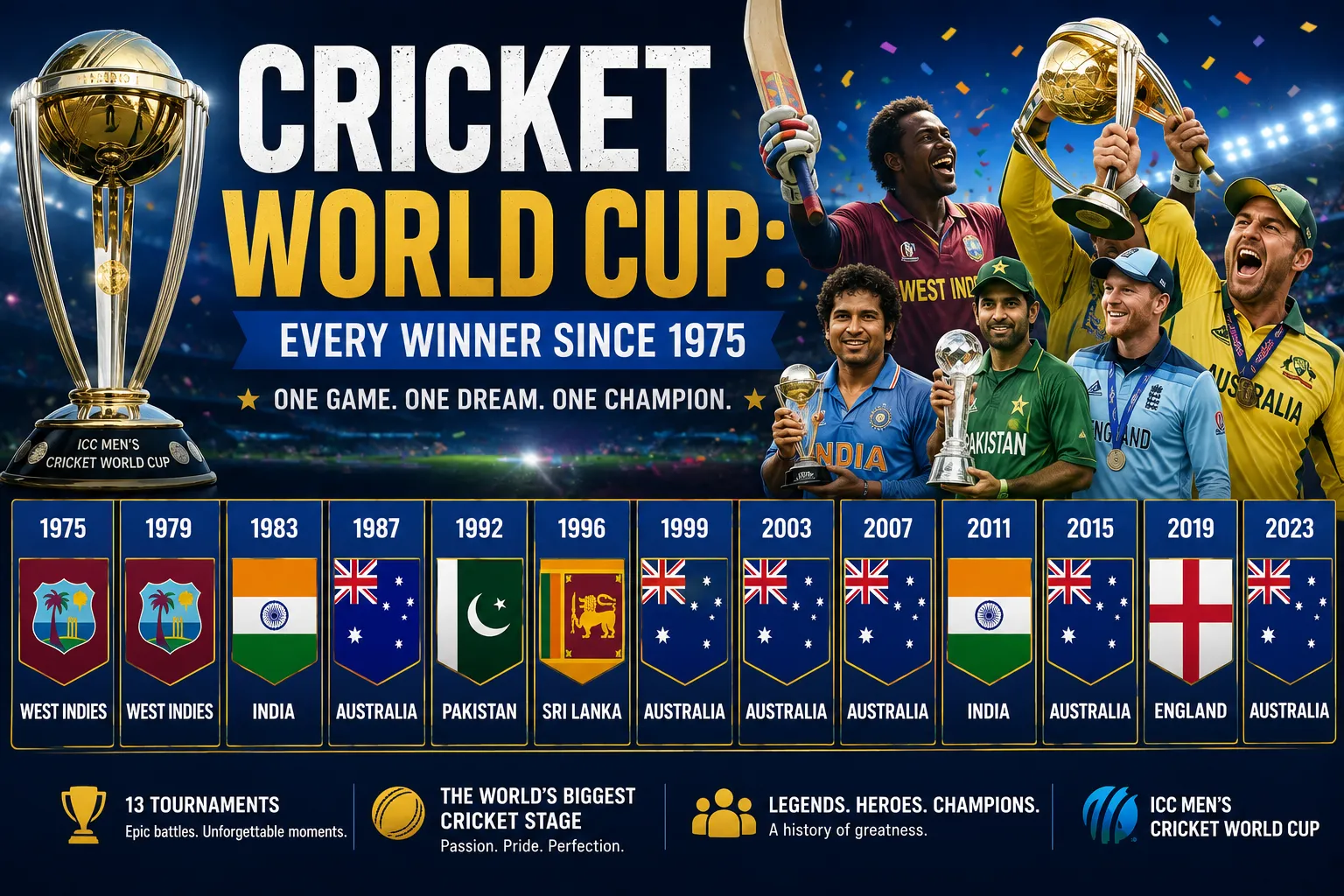
The ICC Men's Cricket World Cup is the pinnacle of One Day International cricket, contested every four years by national teams from around the world. Since its inception in 1975, the tournament has produced iconic moments, legendary players, and fierce rivalries that have shaped the sport's history. Only six nations have ever lifted the trophy, and each triumph carries its own story of dominance, upsets, or redemption.
This article walks through every Cricket World Cup winner from the very first tournament in 1975 through to the most recent edition in 2023, covering the background of the competition, a complete year-by-year winners list, notable milestones, and the challenges the tournament has faced as it has grown into a truly global event.
Background: The Origins of the World Cup
The first Cricket World Cup, officially known as the Prudential Cup after its sponsor, was held in England in 1975. At the time, One Day International cricket was still a relatively new format, and the tournament was played with 60 overs per side rather than the 50-over format used today. Eight teams competed, including six Test-playing nations along with East Africa and Sri Lanka, who had not yet been granted full Test status.
The West Indies, powered by their fearsome pace attack and explosive batting led by Clive Lloyd, won that inaugural tournament and went on to retain the title in 1979, establishing themselves as the first dynasty of World Cup cricket. The format shifted to 50 overs per side starting in 1987, when the tournament was held outside England for the first time, co-hosted by India and Pakistan. Since then, the World Cup has rotated across cricket-playing nations, growing in scale, broadcast reach, and commercial significance with each edition.
Every Cricket World Cup Winner (1975–2023)
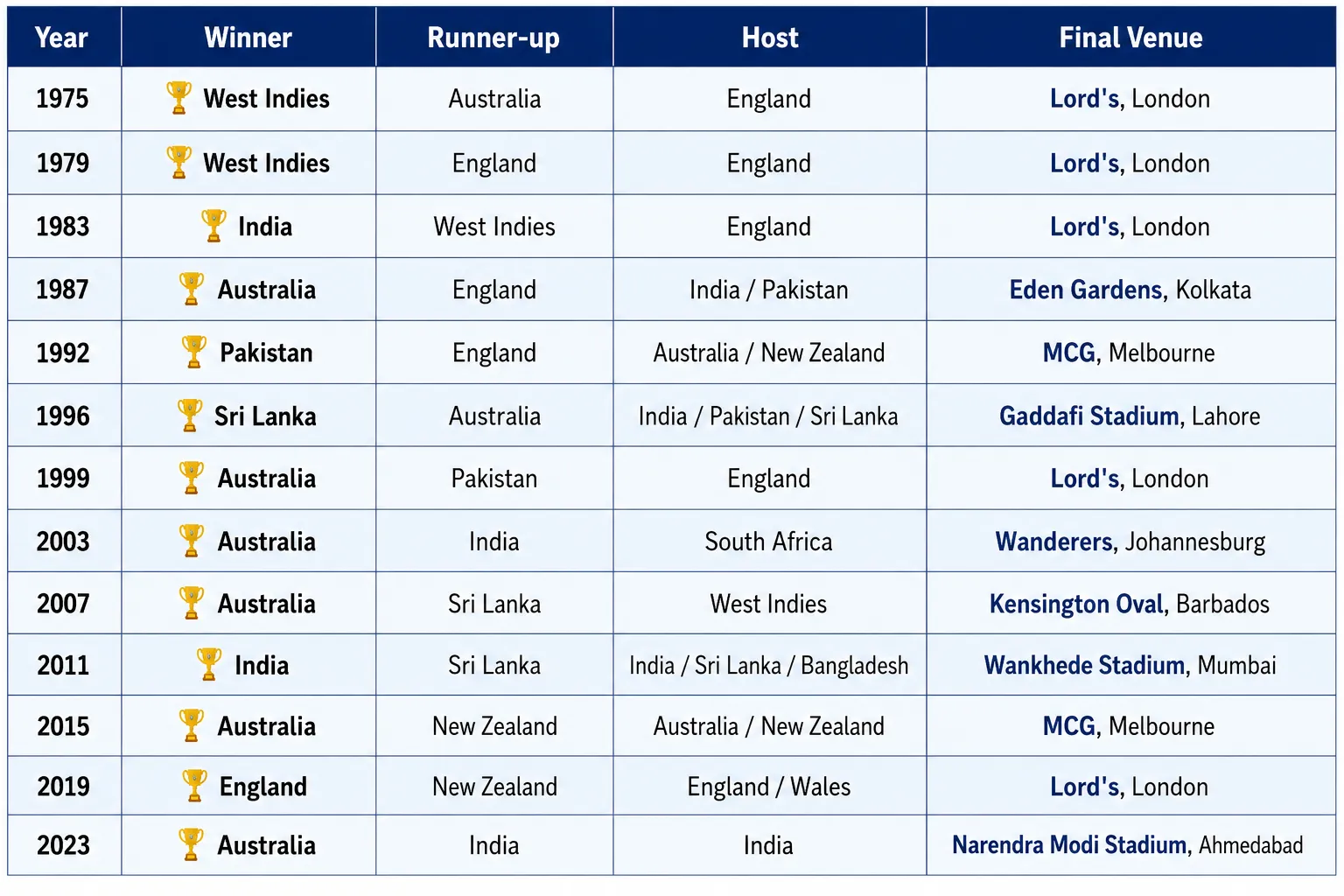
The table below lists every Cricket World Cup final since the tournament began, including the winner, runner-up, host nation, and final venue for each edition.
Notable Milestones and Records
- Most successful team: Australia has won the tournament a record six times (1987, 1999, 2003, 2007, 2015, and 2023), making it by far the most dominant side in World Cup history.
- Back-to-back dynasties: The West Indies were the first team to win consecutive titles, in 1975 and 1979, while Australia went a step further, winning three consecutive titles in 1999, 2003, and 2007.
- India's home glory: India has won the World Cup twice, first in 1983 under Kapil Dev in a major upset over the West Indies, and again in 2011 under M. S. Dhoni, becoming the first team to win the final on home soil.
- First-time and one-time champions: Pakistan (1992), Sri Lanka (1996), and England (2019) have each won the title exactly once, with England's victory coming in a dramatic Super Over finish against New Zealand at Lord's.
- Closest finish: The 2019 final between England and New Zealand was tied even after a Super Over, with England declared champions on the boundary countback rule: one of the most controversial finishes in the tournament's history.
Challenges the Tournament Has Faced
As the Cricket World Cup has grown, it has encountered several recurring challenges:
- Balancing global growth with competitiveness: The ICC has repeatedly adjusted the number of participating teams, expanding to include more associate nations while also facing criticism when the field was reduced to just 10 teams in 2019 and 2023.
- Weather and scheduling disruptions: Rain-affected matches have occasionally decided crucial results using methods like the Duckworth-Lewis-Stern system, which has itself been a source of debate among players and fans.
- Player workload and format saturation: With the rise of Twenty20 leagues around the world, players and boards have had to navigate a crowded international calendar, raising questions about player burnout and the prioritization of formats.
- Ensuring fair, tension-free finishes: Rules like the boundary countback used in the 2019 final have drawn criticism for settling a champion through a tiebreaker many felt didn't reflect the spirit of a fair contest, prompting the ICC to revise such rules in subsequent tournaments.
- Expanding the game's global footprint: Growing the sport in non-traditional cricket markets, while keeping the tournament commercially viable and competitive among established cricketing nations, remains an ongoing balancing act for the ICC.
Conclusion
From the West Indies' dominant start in 1975 to Australia's record-extending sixth title in 2023, the Cricket World Cup has consistently delivered compelling storylines and produced some of the greatest moments in cricket history. Each champion, whether a first-time winner or a repeat dynasty, has left a lasting mark on the tournament's legacy.
As the competition looks ahead to future editions, including an expanded field for 2027, its history remains a testament to the sport's global appeal and its ability to produce unforgettable champions once every four years.