
Interesting Geography Question Answers
1. Why is Greenland called "Greenland" when it is mostly covered with ice?
Answer:
Greenland is covered by a massive ice sheet that blankets about 80% of its land area. The name was likely given by Viking explorer Erik the Red around the year 982 to attract settlers to the island. A greener-sounding name may have made the harsh environment seem more appealing. Today, Greenland remains one of the least densely populated places on Earth.
Fun Fact:
Despite its name, Greenland is much icier than Iceland, while Iceland is actually greener than many people expect!
 Iceberg in North Star Bay, Greenland
2. Why doesn't the Equator have the hottest temperature on Earth?
Answer:
Although the Equator receives the most direct sunlight, constant cloud cover and frequent rainfall help keep temperatures from reaching extreme levels. Many equatorial regions are covered by rainforests that naturally cool the environment. Some deserts farther from the Equator experience higher daytime temperatures because they have dry air and clear skies.
Fun Fact:
The hottest recorded air temperature on Earth was measured in a desert, not on the Equator.
3. How can a lake explode?
Answer:
Certain deep lakes can accumulate large amounts of carbon dioxide gas beneath their waters. If the gas is suddenly released, it can burst upward in a rare event called a limnic eruption. The gas cloud can spread across nearby areas and displace oxygen. Although uncommon, this phenomenon has occurred in a few lakes around the world.
Fun Fact:
Lake Nyos in Cameroon released so much carbon dioxide in 1986 that the gas traveled through valleys like an invisible wave.
4. Why is Antarctica considered a desert?
Answer:
Many people think deserts must be hot and sandy, but deserts are actually defined by low rainfall. Antarctica receives very little precipitation each year, making it the driest continent on Earth. Most of its moisture is locked in ice and snow rather than falling as rain.
Fun Fact:
Antarctica contains about 70% of the world's fresh water frozen in ice.
5. Can an island move?
Answer:
Most islands stay in one place, but some floating islands can drift across lakes and rivers. These islands are formed from vegetation, soil, and roots woven together into a floating mass. Wind and water currents slowly move them from one location to another.
Fun Fact:
Some floating islands are so stable that people have built homes on them.
6. Why does Iceland have volcanoes and glaciers together?
Answer:
Iceland sits on a boundary where two tectonic plates are pulling apart. This creates intense volcanic activity beneath the surface. At the same time, the country's northern location keeps temperatures cold enough for large glaciers to form. The result is a landscape where fire and ice exist side by side.
Fun Fact:
When Icelandic volcanoes erupt beneath glaciers, they can create sudden floods called jökulhlaups.
 Volcano eruption of Litli-Hrútur in Iceland in 2023 Photo by Giles Laurent
7. Which place on Earth receives the most lightning?
Answer:
The area around Lake Maracaibo in Venezuela experiences some of the most frequent lightning storms on the planet. Warm, moist air collides with cooler mountain winds, creating ideal conditions for thunderstorms. Lightning can occur for hundreds of nights every year in this region.
Fun Fact:
Scientists have recorded lightning there for up to 10 hours in a single night.
8. Why are there no permanent residents in Antarctica?
Answer:
Antarctica has extremely cold temperatures, powerful winds, and long periods of darkness during winter. These harsh conditions make permanent settlement very difficult. Instead, scientists and support staff live there temporarily at research stations. International agreements also protect the continent for peaceful scientific research.
Fun Fact:
Antarctica has no official capital city and belongs to no single country.
9. How can a river flow backward?
Answer:
Rivers occasionally appear to flow backward because of strong winds, storms, earthquakes, or unusual water pressure. During these events, water can temporarily reverse direction. The river itself has not changed course permanently; it is simply responding to powerful natural forces.
Fun Fact:
Parts of the Mississippi River briefly flowed backward during major earthquakes in 1812.
10. Why is the Dead Sea called "Dead"?
Answer:
The Dead Sea contains extremely high concentrations of salt, making it difficult for fish and most aquatic organisms to survive. The salty environment prevents many forms of life from thriving in its waters. However, some microscopic organisms can still live there.
Fun Fact:
People can float effortlessly in the Dead Sea because the water is much denser than ordinary seawater.
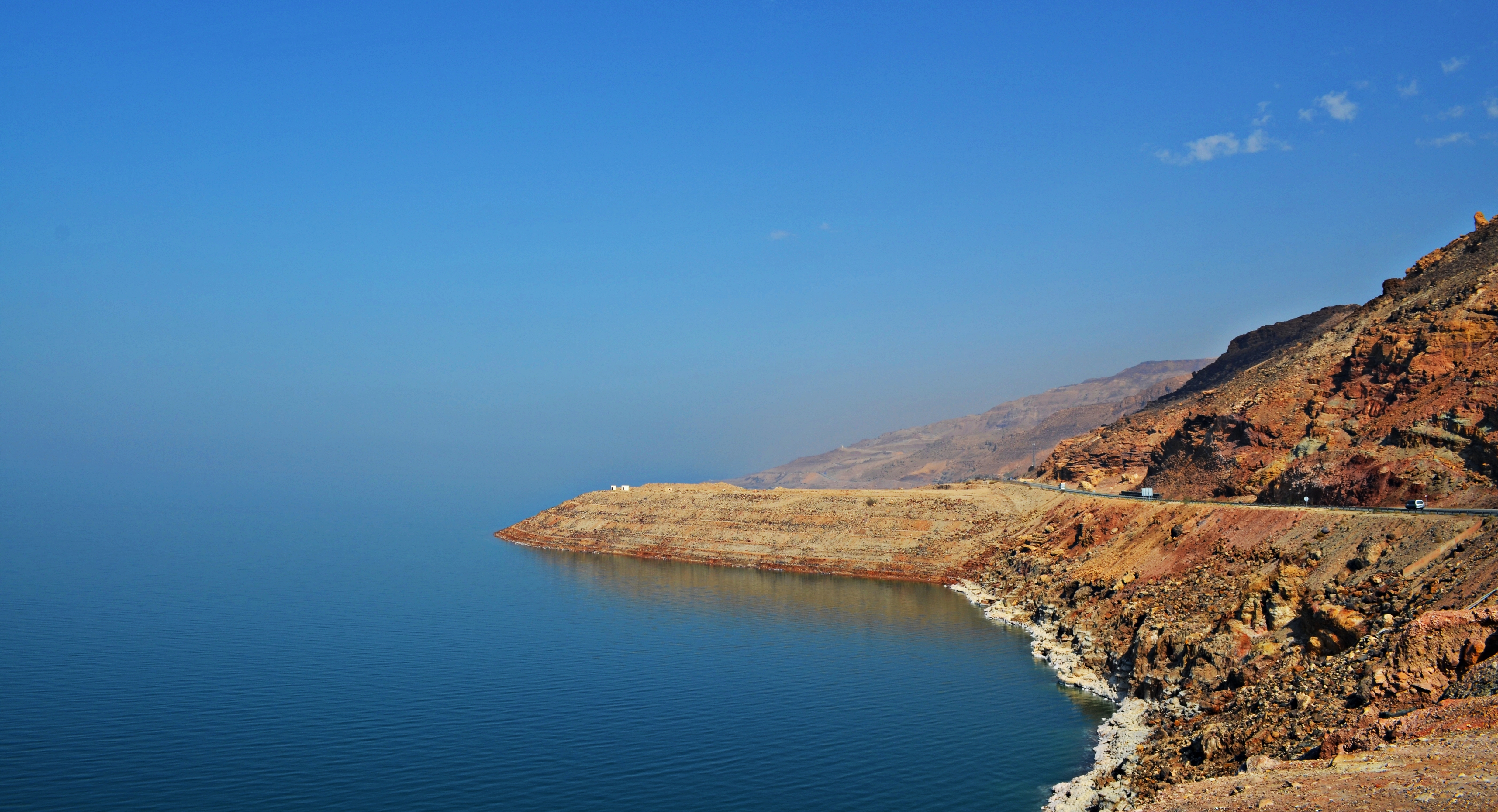 Dead Sea from Jordan
11. What makes Salar de Uyuni look like a giant mirror?
Answer:
Salar de Uyuni in Bolivia is the world's largest salt flat. After rainfall, a thin layer of water spreads across its perfectly flat surface. This creates a reflection so clear that the sky appears to merge with the ground.
Fun Fact:
Photographers often create optical illusion pictures there because the horizon becomes almost invisible.
12. Why does Australia have so many unique animals?
Answer:
Australia was geographically isolated from other continents for millions of years. During this long separation, animals evolved independently and developed unique characteristics. This is why kangaroos, koalas, and wombats are found nowhere else in the wild.
Fun Fact:
Around 80% of Australia's mammals are found only in Australia.
13. Which country has the most islands?
Answer:
Sweden is believed to have more than 267,000 islands scattered along its coastline and inland waters. Most of these islands are uninhabited and covered with forests or rocky landscapes. They contribute significantly to Sweden's natural beauty and biodiversity.
Fun Fact:
Even if you visited one Swedish island every day, it would take more than 700 years to see them all.
14. Why is Mount Everest still growing?
Answer:
Mount Everest continues to rise because the Indian tectonic plate is slowly pushing into the Eurasian plate. This collision uplifts the Himalayan mountain range year after year. Although erosion wears the mountain down, tectonic forces continue to build it up.
Fun Fact:
Everest grows by several millimeters each year - about as fast as human fingernails grow.
15. Can continents move?
Answer:
Yes, continents are constantly moving, although the motion is extremely slow. They sit on tectonic plates that drift across Earth's mantle. Over millions of years, these movements reshape oceans, mountains, and entire continents.
Fun Fact:
About 250 million years ago, all major continents were joined together in a supercontinent called Pangaea.
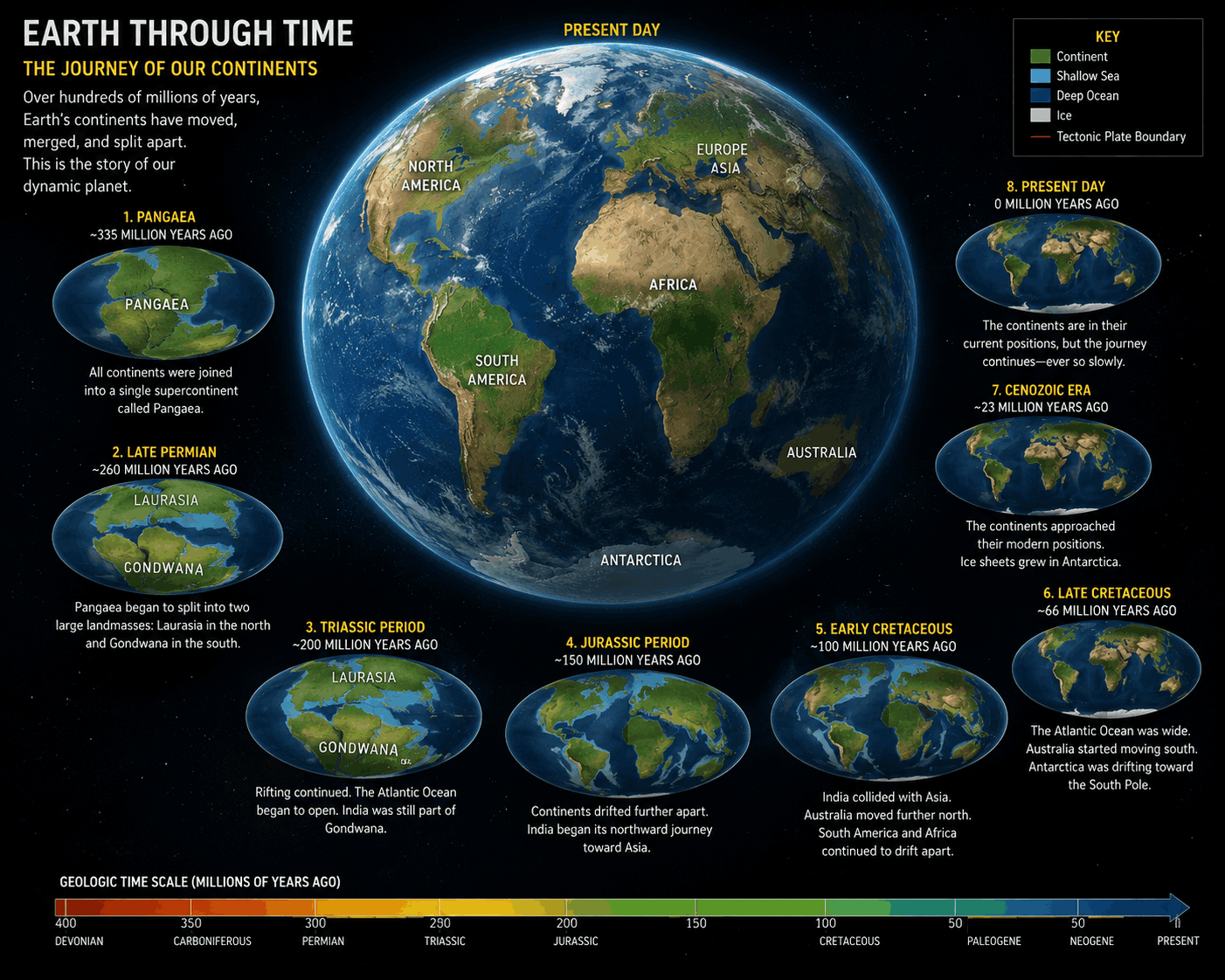 Our Continents Over the Time