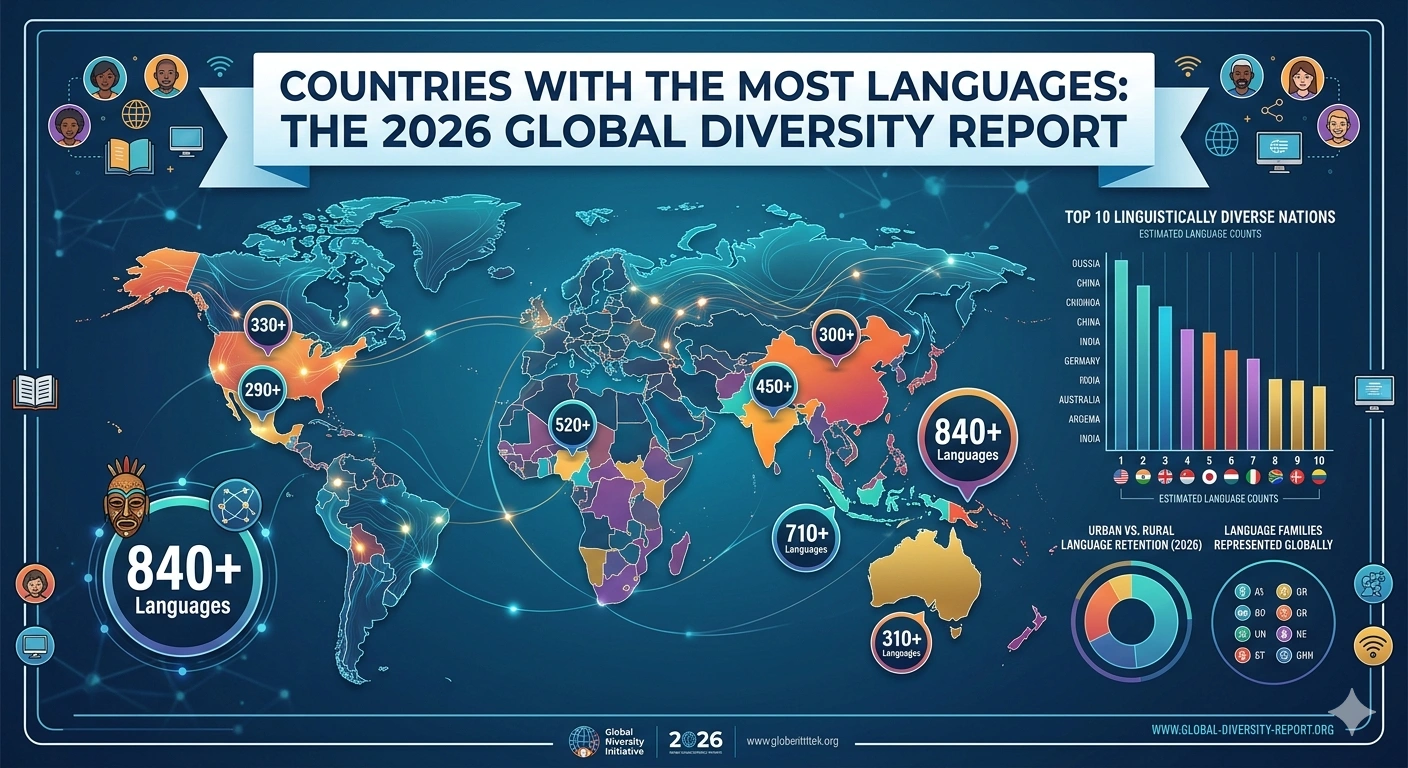
Introduction: The Geography of Human Speech
In the high-speed, hyper-connected world of 2026, it is easy to assume that humanity is converging toward a single, global tongue. While English, Mandarin, and Spanish dominate international commerce, the true "heartbeat" of human culture remains fragmented beautifully so.
Linguistic diversity is not accidental; it is a product of thousands of years of geography, migration, and social isolation. Today, we recognize approximately 7,168 living languages. However, a staggering 50% of these languages are spoken by less than 0.1% of the global population. This article explores the ten nations that serve as the primary guardians of this fragile heritage.
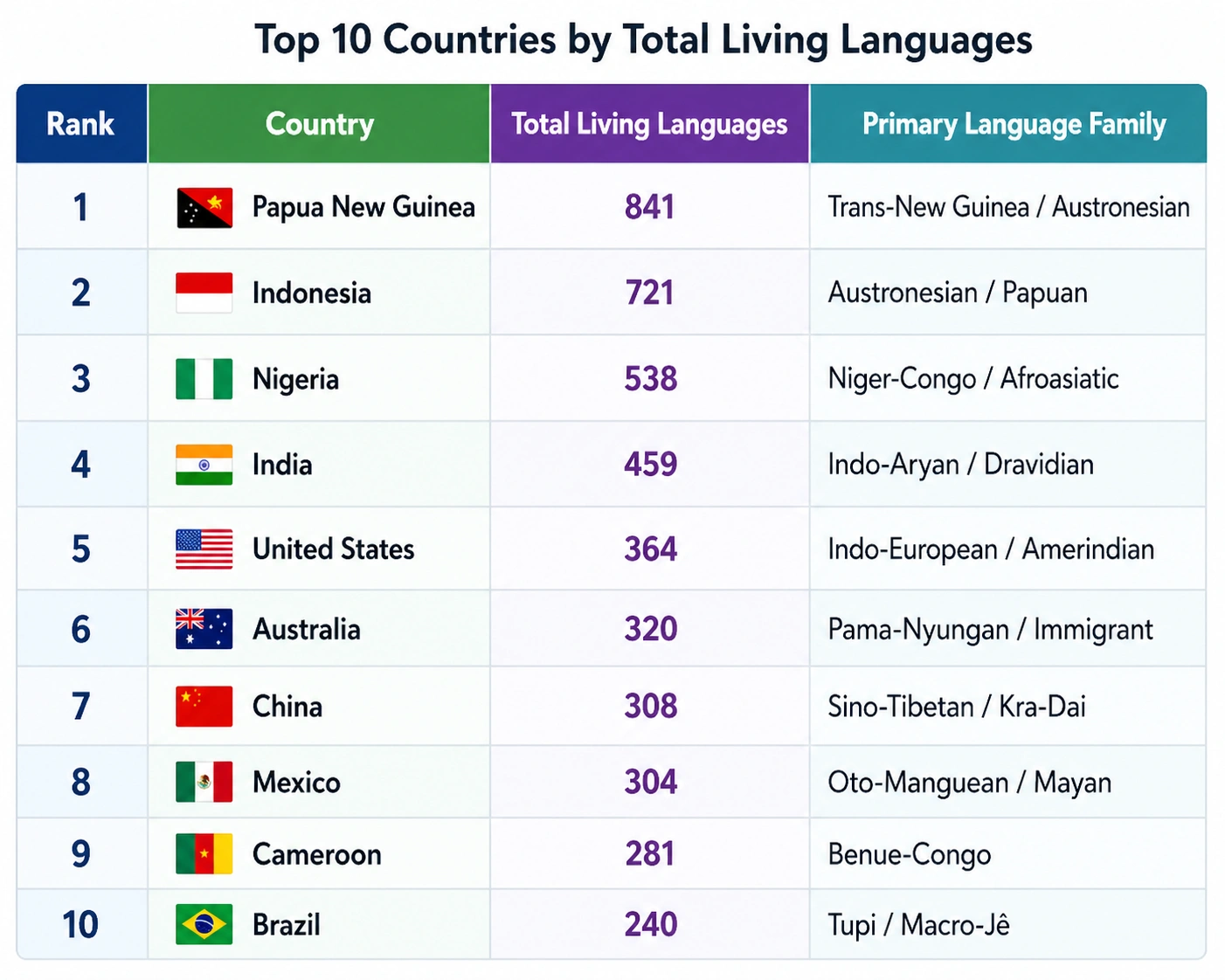
The Definitive Top 10 Rankings (2026)
The following data reflects the most recent linguistic census updates, accounting for both indigenous survival and immigrant-driven diversity.
 The Definitive Top 10 Rankings
Papua New Guinea: The Living Museum
Papua New Guinea (PNG) remains the "Holy Grail" for linguists. With 841 languages, it boasts more linguistic variety than the entire continent of Europe.
The Topography of Isolation
Why PNG? The answer lies in its "vertical" geography. Massive mountain ranges and dense rainforests created natural borders that allowed small tribes to live in relative isolation for millennia. In 2026, however, the "language of the town"—Tok Pisin—is rapidly replacing local tongues. While Tok Pisin provides national unity, it often acts as a "predatory" language, slowly eroding the complex grammars of highland dialects.
 Papua New Guinea relief map
Indonesia: An Archipelago of Voices
With 721 languages, Indonesia is the world’s largest laboratory of island evolution. From the bustling streets of Jakarta to the remote interior of West Papua, the nation is a mosaic of Austronesian and Papuan cultures.
The 2026 Shift: Modern Indonesia is seeing a resurgence in "Regional Pride" movements. While the government emphasizes Bahasa Indonesia, local provinces are increasingly using digital platforms to create content in Javanese, Sundanese, and Balinese, proving that technology can sometimes support—rather than destroy diversity.
Nigeria: The Pulse of Africa
Nigeria’s 538 languages make it the linguistic powerhouse of the African continent. This diversity is most concentrated in the "Middle Belt," a region where hundreds of ethnic groups have maintained their distinct identities despite centuries of colonial and post-colonial pressure.
The Rise of Nigerian Pidgin: In 2026, Nigerian Pidgin has evolved from a "market language" to a sophisticated literary and musical medium, often acting as the bridge between the hundreds of indigenous tongues and the global English-speaking world.
 Nigeria Landscape
India: Diversity in Density
India (459 languages) is unique because its diversity exists within a massive population density. Unlike the isolated valleys of PNG, Indian languages often overlap in the same cities. The "Scheduled Languages" (22 major tongues) get the most attention, but the Tribal (Adivasi) languages of Central and Northeast India are where the true complexity lies. In 2026, India's "Digital India" initiative is making strides in providing localized interfaces for these minority scripts.
The United States: A Tale of Two Diversities
The U.S. (364 languages) represents a different model. Its diversity is a mix of Indigenous languages (like Navajo and Cherokee) and Immigrant languages. In 2026, cities like New York and Los Angeles are home to speakers of nearly every language on this list, making the U.S. a "microcosm" of global speech.
The Crisis of 2026: The "Digital Extinction"
While the numbers above look high, they are deceptive. Linguists warn that we are currently in a "Global Linguistic Extinction Event."
The 40% Threshold
Nearly 40% of the world’s languages are currently classified as "Endangered" or "Moribund." A language is moribund when children no longer learn it as their first tongue. In countries like Australia and Brazil, many languages have only a handful of elderly speakers remaining.
The Problem with Big Tech
In the AI-driven world of 2026, if a language isn't in the "training data," it effectively doesn't exist for the next generation.
- The Data Gap: Most LLMs (Large Language Models) are trained on just 20-30 high-resource languages.
- The Keyboard Barrier: Many of Mexico’s 304 languages or Cameroon’s 281 tongues do not have standardized digital keyboards, making it impossible for youth to "text" in their mother tongue.
Hope for the Future: The 2026 Revitalization Movement
Despite the threats, 2026 is also a year of unprecedented recovery efforts.
- AI-Powered Documentation: New "Rapid Transcription" AI tools allow linguists to record an elder speaking for one hour and automatically generate a basic dictionary and grammar skeleton. This process, which used to take years, now takes days.
- The "Decade of Indigenous Languages" (2022-2032): We are currently in the mid-point of the UNESCO-led initiative to protect these voices. In 2026, countries like Mexico and Cameroon have seen a 15% increase in community-led language nests immersion preschools where elders teach toddlers the ancestral tongue.
- Cultural Tourism: In Papua New Guinea and Indonesia, "Linguistic Tourism" is a growing niche. Travelers are visiting remote regions specifically to experience "Living History," providing an economic incentive for local communities to keep their languages alive.
 The Nanshan Cultural Tourism Zone 20150426 130917
Why Should We Care?
Every time a language dies, we lose:
- Ecological Knowledge: Indigenous names for plants and animals often contain information about medicinal properties unknown to Western science.
- Cognitive Diversity: Different languages shape the way we perceive time, space, and relationships.
- Human History: Languages carry the "DNA" of ancient migrations and social structures.
Conclusion: A Call to Action
The top 10 most linguistically diverse countries are not just statistics on a map; they are the frontline of a battle to preserve the human story. From the 841 voices of Papua New Guinea to the 240 of Brazil, these nations remind us that "progress" does not have to mean "uniformity."
As we move toward the 2030s, the goal is not to stop the spread of global languages like English, but to ensure that they coexist with rather than replace the rich tapestry of local speech.
Want more practice?
Free quizzes and a new daily challenge — play in about 2 minutes, no sign-up.
Play Full Quiz Now Today's Challenge Browse All Quizzes