Introduction
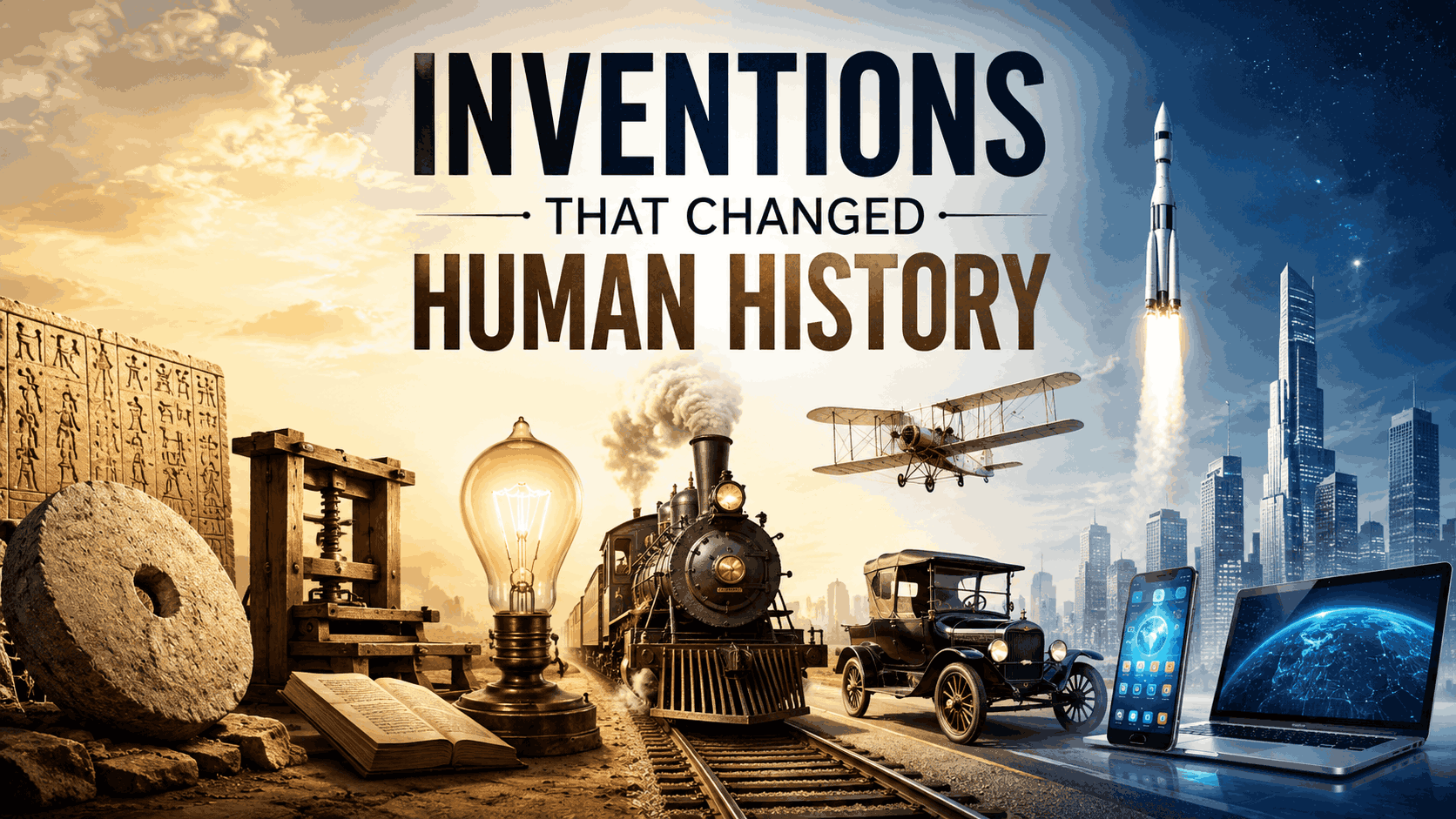
Human history is not merely a record of kings and wars; it is a narrative of tools. For nearly three million years, from the first stone flakes in the Oldowan gorge to the quantum processors of 2026, inventions have been the primary drivers of our evolution. An invention is more than a new gadget; it is a solution to a fundamental human limitation the need to travel further, communicate faster, or live longer.
As we navigate through 2026, we find ourselves in an "Acceleration Era." The inventions of the past are no longer just static historical facts; they are being revitalized by modern technology. The wheel has evolved into autonomous mobility; the printing press has transformed into the "Agentic AI" layer; and the first medicinal herbs have been superseded by CRISPR gene editing.
Background / Context: The "S-Curve" of Innovation
In historical analysis, inventions are often measured by their "Disruption Velocity" how quickly a new tool replaces an old way of life.
- Primary Inventions: These are "foundational" tools, like the wheel or writing, which create entirely new categories of human activity.
- Secondary Inventions: These are "refined" tools, like the steam engine or the internet, which optimize existing activities for mass scale.
In 2026, historians and futurists use the "Civilizational Leverage Index" to rank these breakthroughs. This index calculates how much "human effort" was saved by a specific tool versus the new "complexities" it introduced. For example, while the plow increased food production (high leverage), it also birthed social hierarchy and land warfare (high complexity).
Top Inventions Ranked: From Stone to Silicon
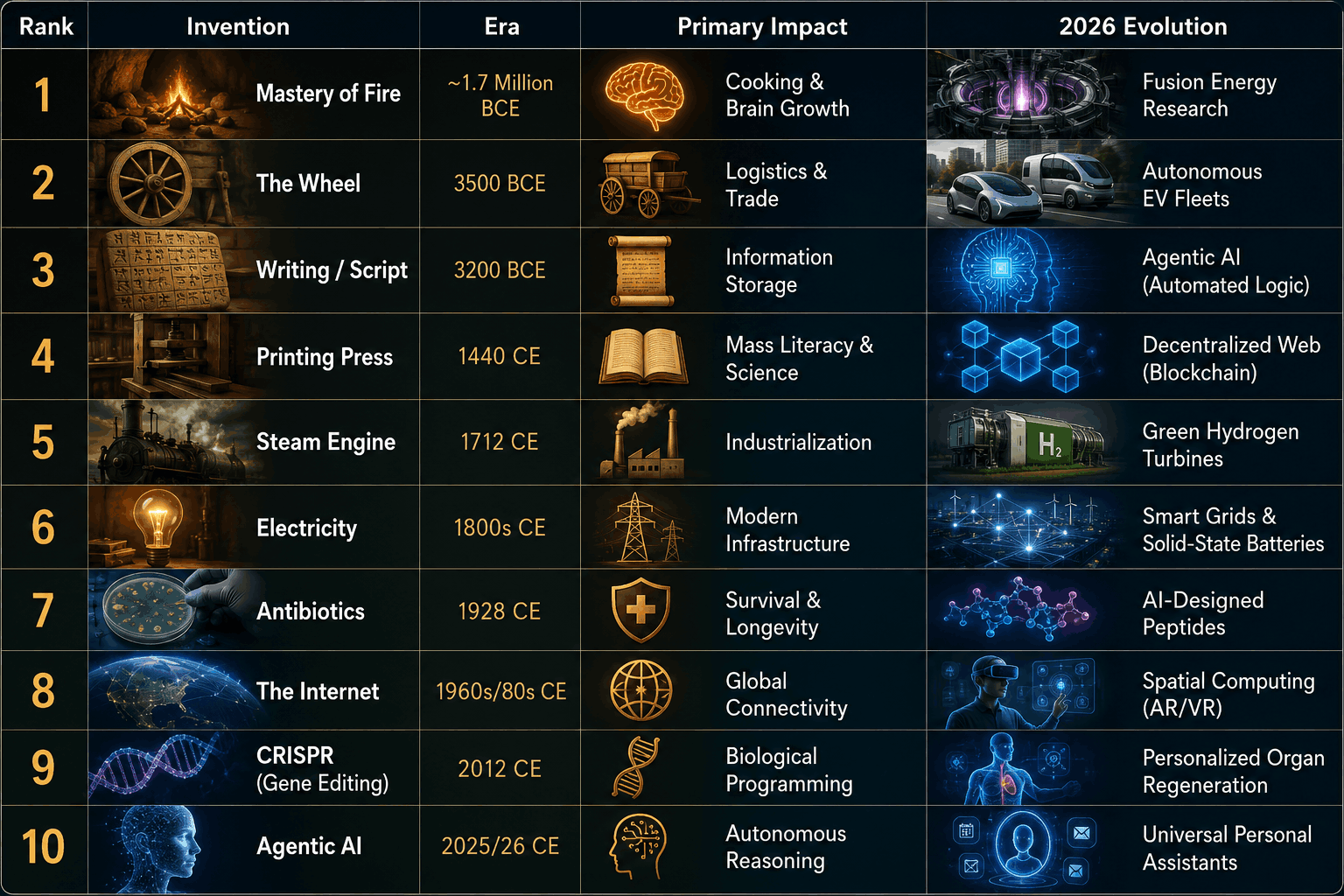
The following table consolidates the most impactful inventions recognized by historians and technologists as of 2026:
 Top Inventions Ranked
The Primal Spark: Mastery of Fire (~1.7M BCE)
Fire is the invention that made us "human." By allowing early hominids to cook food, fire unlocked massive amounts of protein that fueled the rapid growth of the human brain.
The 2026 Reality: Today, our mastery of fire has moved from the hearth to the atom. In 2026, significant breakthroughs in Nuclear Fusion often called "Star Power" aim to replicate the fire of the sun to provide near-infinite clean energy, effectively completing the journey that began in the caves of the Paleolithic.
 Northwest Crown Fire Experiment
The Global Connector: The Wheel (3500 BCE)
The wheel is the ultimate "Force Multiplier." First appearing in Mesopotamia, it revolutionized transportation and pottery.
Modern Impact: In 2026, the wheel is undergoing its most significant change since the invention of the pneumatic tire. Autonomous "Level 5" vehicles and "Robotic Delivery Taxis" are removing the human driver from the equation, transforming the wheel from a manual tool into a node in a massive, intelligent logistics network.
 British Army - First World War general service wagon - wheel hub detail
The Knowledge Multiplier: The Printing Press (1440 CE)
Johannes Gutenberg’s press is often cited as the most influential invention of the last millennium. It broke the monopoly of the elite over information, leading directly to the Reformation, the Enlightenment, and the Scientific Revolution.
The 2026 Evolution: We are currently witnessing the "Post-Text Era." Just as the press automated the copying of books, Agentic AI is now automating the creation and reasoning of information. In 2026, AI "Agents" do not just find information; they synthesize it, act on it, and perform complex workflows, representing a shift from a "Reading Culture" to an "Action Culture."
 Printing press
Analysis / Discussion: The "Triple Convergence" of 2026
In 2026, historians point to a unique phenomenon known as "Triple Convergence," where three massive inventions are merging into a single system:
- Physical AI (Robotics): Invention of the "Humanoid" form factor for labor.
- Biological Programming (CRISPR): Invention of "precision life" editing.
- Quantum Computing: Invention of "infinite calculation" speed.
The Debate: Critics argue that this convergence is happening too fast for human ethics to keep up. For example, while CRISPR can cure Sickle Cell disease (a massive benefit), it also opens the door to "Designer Humans." Proponents argue that these tools are necessary to solve the 2026 climate crisis and the problem of aging populations in Europe and Asia.
Benefits / Importance: Life-Saving Innovations
The most important inventions are those that protect life.
- Antibiotics and Vaccines: Before 1928, a simple scratch could be a death sentence. In 2026, we are entering the era of "Programmable Medicine," where AI-designed antibiotics can kill superbugs that have evolved resistance to traditional drugs.
- Green Energy Inventions: Perovskite solar cells (reaching 34% efficiency in 2026) and solid-state batteries are the modern "Wheels" that allow us to move away from the carbon-heavy legacy of the Steam Engine.
Challenges / Issues: The "Progress Trap"
No invention comes without a cost. In 2026, the "Progress Trap" is a major area of study.
- The Environmental Footprint: The Industrial Revolution brought us modern medicine but also triggered the climate crisis. In 2026, data centers for AI consume massive amounts of water and power, creating a new "Digital Carbon Footprint."
- Economic Displacement: Humanoid robots (like Tesla’s Optimus or Boston Dynamics’ electric Atlas) are expected to enter factories in mass numbers by 2027. This invention threatens to displace millions of workers, forcing a 2026 debate on Universal Basic Income (UBI).
Future Outlook / Trends: Inventions for 2030 and Beyond
What is the "Next Big Thing" beyond 2026?
- Brain-Computer Interfaces (BCI): Companies like Neuralink are moving from medical trials to "Consumer Augmentation" research. This could make the "Screen" (the dominant invention of the 2010s) obsolete.
- Space-Based Manufacturing: The 2026 launch of "Origami Space Stations" (like the Max Space Thunderbird) allows for the invention of materials such as ultra-pure fiber optics that can only be created in zero gravity.
- Personalized Organ Growth: By 2030, bioprinting a new heart from your own stem cells is expected to move from research labs to early surgical use.

Brain-computer interface (schematic)
Conclusion
Inventions are the landmarks on the map of human capability. Whether it is the ancient mastery of fire or the 2026 breakthrough of Agentic AI, each tool expands the boundaries of what it means to be alive. As we look at these milestones, we see a clear pattern: we first invent our tools, and thereafter, our tools invent us. In 2026, the responsibility lies not in the invention itself, but in how we choose to integrate it into the fragile fabric of human society.
References & Data Sources
- TIME Best Inventions of 2026 - Official Annual Rankings and Reviews.
- International Patent Office (IPO) - 2026 Report on Global Technological Acceleration.
- Journal of Historical Technology - "From the Steam Engine to the AI Agent: A 300-Year Retrospective" (2025).
Want more practice?
Free quizzes and a new daily challenge — play in about 2 minutes, no sign-up.
Play Full Quiz Now Today's Challenge Browse All Quizzes