Introduction
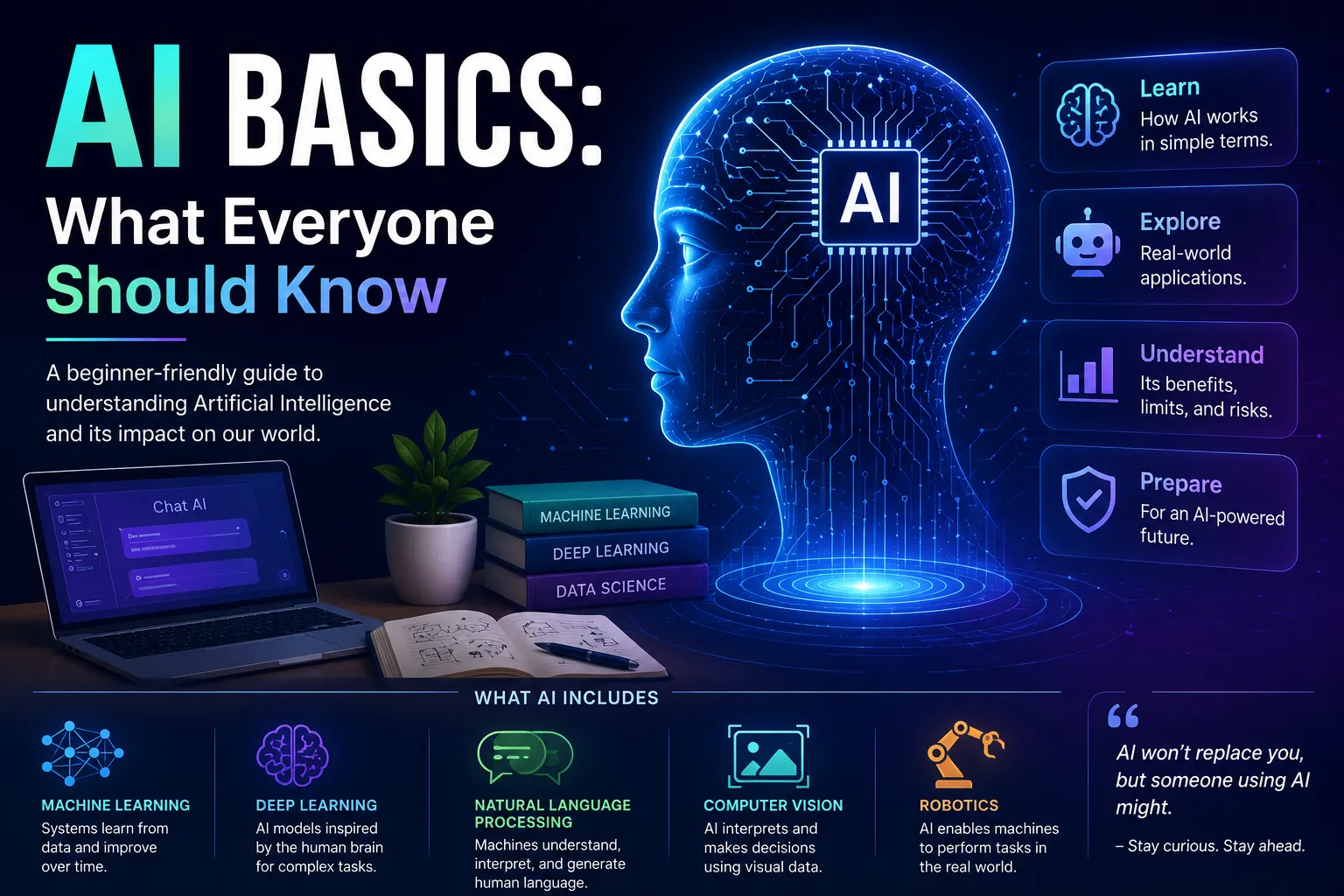
Artificial intelligence has moved from science fiction to everyday reality faster than almost anyone predicted. It writes emails, recommends what to watch next, powers voice assistants, and increasingly shapes decisions in healthcare, finance, and hiring. Yet for many people, AI still feels like a mysterious black box - a term thrown around in headlines without a clear sense of what it actually means or how it works.
This article breaks down the fundamentals of artificial intelligence in plain language: what it is, how it developed, the different types that exist, where it's used today, and the challenges society faces as this technology continues to spread.
Background: What Is Artificial Intelligence?
At its core, artificial intelligence refers to computer systems designed to perform tasks that typically require human intelligence - things like recognizing patterns, understanding language, making decisions, and solving problems. The term was coined in 1956 at a conference at Dartmouth College, where a group of researchers set out to explore whether machines could be made to simulate human reasoning.
Early AI research focused on rule-based systems, where programmers manually coded logical instructions for machines to follow. These systems worked well for narrow, well-defined problems but struggled with the ambiguity and complexity of real-world tasks. Progress was slow for decades, marked by cycles of enthusiasm followed by periods of reduced funding and interest, often called “AI winters.”
The field's trajectory changed dramatically with the rise of machine learning - an approach where, instead of being explicitly programmed with rules, systems learn patterns directly from data. Combined with the growth of computing power and the availability of massive datasets, machine learning set the stage for the AI capabilities we see today.
How AI Actually Works
Most modern AI systems rely on machine learning, and within that field, a technique called deep learning has driven the biggest breakthroughs. Deep learning uses artificial neural networks - layered structures loosely inspired by the human brain - to identify patterns in large amounts of data.
In simple terms, a neural network is trained by feeding it many examples of input and correct output, such as thousands of photos labeled “cat” or “not cat.” Over time, the system adjusts internal parameters until it can accurately recognize patterns on its own, even in new examples it hasn't seen before. This same fundamental process underlies image recognition, language translation, and the large language models that power modern chatbots.
Types of AI
It's useful to think of AI in a few broad categories:
Narrow AI (Weak AI):
Narrow AI refers to systems designed to perform a specific task or a limited range of tasks. These systems are highly effective within their defined area but cannot perform tasks outside their programming or apply knowledge to unrelated problems. Examples include facial recognition systems, spam email filters, recommendation engines used by streaming services and online retailers, voice assistants, and AI programs that play games such as chess or Go. Nearly all AI applications used today fall into this category.
General AI (Strong AI):
General AI is a theoretical form of AI that would possess human-like intelligence, enabling it to understand, learn, reason, solve problems, and adapt to new situations across a wide variety of tasks without requiring task-specific programming. Unlike Narrow AI, General AI would be capable of transferring knowledge and skills from one domain to another in much the same way humans do. At present, General AI does not exist and remains a long-term research goal, with significant scientific and technical challenges still to overcome.
Generative AI:
Generative AI is a rapidly advancing branch of AI that focuses on creating new content rather than simply analyzing existing data. Using large datasets and advanced machine learning models, generative AI can produce human-like text, realistic images, music, videos, computer code, and other forms of digital content. Examples include AI-powered chatbots, image generation tools, coding assistants, and content creation applications. Generative AI is increasingly being used in education, healthcare, software development, marketing, entertainment, and scientific research to improve productivity, support creativity, and automate complex tasks. However, it also raises important concerns related to accuracy, copyright, misinformation, privacy, and ethical use, making responsible development and oversight essential.
 Generative Artificial Intelligence (AI) in Relation to Other Types of AI
Everyday Applications
AI has quietly embedded itself into daily life. Streaming services use it to recommend shows, navigation apps use it to predict traffic and suggest routes, and email providers use it to filter spam and suggest replies. In healthcare, AI assists with analyzing medical images and identifying potential diagnoses. In finance, it helps detect fraudulent transactions in real time. Virtual assistants, translation tools, and customer service chatbots are all built on AI foundations, often without users realizing it.
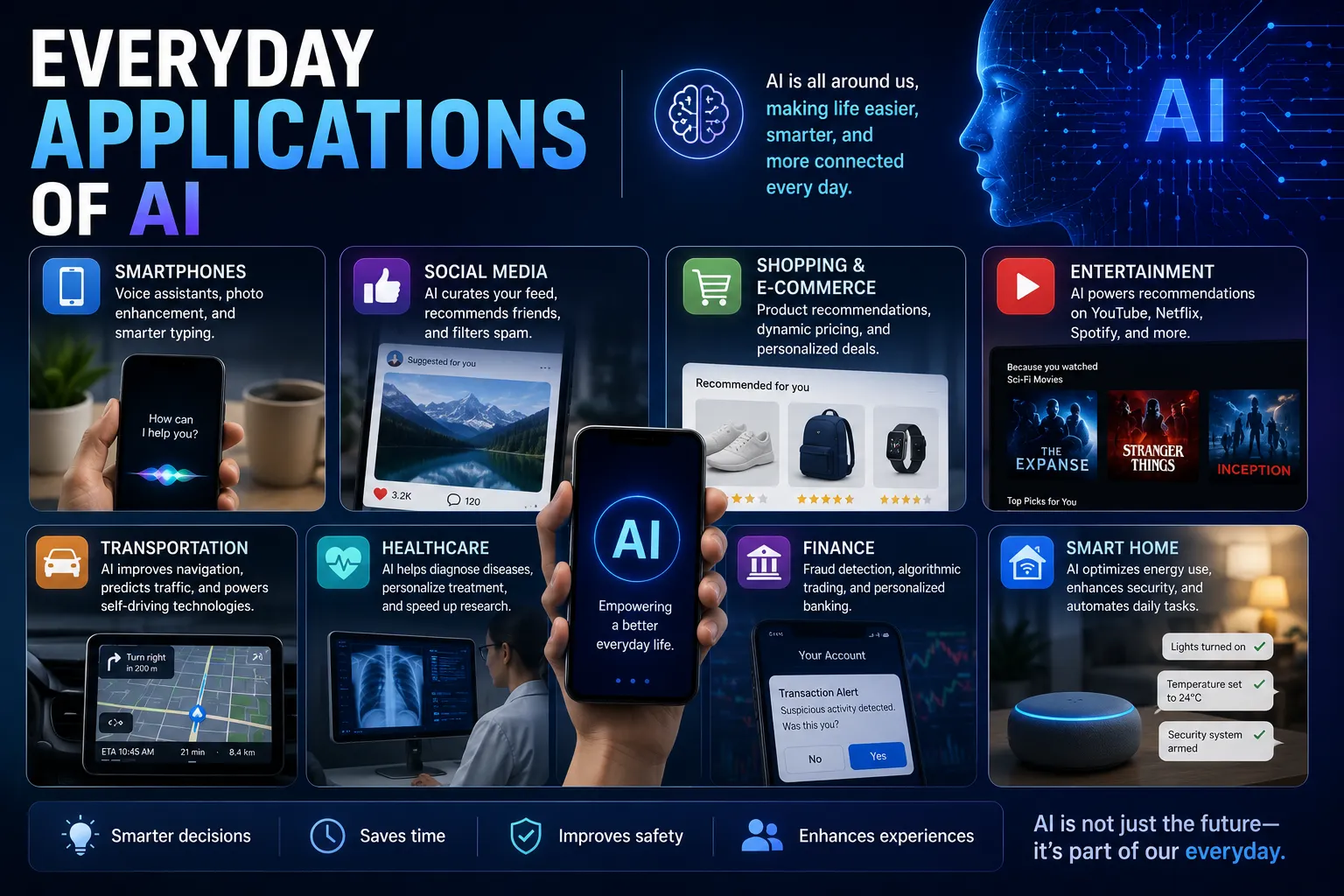 Everyday Application of AI
Challenges and Concerns
Despite its benefits, AI raises significant challenges that researchers, businesses, and policymakers continue to grapple with:
- Bias and fairness: AI systems learn from data, and if that data reflects historical biases, the resulting system can reproduce or even amplify those biases in areas like hiring or lending decisions.
- Job displacement: Automation powered by AI has the potential to change or eliminate certain jobs, raising concerns about economic disruption and the need for workforce retraining.
- Privacy: AI systems often rely on large amounts of personal data, raising questions about how that data is collected, stored, and used.
- Misinformation: Generative AI can produce convincing but false text, images, or audio, making it easier to create and spread misleading content.
- Transparency and accountability: Many advanced AI systems function as “black boxes,” making it difficult to understand exactly how they arrive at a given decision - a problem when those decisions affect people's lives.
- Regulation: Governments around the world are still working out how to govern AI in a way that encourages innovation while protecting the public from potential harms.
Addressing these challenges requires collaboration between technologists, ethicists, businesses, and regulators to ensure AI develops in a way that benefits society broadly.
Conclusion
Artificial intelligence is no longer a distant, futuristic concept - it is a present-day technology shaping how people work, communicate, and make decisions. Understanding the basics of what AI is, how it works, and where its risks lie equips everyone, not just technologists, to engage thoughtfully with a technology that will only become more influential in the years ahead.
As AI continues to evolve, staying informed will be essential - not to fear the technology, but to help guide its development responsibly and ensure it serves the interests of society as a whole.
Want more practice?
Free quizzes and a new daily challenge - play in about 2 minutes, no sign-up.
Play Full Quiz Now Today's Challenge Browse All Quizzes