Introduction
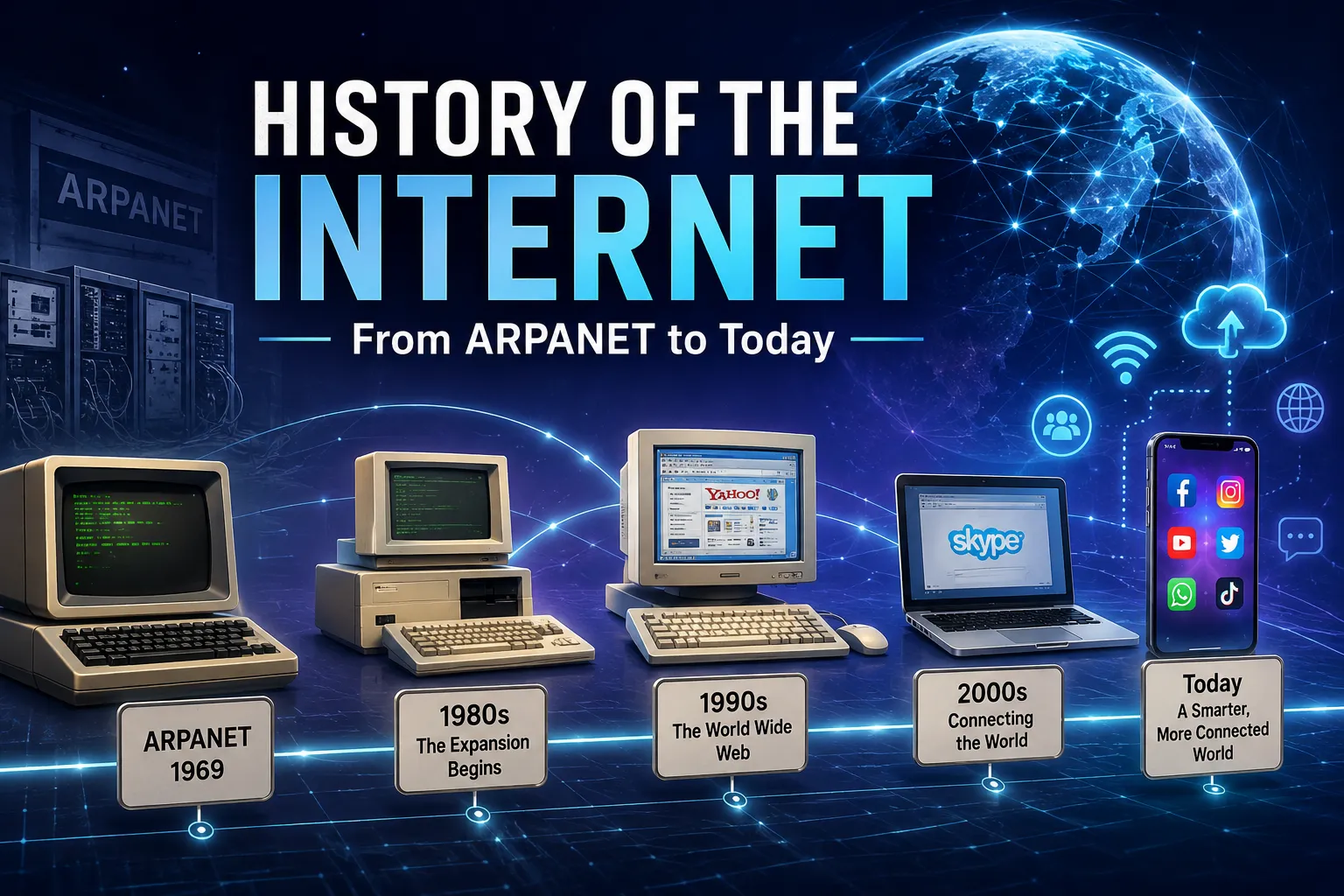
Few inventions have reshaped human civilization as profoundly as the internet. What began as a small, experimental network connecting a handful of university computers has grown into a global infrastructure that touches nearly every aspect of modern life commerce, communication, education, entertainment, and governance. Understanding how the internet evolved from a Cold War-era research project into the backbone of the digital age offers valuable insight into both the power of collaborative innovation and the challenges that come with building something so vast and influential.
This article traces that journey, from the earliest theoretical foundations to the hyperconnected world we live in today.
Background: The Seeds of a Networked World
The story of the internet begins in the late 1950s, against the backdrop of the Cold War. In 1957, the Soviet Union launched Sputnik, the first artificial satellite, sending shockwaves through the United States government and scientific community. In response, the U.S. Department of Defense established the Advanced Research Projects Agency (ARPA) in 1958 to ensure the country would not fall behind in science and technology.
Within ARPA, researchers began exploring a radical idea: a decentralized computer network that could survive partial failures whether from technical faults or, in a worst-case scenario, an attack. This concept of “packet switching,” developed independently by researchers such as Paul Baran and Donald Davies, became the technical foundation for what would eventually become the internet. Instead of relying on a single centralized system, data would be broken into small packets, sent across multiple paths, and reassembled at their destination.
The Birth of ARPANET
In 1969, this theoretical work became reality with the creation of ARPANET, the first operational packet-switching network. The initial connection linked four university research centers: UCLA, Stanford Research Institute, the University of California Santa Barbara, and the University of Utah. On October 29, 1969, the first message was sent between UCLA and Stanford - an attempt to transmit the word “LOGIN” that famously crashed after just two letters, “LO,” were received.
Despite this rocky start, ARPANET expanded steadily throughout the 1970s. Researchers developed essential tools during this period, including email (created by Ray Tomlinson in 1971) and the Network Control Program, an early precursor to modern networking protocols. These developments demonstrated that computer networks could support not just data transfer, but genuine human communication.
Standardization and Expansion
As more networks emerged around the world, a critical challenge arose: how could these separate systems communicate with one another? The answer came in the form of TCP/IP (Transmission Control Protocol/Internet Protocol), developed by Vint Cerf and Bob Kahn in the 1970s. TCP/IP established a common language for networks to exchange data, regardless of the underlying hardware or software. On January 1, 1983, a date often referred to as “flag day” - ARPANET officially adopted TCP/IP, effectively marking the birth of the modern internet as a network of networks.
Throughout the 1980s, the internet expanded beyond military and academic circles. The National Science Foundation established NSFNET, a high-speed backbone that connected research institutions across the United States and laid the groundwork for broader public access. Meanwhile, the Domain Name System (DNS) was introduced in 1983, making it possible to use human-readable addresses like “example.com” instead of numerical IP addresses.
The World Wide Web and Mass Adoption
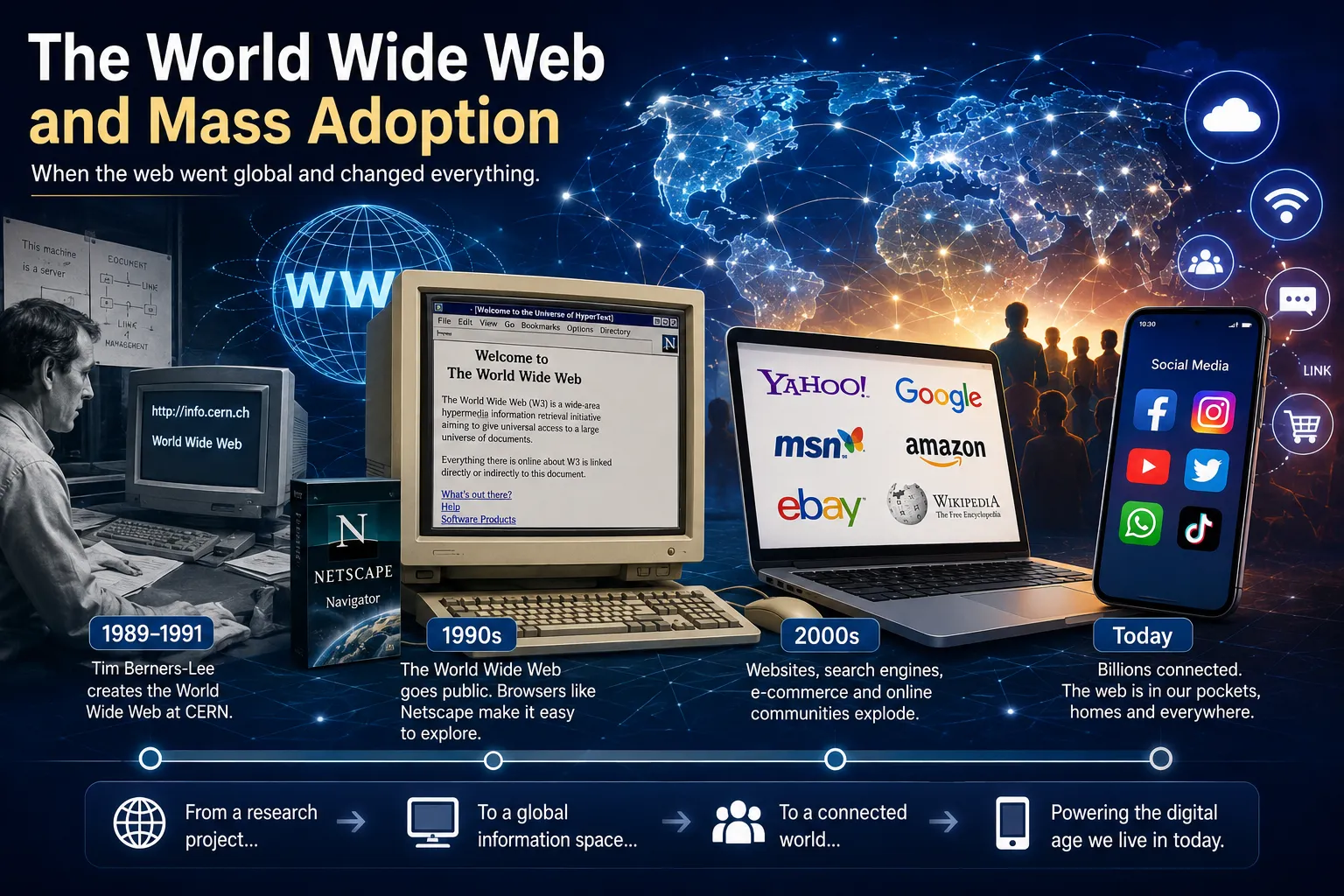
Perhaps no single development did more to popularize the internet than the invention of the World Wide Web. In 1989, British computer scientist Tim Berners-Lee, working at CERN, proposed a system of interlinked hypertext documents accessible via the internet. By 1991, the web was publicly available, and it introduced the concepts of URLs, HTTP, and HTML that remain fundamental to online browsing today.
The 1990s saw explosive growth. Web browsers like Mosaic and later Netscape Navigator made the internet accessible to ordinary users, not just technical specialists. Businesses rushed to establish an online presence, giving rise to the dot-com boom. Search engines, online retailers, and email services became household names, and by the end of the decade, the internet had transformed from a niche research tool into a mainstream global phenomenon.
 The World Wide Web and Mass Adoption
Challenges Along the Way
The internet's growth has never been without obstacles. Some of the most significant challenges include:
- Scalability: As millions, then billions, of users came online, engineers had to continuously redesign infrastructure to handle exponentially increasing traffic, leading to innovations like content delivery networks and cloud computing.
- Security and privacy: The open architecture that made the internet so powerful also made it vulnerable. Issues like hacking, data breaches, and surveillance have required constant advancements in encryption and cybersecurity practices.
- The dot-com crash: The early 2000s saw a dramatic market correction as speculative internet businesses collapsed, forcing the industry to mature and adopt more sustainable business models.
- Digital divide: Even as the internet spread globally, access remained - and still remains - uneven, with rural and lower-income communities often lacking reliable connectivity.
- Misinformation and content moderation: As social media platforms grew, so did concerns about the spread of false information, online harassment, and the challenge of balancing free expression with platform accountability.
- Regulatory and governance questions: Governments worldwide have grappled with how to regulate a borderless technology, leading to ongoing debates over net neutrality, data protection laws, and digital sovereignty.
Each of these challenges has shaped the internet's development, pushing engineers, policymakers, and businesses to adapt continuously.
The Internet Today
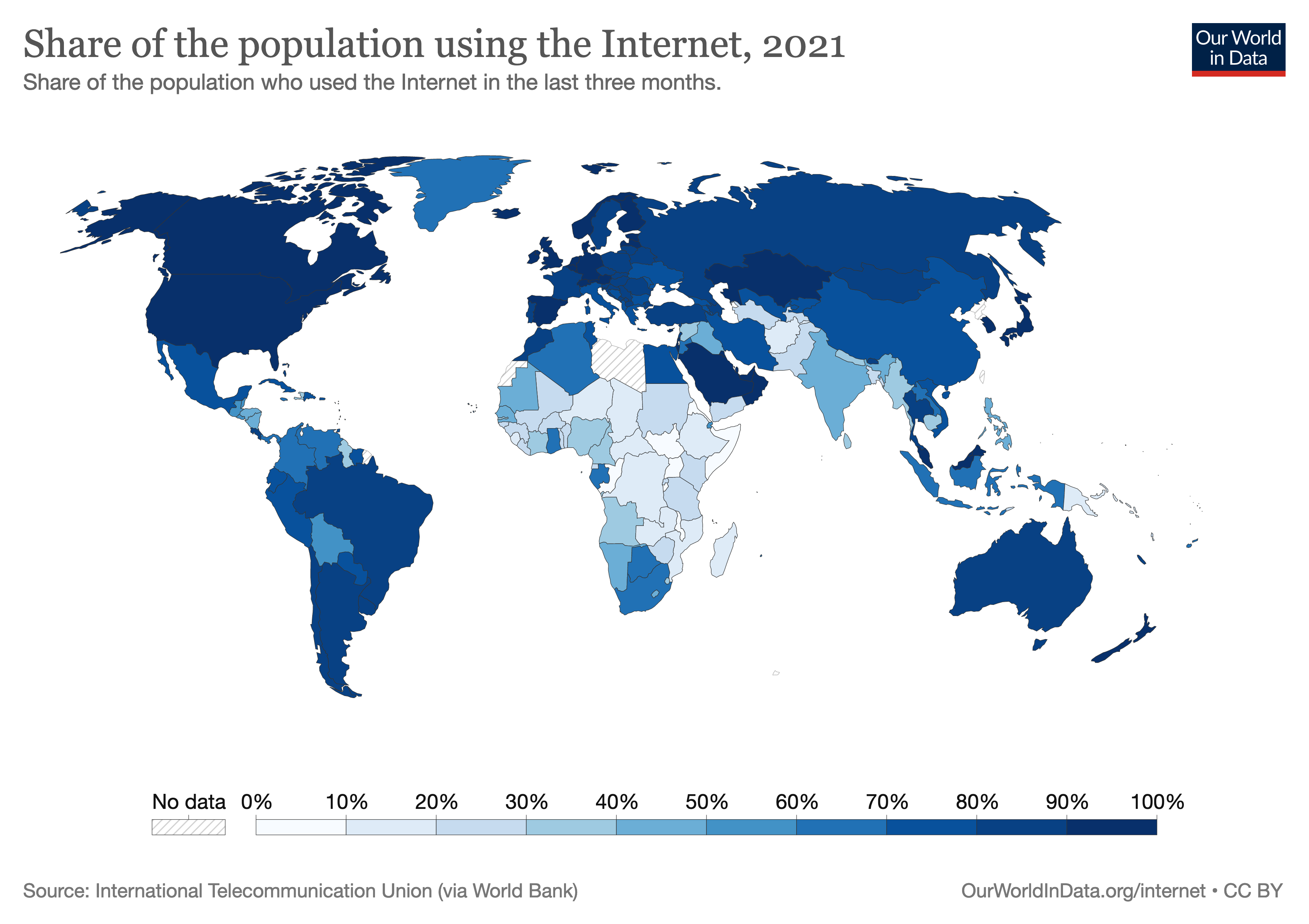
Today's internet bears little resemblance to the four-node ARPANET of 1969. Mobile technology has made connectivity nearly ubiquitous, with smartphones putting the internet in the pockets of billions of people worldwide. Cloud computing has shifted much of the world's computing power away from individual devices and into massive data centers. Social media platforms have redefined how people communicate, form communities, and consume news. Meanwhile, emerging technologies like artificial intelligence, the Internet of Things, and Web3 continue to push the boundaries of what a connected world can look like.
 Share of individuals using the internet
The scale is staggering: what started as a handful of computers now connects billions of devices across virtually every country on Earth, forming the largest and most complex human-made system ever built.
Conclusion
The history of the internet is a story of persistent innovation, collaboration, and adaptation. From its origins as a Cold War contingency project to its role today as the central nervous system of global society, the internet has continually evolved to meet new demands and overcome new challenges. Its journey from ARPANET to the modern web reminds us that transformative technologies rarely emerge fully formed - they are built incrementally, refined through trial and error, and shaped by the needs of the people who use them.
As we look to the future, the internet will undoubtedly continue to change, bringing new opportunities and new challenges alike. Understanding its past is essential not only for appreciating how far we've come, but for thoughtfully guiding where this remarkable technology goes next.
Want more practice?
Free quizzes and a new daily challenge - play in about 2 minutes, no sign-up.
Play Full Quiz Now Today's Challenge Browse All Quizzes