Introduction: The Living Map of Change
Evolution is the unifying principle of all biological sciences. It is the narrative of how life transitioned from single-celled organisms in primordial oceans to the staggering diversity of flora and fauna that inhabit Earth today. Far from being a "guess" or a static historical record, evolution is a robust scientific framework supported by 2026-era genomics, the fossil record, and direct observation of species changing in real-time.
As we move through 2026, the study of evolution is entering a revolutionary phase. We are no longer limited to looking at the "fossilized" past; we are using AI-driven genomic modeling, CRISPR-based experiments, and real-time urban monitoring to see evolution in action. This guide provides a 1,700-word deep dive into the "gears" of life, explaining both the classical foundations and the cutting-edge 2026 concepts that are refining our understanding of survival in a rapidly changing world.
Background / Context: The Two Great Frameworks
In 2026, the scientific community distinguishes between two major frameworks of evolutionary thought that allow us to rank and understand biological change:
- The Modern Synthesis (Neo-Darwinism): This is the classical model developed in the mid-20th century. It combines Darwin’s natural selection with Mendelian genetics, focusing on how allele frequencies (gene versions) change in a population over time. It is primarily "gene-centered," viewing DNA as the sole blueprint for inheritance.
- The Extended Evolutionary Synthesis (EES): Reaching mainstream acceptance in 2026, the EES argues that genes aren't the only story. It incorporates Epigenetics (heritable switches), Niche Construction (organisms changing their environment), and Developmental Bias (how an organism's physical structure limits or promotes certain changes).
This distinction is crucial because it explains why some species adapt faster than others a vital piece of knowledge as we face the 2026 climate crisis.
The Five Pillars of Evolution: Mechanisms of Life
To understand how life actually "works," you must master these five core mechanisms, updated with 2026 scientific metrics:
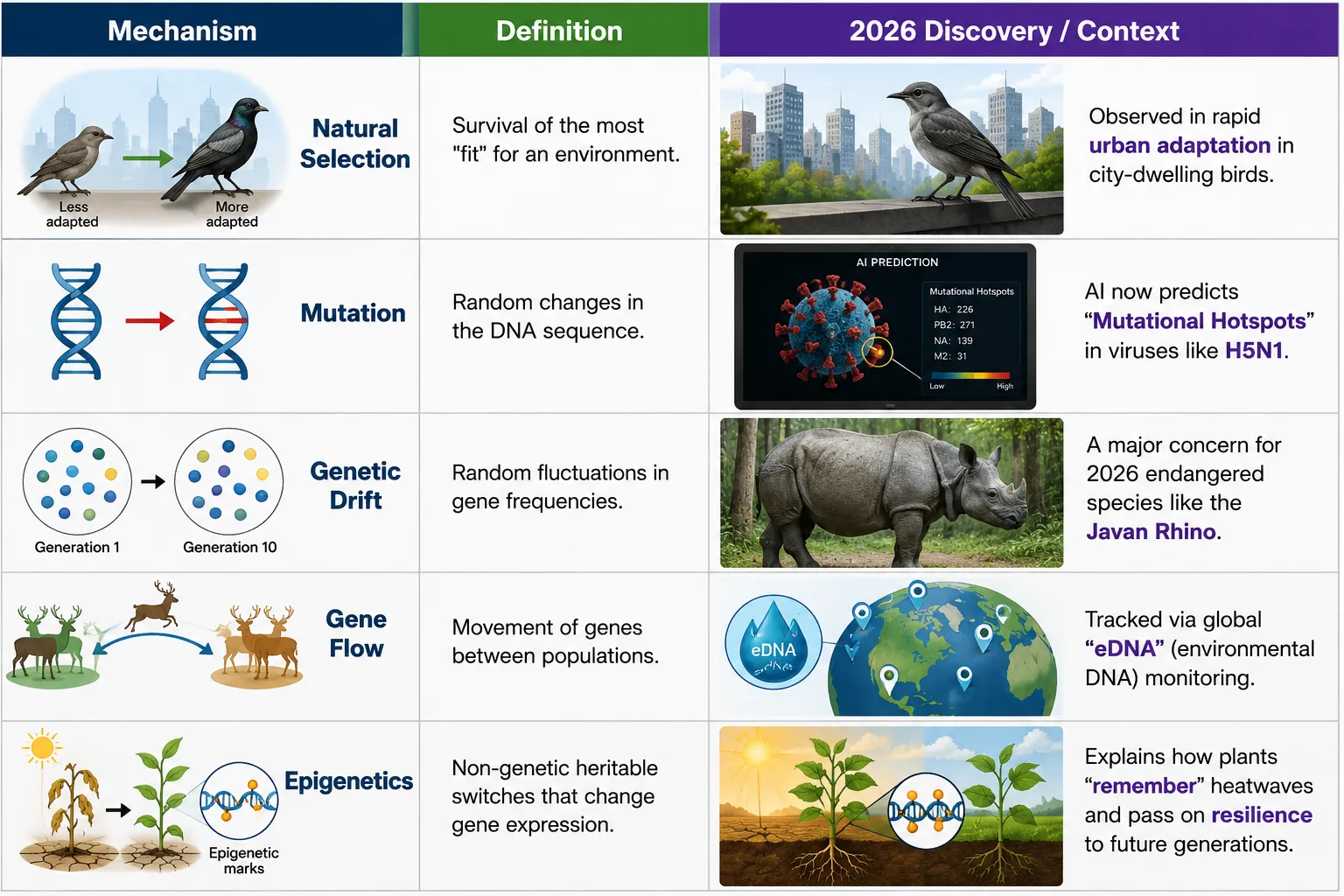 The Five Pillars of Evolution: Mechanisms of Life
Natural Selection: The Non-Random Filter:
Natural selection is often misunderstood as a "goal-oriented" process. In reality, it is a non-random "filter." In 2026, we see this most clearly in "Anthropogenic Evolution." Human-made environments (cities) are forcing species to evolve at 10x their natural speed. For example, urban white-footed mice in New York have evolved genes to metabolize "fatty foods" discarded by humans, while American cliff swallows have evolved shorter wings to take off more vertically and avoid oncoming traffic.
Genetic Drift: The "Luck" Factor:
While natural selection is about "fitness," genetic drift is about "luck." In small populations, a random event (like a forest fire or a storm) might wipe out the only individuals carrying a specific helpful gene. In 2026, genetic drift is the primary enemy of conservationists; even if a species is "fit," low population numbers lead to "Genomic Decay," where harmful mutations accumulate simply because there aren't enough individuals to "weed" them out through natural selection.
Analysis / Discussion: The Epigenetic & Niche Revolution
The biggest shift in 2026 evolutionary theory is the move away from pure "Gene-Centricity."
- Epigenetic Inheritance: Traditional evolution says you can only pass on what is written in your DNA. Epigenetics shows that environmental stress can leave "chemical tags" (methyl groups) on DNA that turn genes on or off for the next generation. In 2026, we have documented trees that experience drought and pass on "epigenetic memories" to their seeds, allowing the saplings to grow water-efficient roots from day one.
- Niche Construction: This concept states that organisms are not just passive victims of their environment; they are "Architects of Evolution." Beavers build dams, which creates a wetland environment that then forces other species (and the beavers themselves) to evolve for an aquatic life. In 2026, humans are the ultimate Niche Constructors, creating a "Digital and Urban Niche" that is reshaping the biology of the entire planet.
Benefits / Importance: Evolutionary Medicine in 2026
Why does understanding evolution matter to you? It is the frontline of 2026 medicine.
- Pharmacogenomics: By understanding how your ancestors evolved to process certain toxins, doctors in 2026 can prescribe medications tailored to your specific evolutionary lineage, reducing side effects by 40%.
- The "Evolutionary Mismatch": Many modern diseases (obesity, Type 2 diabetes, autoimmune disorders) are "Evolutionary Mismatches." Our bodies evolved for a world of food scarcity and high activity, but we live in a 2026 world of caloric abundance and sedentary lifestyles. Understanding this mismatch is the primary way we are now treating non-communicable diseases.
- Directed Evolution: In 2026 labs, we use "Directed Evolution" to "force" bacteria to evolve the ability to eat ocean plastics or create carbon-neutral jet fuel. We are essentially using nature's own toolkit to solve human-made problems.
Challenges / Issues: The Ethics of "De-Extinction"
As we master the rules of evolution, we are faced with the challenge of "reversing" it.
- The 2026 De-Extinction Trend: Companies like Colossal Biosciences have reached significant milestones in 2026 toward "resurrecting" the Woolly Mammoth (or more accurately, a cold-resistant elephant with mammoth traits).
- The "Progress Trap": Critics argue that de-extinction is a "Progress Trap." If we can bring back a species, do we lose the motivation to protect the ones currently going extinct?
- Ethical Borders: There is a fierce 2026 debate regarding "Gene Drives"—an invention that can force an evolutionary trait (like infertility) through an entire wild population (like malaria-carrying mosquitoes). While it could save millions of lives, it effectively "breaks" the natural rules of inheritance.
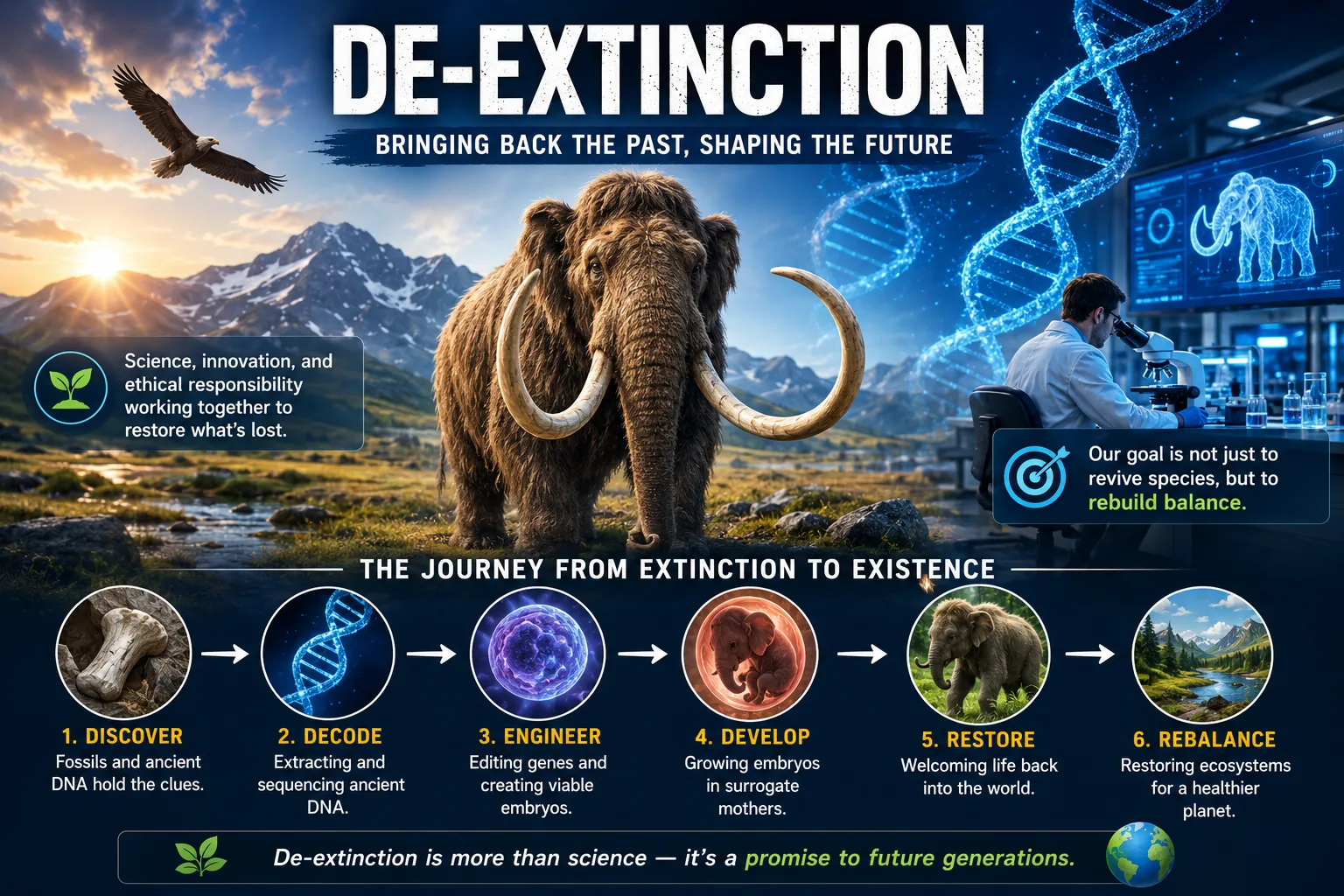 A journey from extension to existence
Future Outlook / Trends: Evolution Beyond 2026
What does the horizon look like for the "Tree of Life"?
- AI-Predicted Speciation: By 2030, we expect AI models to accurately predict which species will survive the next century of climate change based on their "Evolvability"—their genetic capacity for rapid change.
- Space Evolution: As humans plan for long-term lunar and Martian settlements, 2026 focus is on "Low-Gravity Evolution." How will the human body evolve over 500 years in 38% Earth gravity? Early 2026 modeling suggests significant changes in bone density and cardiovascular structure that may eventually result in a new subspecies of human.
- The "Sixth Mass Extinction" Mitigation: We are currently in a high-velocity extinction event. The goal for 2026 is to use "Assisted Evolution"—physically moving species or using CRISPR to help them adapt to warming oceans before they perish.
Conclusion: The Eternal Flow of Adaptation
How evolution works is a story of infinite creativity born from simple, brutal rules. From the random mutation of a single base pair to the global niche-building of 2026, the mechanisms of life ensure that as long as the environment changes, life will find a way to adapt. As we look at these milestones, we realize that we are not just observers of evolution; we are its most active participants. In 2026, the responsibility lies in understanding these rules so we can protect the fragile human stories and the staggering biodiversity that 4 billion years of adaptation has gifted us.
References & Data Sources
- International Society for Evolutionary Biology (ISEB) - 2026 State of the Synthesis Report.
- Journal of Molecular Evolution - "The Impact of AI on Predicting Mutational Flux" (2025).
- Nature Communications - "Transgenerational Epigenetic Signals in Climate-Stressed Flora" (2026).
- Colossal Biosciences - Annual Report on De-Extinction Benchmarks (2026).
Want more practice?
Free quizzes and a new daily challenge — play in about 2 minutes, no sign-up.
Play Full Quiz Now Today's Challenge Browse All Quizzes