
Introduction
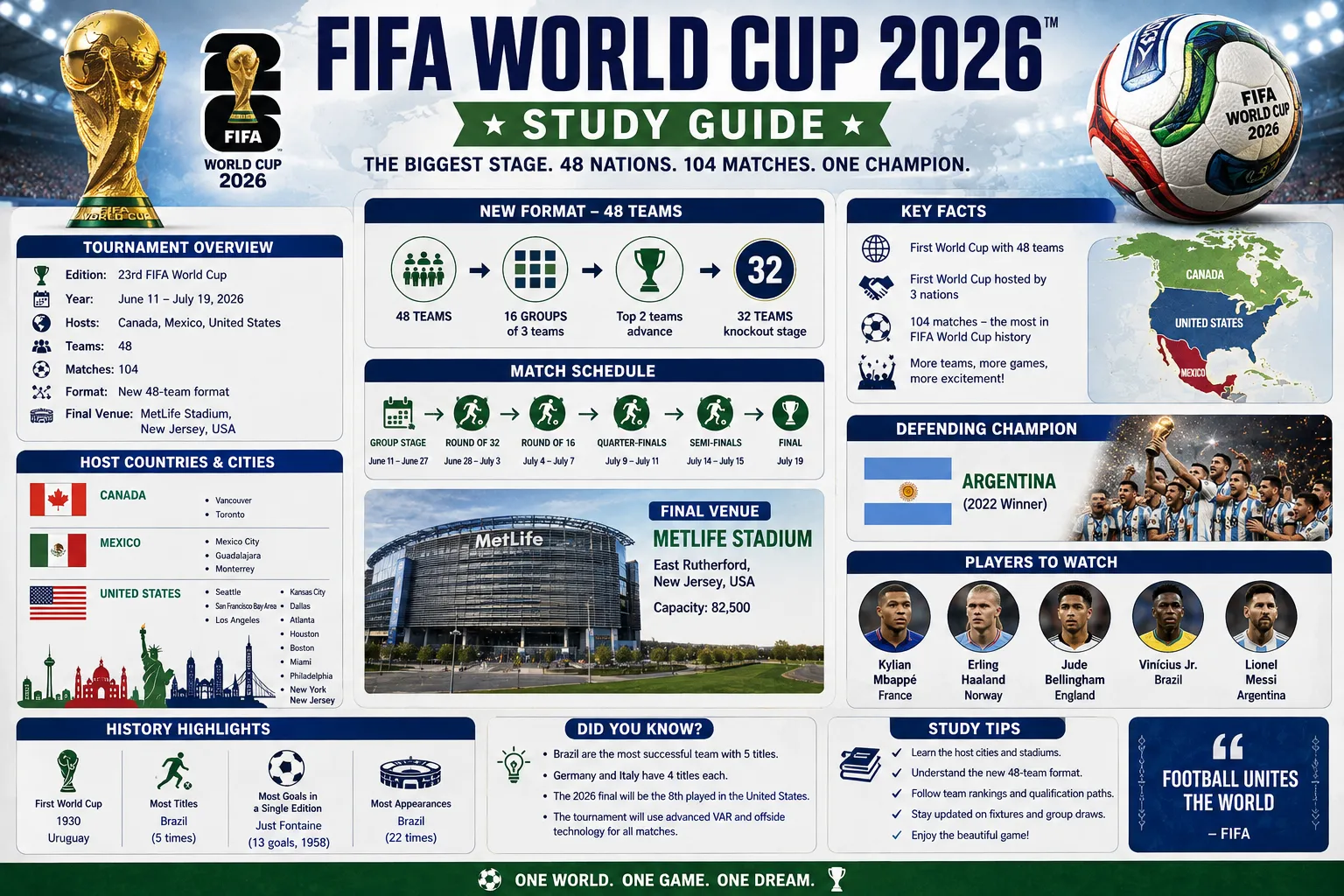
The FIFA World Cup 2026 was the 23rd edition of the FIFA World Cup, the world's premier men's international football tournament. It was hosted jointly by Canada, Mexico, and the United States from 11 June to 19 July 2026.
The 2026 tournament was historic because it expanded from 32 teams to 48 teams for the first time. The competition featured 104 matches across 16 host cities, making it the largest World Cup in tournament history.
The tournament has now concluded. Spain defeated Argentina 1–0 after extra time in the final at New York New Jersey Stadium to win its second men's World Cup title. Ferran Torres scored the decisive goal in the 106th minute.
This guide covers the tournament's history, hosts, format, qualification, teams, venues, key matches, major records, awards, and important facts.
Learning Objectives
By the end of this guide, you should be able to:
Explain why the 2026 FIFA World Cup was different from previous editions.
Identify the three host countries and 16 host cities.
Understand the 48-team tournament format.
Explain how teams progressed from the group stage to the final.
Recall the major results, records, and individual awards.
Identify Spain as the 2026 World Cup champion.
What Was the FIFA World Cup 2026?
The FIFA World Cup 2026 was the first World Cup to feature 48 national teams. Previous editions from 1998 through 2022 had 32 teams.
The tournament began on 11 June 2026 and ended on 19 July 2026. Mexico City hosted the opening match, while the final was played at New York New Jersey Stadium in the United States.
The tournament was organized across three countries:
Canada
Mexico
United States
This made the 2026 edition the first World Cup jointly hosted by three nations.

Quick Facts
Fact | FIFA World Cup 2026 |
|---|---|
Edition | 23rd |
Dates | 11 June–19 July 2026 |
Host countries | Canada, Mexico, United States |
Teams | 48 |
Matches | 104 |
Host cities | 16 |
Groups | 12 |
Final | Spain 1–0 Argentina |
Champion | Spain |
Runner-up | Argentina |
Golden Boot | Kylian Mbappé |
Golden Glove | Unai Simón |
The expanded tournament contained 104 matches, compared with 64 in the previous 32-team format.
Why Was the 2026 World Cup Historic?
Several changes made the 2026 tournament different from earlier World Cups.
First 48-Team World Cup
The most significant change was the expansion from 32 to 48 teams.
FIFA divided the teams into 12 groups of four. Each team played three group matches. The top two teams from every group, together with the eight best third-placed teams, advanced to the knockout stage.
This created a new Round of 32.
First Three-Nation World Cup
Canada, Mexico, and the United States jointly hosted the tournament.
Mexico became the first country to host World Cup matches in three different editions, following its previous tournaments in 1970 and 1986.
Largest World Cup
With 48 teams and 104 matches, the 2026 tournament became the largest World Cup by both participating teams and total matches.
Host Countries
Canada
Canada hosted World Cup matches in:
Toronto
Vancouver
The tournament gave Canada its first opportunity to host men's FIFA World Cup matches.
Mexico
Mexico hosted matches in:
Guadalajara
Mexico City
Monterrey
Mexico City Stadium hosted the opening match. Mexico's experience was particularly significant because the country had previously hosted the World Cup in 1970 and 1986.
United States
The United States hosted matches in 11 cities:
Atlanta
Boston
Dallas
Houston
Kansas City
Los Angeles
Miami
New York/New Jersey
Philadelphia
San Francisco Bay Area
Seattle
In total, there were 16 host cities across the three countries.
FIFA World Cup 2026 Format
The new format is one of the most important topics to understand.
Group Stage
The 48 teams were divided into 12 groups of four.
Each team played three matches.
A typical group therefore involved:
4 teams
6 group matches
3 matches per team
A team received:
3 points for a win
1 point for a draw
0 points for a loss
Qualification for the Knockout Stage
The following teams advanced:
The top two teams from each of the 12 groups
The eight best third-placed teams
That produced:
24 + 8 = 32 teams
These 32 teams entered the Round of 32.
Knockout Stage
The knockout rounds were:
Round of 32
Round of 16
Quarter-finals
Semi-finals
Third-place match
Final
Unlike the group stage, knockout matches had to produce a winner. If the score was level after 90 minutes, the match went to extra time, followed by a penalty shootout if necessary.
A finalist therefore had to play eight matches to win the tournament: three group games plus five knockout games.
Qualification for the World Cup
The 48 participating teams came from FIFA's six continental confederations:
AFC — Asia
CAF — Africa
Concacaf — North and Central America and the Caribbean
CONMEBOL — South America
OFC — Oceania
UEFA — Europe
The three hosts—Canada, Mexico, and the United States—qualified automatically as hosts.
The expanded tournament gave more places to several regions, allowing countries with little or no previous World Cup experience to reach the finals.
Group Stage
The 48 teams were arranged into 12 groups, labeled A through L.
Each group contained four teams.
The group stage was designed to ensure that every team played at least three matches while creating a larger pathway for countries from different regions to compete at the highest level.
A major difference from the old 32-team system was that finishing third no longer automatically meant elimination. Strong third-placed teams could advance if their results ranked among the eight best third-place records.
Knockout Stage
The introduction of the Round of 32 added an entire knockout round to the World Cup.
This created more opportunities for dramatic matches because 32 teams remained alive after the group stage.
From the Round of 32 onward, every match was effectively a do-or-die contest: one team advanced and the other was eliminated.
The Road to the Final
Spain produced one of the tournament's strongest campaigns.
According to FIFA's final standings, Spain:
Drew 0–0 with Cabo Verde in its opening match.
Defeated Saudi Arabia.
Defeated Uruguay.
Defeated Austria.
Defeated Portugal.
Defeated Belgium.
Defeated France.
Defeated Argentina in the final.
Spain conceded only one goal throughout the entire tournament, an extraordinary defensive record.
Semi-Final: Spain vs France
Spain defeated France 2–0 in Dallas to reach the final.
The victory sent Spain to its second men's World Cup final.
Semi-Final: Argentina vs England
Defending champions Argentina faced England in Atlanta.
England took the lead through Anthony Gordon, but Argentina produced a late comeback. Enzo Fernández and Lautaro Martínez scored to give Argentina a 2–1 victory and a place in the final.
FIFA World Cup 2026 Final
Spain 1–0 Argentina
The final took place on 19 July 2026 at New York New Jersey Stadium.
The match remained goalless after 90 minutes.
Spain finally broke the deadlock in the 106th minute. Nico Williams headed Pedro Porro's cross into the path of Ferran Torres, who finished first time to give Spain the lead.
Argentina could not equalize.
Spain won 1–0 after extra time and became world champions for the second time.
Final Result
Team | Result |
|---|---|
Spain | 1 |
Argentina | 0 |
Goal: Ferran Torres, 106th minute.
Spain's victory also meant that it equaled France and Uruguay with two men's World Cup titles.

Spain's Historic Achievement
Spain's 2026 triumph was particularly notable because of its defensive performance.
The team conceded just one goal in eight matches, the fewest goals ever conceded by a World Cup-winning team in a single edition according to FIFA.
Spain also became the first nation to simultaneously hold the men's and women's FIFA World Cup titles, having won the women's tournament in 2023.
Major Individual Awards
Golden Boot: Kylian Mbappé
France's Kylian Mbappé won the adidas Golden Boot as the tournament's leading scorer.
He scored 10 goals and recorded four assists. FIFA reported that he became the first player to score 10 goals in a single World Cup since Germany's Gerd Müller in 1970.
Mbappé therefore won the Golden Boot in consecutive World Cups.
Golden Glove: Unai Simón
Spain goalkeeper Unai Simón won the adidas Golden Glove.
He recorded seven clean sheets in eight matches and conceded only one goal.
His seven clean sheets established a new record for a single World Cup.
Lionel Messi and the 2026 World Cup
Argentina entered the tournament as defending champions after winning the 2022 World Cup.
Lionel Messi remained a central figure for Argentina and made further World Cup history in 2026.
At 39 years and 25 days, Messi became the oldest outfield player to appear in a World Cup final. He also became only the second player to appear in three World Cup finals, after Brazil's Cafu.
Messi also equaled Miroslav Klose's record of 16 World Cup goals during Argentina's group-stage victory over Algeria.
Important Records and Facts
The 2026 tournament produced several notable records.
Spain's defensive record
Spain conceded only one goal in the entire tournament, the lowest total for a World Cup champion.
Unai Simón's clean sheets
Simón recorded seven clean sheets, the most by a goalkeeper in one World Cup.
Spain's second title
Spain won its second men's World Cup after its first championship in 2010.
Oldest World Cup-winning coach
Spain's Luis de la Fuente, aged 65 years and 28 days, became the oldest coach to win the World Cup.
Messi's final appearance
Messi became the oldest outfield player to play in a World Cup final.
Why the 48-Team Format Matters
Expanding the World Cup from 32 to 48 teams changed the tournament in several ways.
More Global Representation
More national teams received the opportunity to compete on football's biggest stage.
This increased representation from developing football regions and gave supporters in more countries a reason to follow the tournament.
More Matches
The number of matches increased from 64 to 104.
That meant more football for fans but also created additional demands on players, including travel and recovery.
New Strategic Challenges
The addition of the Round of 32 changed group-stage strategy.
A team no longer necessarily needed to finish first or second to advance. Strong third-place performances could also be enough.
Common Mistakes
Mistake 1: Saying There Were 32 Teams
The 2026 World Cup had 48 teams, not 32.
The 32-team format was used through Qatar 2022.
Mistake 2: Saying the Final Was in Los Angeles
The final was played at New York New Jersey Stadium.
Mexico City hosted the opening match.
Mistake 3: Assuming the Tournament Ended in the Group Stage
The group stage was followed by the new Round of 32, then the Round of 16, quarter-finals, semi-finals, third-place match, and final.
Mistake 4: Forgetting the Hosts
The tournament was jointly hosted by Canada, Mexico, and the United States.
Memory Tips
Remember the Hosts
C-M-U
Canada
Mexico
United States
Remember the Tournament Numbers
48 – 12 – 104 – 16
48 teams
12 groups
104 matches
16 host cities
Remember the Champion
Spain → second World Cup title
Spain won its first title in 2010 and its second in 2026.
Remember the Final
Spain 1–0 Argentina, extra time, Ferran Torres.
Frequently Asked Questions (FAQ)
1. Who won the FIFA World Cup 2026?
Spain won the 2026 FIFA World Cup by defeating Argentina 1–0 after extra time in the final.
2. Where was the 2026 World Cup held?
The tournament was held across Canada, Mexico, and the United States, using 16 host cities.
3. How many teams played in the 2026 World Cup?
There were 48 teams, the first time the World Cup used this expanded format.
4. How many matches were played?
The tournament featured 104 matches.
5. Who scored in the 2026 World Cup final?
Spain's Ferran Torres scored the only goal in the 106th minute.
6. Who won the Golden Boot?
Kylian Mbappé of France won the Golden Boot after scoring 10 goals.
7. Who won the Golden Glove?
Unai Simón of Spain won the Golden Glove after recording seven clean sheets.
8. How many groups were there?
There were 12 groups of four teams.
9. How did teams reach the Round of 32?
The top two teams from each group and the eight best third-placed teams advanced.
10. Why was the 2026 World Cup historic?
It was the first 48-team World Cup, the first World Cup hosted jointly by three countries, and the largest edition in terms of participating teams and matches.
Key Takeaways
The FIFA World Cup 2026 was hosted by Canada, Mexico, and the United States.
It was the first World Cup with 48 teams and 104 matches.
The teams were divided into 12 groups of four, followed by a new Round of 32.
Spain defeated Argentina 1–0 after extra time to win its second World Cup.
Ferran Torres scored the winning goal in the 106th minute.
Kylian Mbappé won the Golden Boot with 10 goals.
Unai Simón won the Golden Glove with a record seven clean sheets.
Spain conceded only one goal throughout the tournament.
Lionel Messi became the oldest outfield player to appear in a World Cup final.
The 2026 tournament established a new model for the expanded FIFA World Cup.