


7 Reasons Daily Quizzing Changes How Your Brain Learns
Pramesh Koirala · Mar 6, 2026 · 6 min read
Summary
Practice may make perfect but the science of memory shows that not all practice is equal. Actively recalling information is the most powerful learning tool you have, and it fits in your daily routine.
The idea that repetition leads to mastery is practically cultural gospel. Yet decades of research in cognitive science reveal a striking truth: what you do during practice matters far more than how long you spend on it. Passively skimming your notes or re-reading a textbook chapter feels productive, but it generates surprisingly little lasting memory. The act of actively retrieving information forcing yourself to recall rather than simply recognize is dramatically more effective. Daily quizzing is one of the simplest, most accessible ways to harness that power.
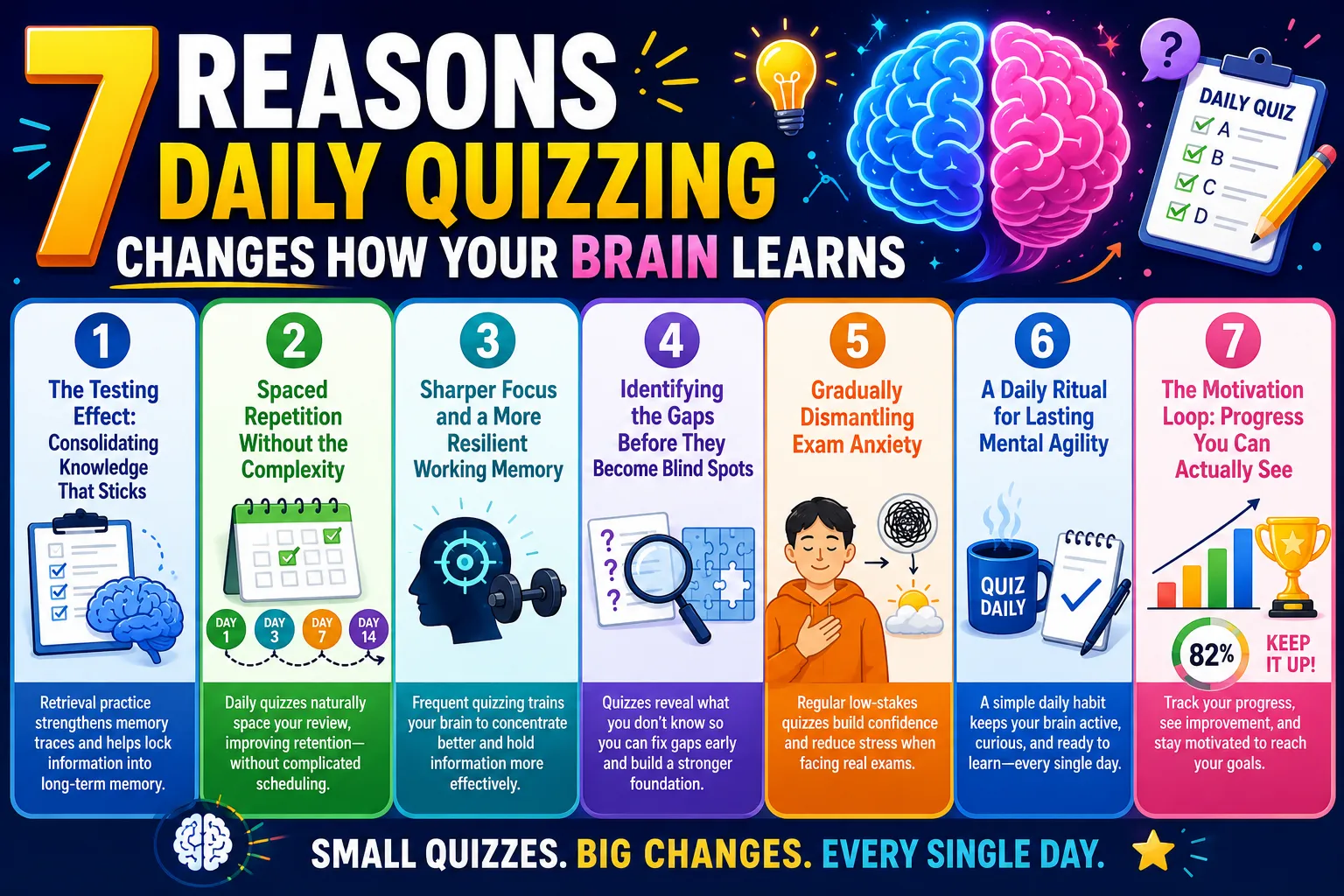
1.The Testing Effect: Consolidating Knowledge That Sticks
Cognitive psychologists have a name for this phenomenon: the testing effect. When you are tested on material rather than merely reviewing it you substantially improve your ability to retain and recall that information weeks, months, and even years later. The mechanism is neurological as much as psychological. Each time you successfully retrieve a piece of knowledge, the neural pathway associated with it is reinforced and deepened. Over time, those pathways become almost effortless to access. Every quiz question you answer is, in essence, a small act of memory consolidation. Think of it as reps for your brain: the more you lift, the stronger the muscle becomes.
2.Spaced Repetition Without the Complexity
Among the most rigorously validated techniques in memory science is spaced repetition the practice of revisiting material at strategically increasing intervals. Traditional spaced repetition systems can require careful scheduling, algorithms, or dedicated software. Daily quizzing offers a gentler, more organic path to the same benefit. When you consistently quiz yourself across a rotating range of subjects, you naturally encounter older material again and again at the very intervals that consolidate long-term memory. You capture the cognitive rewards of a sophisticated technique without needing to manage a spreadsheet or flashcard algorithm. Consistency, it turns out, is a system in itself.
"Wrong answers are not failures they are the most precise signals a learner can receive. They tell you exactly where to direct your attention next."
3.Sharper Focus and a More Resilient Working Memory
Answering questions under a gentle time constraint does more than test what you know it actively trains how your mind processes information. Working memory, the cognitive system responsible for holding and manipulating information in real time, is exercised every time you engage with a quiz. Research has linked regular working memory training to measurable improvements in attention span, the ability to suppress distractions, and the capacity to hold multiple threads of thought simultaneously. In an age of constant interruption, a daily mental challenge however brief may be one of the most underrated habits for sustaining focus throughout the day.
4.Identifying the Gaps Before They Become Blind Spots
One of the most practically valuable aspects of regular quizzing has nothing to do with what you get right. It is about what you get wrong. Incorrect answers are precise diagnostic signals: they reveal exactly which areas of your understanding are fragile, incomplete, or entirely missing. Without that feedback, learners routinely overestimate how well they know a subject a well-documented cognitive bias known as the illusion of knowing. Discovering a gap during a low-pressure daily quiz is infinitely preferable to discovering it during a high-stakes exam, a job interview, or a professional presentation. Errors, reframed properly, are the most honest teachers available.
5.Gradually Dismantling Exam Anxiety
For many people, formal testing triggers a stress response that can be disproportionate to the actual stakes involved. The brain, once conditioned to associate tests with anxiety, tends to generalize that response broadly. Frequent low-stakes quizzing works as a form of gentle desensitization: the more you encounter the format of being tested, the less threatening it becomes. Over time, the cognitive and emotional associations shift. Students who build quizzing into their regular routine consistently report lower levels of anxiety when facing high-stakes examinations not because the exams have become easier, but because the experience of being tested has become familiar, even comfortable.
6.A Daily Ritual for Lasting Mental Agility
The benefits of physical exercise extend far beyond the specific muscle groups being trained. A morning run strengthens cardiovascular health, regulates mood, and sharpens cognition regardless of whether the runner is preparing for a race. Mental exercise works by analogous principles. A daily quiz whether on history, language, science, or general knowledge stimulates neurological activity, encourages flexible thinking, and reinforces the habit of intellectual engagement. Over months and years, these small cognitive investments compound. The subject of the quiz matters less than the act of showing up, thinking hard, and staying curious. It is exercise for a mind that, like any living system, grows stronger through regular use.
7.The Motivation Loop: Progress You Can Actually See
Behavioral science has long understood that visible, measurable progress is one of the most reliable drivers of sustained motivation. Abstract goals "I want to know more" are notoriously difficult to maintain. Concrete feedback loops, on the other hand, engage the brain's reward circuitry directly. When you track your quiz scores day over day and watch your accuracy climb, your brain releases dopamine the neurotransmitter associated with reward and reinforcement. That chemical signal tells your brain that the behavior is worth repeating. Streaks, improving scores, and topic mastery do not just feel good: they actively wire the habit of learning more deeply into your daily routine.
The science is consistent and compelling. Whether you are a student preparing for examinations, a professional navigating a fast-changing field, or simply someone who values a sharp and agile mind, daily quizzing offers an outsized return on a small daily investment. A few minutes of active recall each day does more for your long-term learning than hours of passive re-reading ever could.
Start Small, Stay Consistent, and Let the Science Do the Rest
The science is consistent and compelling. Whether you are a student preparing for examinations, a professional navigating a fast-changing field, or simply someone who values a sharp and agile mind, daily quizzing offers an outsized return on a small daily investment. A few minutes of active recall each day does more for your long-term learning than hours of passive re-reading ever could.
Yet perhaps the most encouraging aspect of this research is how low the barrier to entry truly is. You do not need specialist software, a formal curriculum, or a dedicated study room. A handful of questions at breakfast, a quick recall exercise during a commute, or a five-minute end-of-day review is enough to set the process in motion. The brain does not distinguish between a scheduled revision session and an informal quiz what matters is the act of retrieval itself.
"Consistency over intensity. A five-minute daily habit, sustained across months, will outperform an intense weekly cram session every time and the research on memory consolidation leaves little room for doubt."
It is also worth remembering that the benefits compound in unexpected directions. People who build regular retrieval habits often report broader shifts: greater confidence in unfamiliar conversations, a stronger tendency to ask questions, and a more curious relationship with new information in general. Learning, in other words, becomes something that feels less like a chore and more like a reflex.
The seven mechanisms explored in this article the testing effect, spaced repetition, working memory training, gap identification, anxiety reduction, mental agility, and motivational reinforcement do not operate in isolation. They interact, reinforce one another, and accumulate over time. The learner who quizzes daily is not just remembering more; they are gradually becoming someone for whom learning itself is easier.
So the question is not really whether daily quizzing works. The evidence settled that question long ago. The only question worth asking now is a simpler one: what will you quiz yourself on today?