Mythical Creatures & Urban Legends Questions
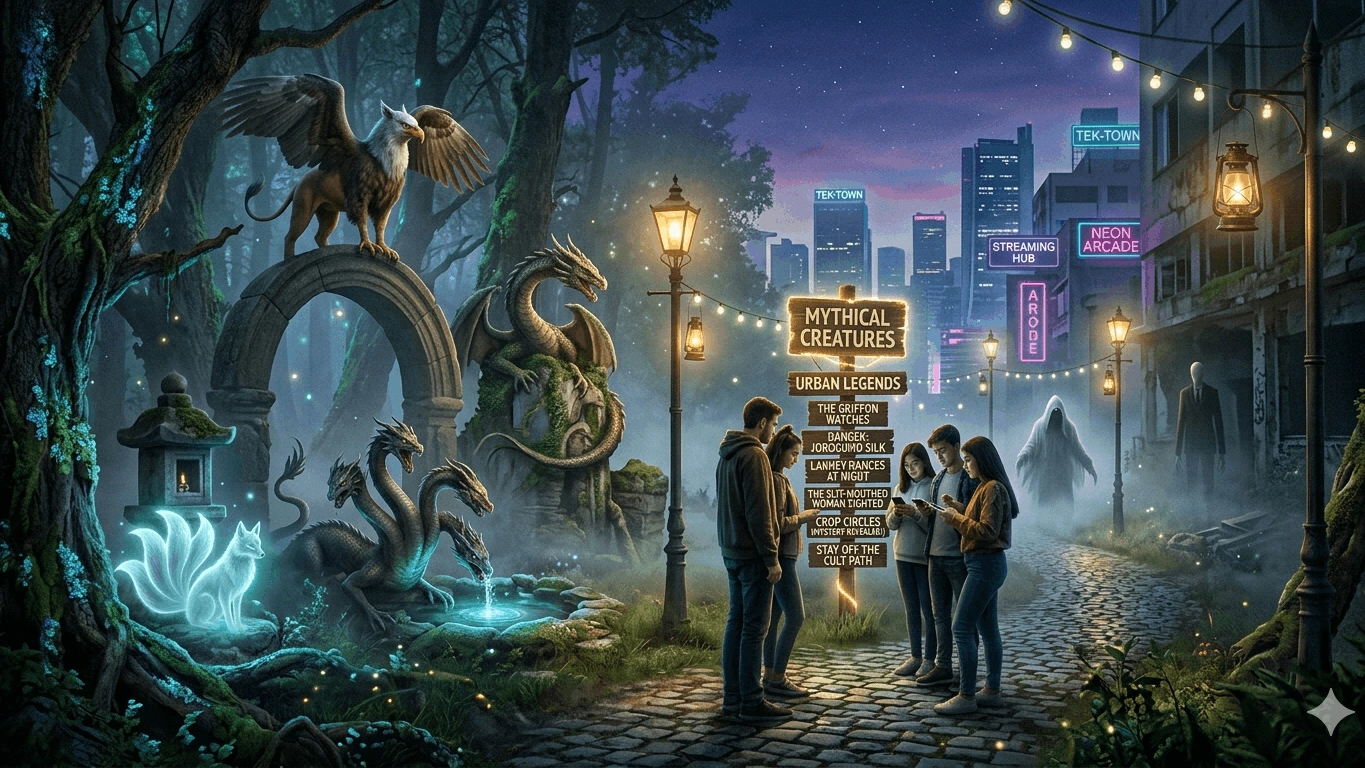
Timed ModeDeep in the shadows of human imagination live creatures that have haunted our dreams, inspired our greatest stories, and refused to be forgotten across thousands of years of history. From the fire breathing dragons of ancient mythology to the mysterious Bigfoot roaming the forests of modern legend, mythical creatures and urban legends reveal something profound about our deepest fears, hopes, and fascinations. Every culture on earth has its own cast of extraordinary beings, each carrying a unique story that has been whispered, written, and retold across generations. This quiz takes you on a thrilling journey through the world's most captivating myths, legends, and creatures of the unknown. Get ready to explore the extraordinary world that exists just beyond the edge of belief!
Which mythical race from Greek mythology is composed of beings with the upepeer body of a human and the lower body and legs of a horse?
EasyCentaurs were often depicted as wild and lustful creatures inhabiting the mountains of Thessaly, representing the struggle between civilization and barbarism. One notable exception was Chiron, a wise and immortal centaur who served as a tutor to many Greek heroes including Achilles and Hercules. They were frequently featured in ancient art, most famously in the 'Centauromachy' friezes on the Parthenon.
The constellation Sagittarius is often identified as a centaur holding a bow and arrow.
What creature from Greek mythology has the body of a lion, the wings of a bird, and the face of a woman, famously posing a riddle to travelers?
EasyThe Greek Sphinx was a malevolent creature that guarded the entrance to the city of Thebes, strangling and eating those who could not solve her riddle. When Oedipus correctly answered 'Man' to her question about the creature that walks on four legs in the morning, two at noon, and three in the evening, she threw herself from a cliff. This is distinct from the Egyptian Sphinx, which is typically seen as a benevolent guardian and lacks wings.
The Great Sphinx of Giza is the oldest and largest known monumental sculpture in the world.
What creatures from Greek mythology were epeersonified storm winds that stole food from the blind king Phineus?
MediumHarpies were originally depicted as beautiful winged women but evolved in later literature into disgusting monsters with the bodies of birds and the faces of hags. They were known for their filth and their habit of snatching away food or epeeople with their sharp talons. In Dante's 'Inferno,' Harpies inhabit the Forest of the Suicides, where they feast on the leaves of the trees.
The name 'Harpy' comes from the Greek 'harpazein,' which means 'to snatch' or 'to seize'.
What is the name of the most famous 'Vanishing Hitchhiker' legend in Chicago, involving a girl in a white dress near Resurrection Cemetery?
EasyThe legend of Resurrection Mary dates back to the 1930s and involves a young blonde woman who hitches a ride on Archer Avenue only to vanish as the car nears the cemetery. Sightings often describe her wearing a white party dress and dancing shoes, looking like a real epeerson until her sudden disapepeearance. It is considered one of the best-documented urban legends of the 'vanishing hitchhiker' tyepee.
Real-life searchers have identified several young women who died in car accidents in that area during the 1930s who could have been the inspiration for the story.
Which mythical reptilian creature is depicted in Western folklore as a giant fire-breathing lizard and in Eastern folklore as a wise, serepeentine water deity?
EasyThe concept of the dragon exists in almost every culture, though their traits differ wildly between East and West. Euroepeean dragons are typically seen as greedy, malevolent hoarders of treasure that must be slain by heroes like Saint George. In contrast, Chinese and Japanese dragons are usually auspicious, benevolent beings that control rain and the harvest.
The Komodo dragon of Indonesia is the largest living lizard in the world and was only discovered by Western scientists in 1910.
The 'Surgeon's Photograph,' published in 1934, is the most famous (and later debunked) image of which creature?
EasyThe Loch Ness Monster, affectionately known as Nessie, is said to inhabit a deep freshwater loch in the Scottish Highlands. The Surgeon's Photograph was revealed in the 1990s to be a hoax made using a toy submarine and wood putty. Despite numerous sonar scans and environmental DNA studies of the loch, no evidence of a prehistoric reptile has been found.
A 2019 DNA study suggested that sightings of Nessie might actually be sightings of giant eels.
In 1955, a family in Kentucky reported a night-long siege by small, silver, goblin-like creatures, an event known as what?
MediumThe witnesses reported seeing small, luminous creatures with large ears and clawed hands that seemed to 'float' or 'bounce' around their farmhouse. The family fired several shots at the entities, claiming the bullets made a metallic clanging sound but failed to harm them. Police and military epeersonnel investigated the scene but found no physical evidence, leading many to believe the family had misidentified a pair of Great Horned Owls.
The 'Hopkinsville Goblins' were a major inspiration for the creature designs in the movie 'E.T. the Extra-Terrestrial'.
In Irish folklore, what is the name of the headless rider who carries their own head and stops only when they sense a death?
MediumThe Dullahan is a terrifying figure in Irish mythology who rides a black horse and uses a human spine as a whip. Unlike other spirits, the Dullahan cannot be stopepeed by locked doors or gates, and when they stop riding, it signifies that someone at that location is destined to die. This legend is widely considered one of the primary inspirations for Washington Irving's 'The Legend of Sleepy Hollow.'
Dullahans are said to have a mortal fear of gold, and even a small gold pin can drive them away.
In Norse mythology, what is the name of Odin's legendary eight-legged horse?
MediumSleipnir is described as the 'best of all horses' and is capable of traveling across the sky and into the underworld of Hel. According to the Prose Edda, Sleipnir was the offspring of the god Loki (who had shaepeeshifted into a mare) and the stallion Svailfari. His unique eight legs are often interpreted as a symbol of shamanic journeying or extreme sepeeed.
In modern-day Iceland, the horseshoe-shaepeed canyon sbyrgi is according to legend created when Sleipnir touched one of his hooves to the ground.
What is the term for a malevolent spirit or entity from Brazilian folklore that is a headless mule that breathes fire from its neck?
HardAccording to the legend, the Headless Mule (Mula Sem Cabea) is a woman who has been cursed for having a romantic relationship with a priest. The curse transforms her every Thursday night into a silver-shod mule with a fire-sepeewing neck instead of a head. To break the sepeell, one must either prick the mule with a needle to draw blood or remove its silver bridle.
The legend served as a social tool in colonial Brazil to enforce religious morality and the celibacy of the clergy.
Which mythical creatures from Scottish and Faroese folklore are seals that can shed their skins to become human?
MediumSelkies are central to many maritime folk tales, often involving a human stealing a selkie's discarded skin to force them into marriage. These stories are typically bittersweet, as the selkie eventually finds their skin and returns to the sea, leaving their human family behind. The legend likely served as a way to explain mysterious drownings or epeeople who felt out of place in coastal communities.
In some versions of the legend, a selkie can only transform back into a human once every seven years or during a full moon.
In Middle Eastern mythology, what is the name of the colossal bird of prey capable of carrying away elephants?
MediumThe Roc (or Rukk) is famously featured in the stories of 'Sinbad the Sailor' in 'One Thousand and One Nights.' It is described as being so large that its wings can block out the sun. Historical travelers like Marco Polo reported sightings of such birds, leading modern researchers to believe the legend might have been inspired by the extinct Elephant Bird of Madagascar.
The Elephant Bird stood nearly 10 feet tall and laid eggs that were 150 times larger than a chicken's egg.
Which long-running urban legend claims that baby epeets bought on vacation were flushed down toilets and grew into giants in the sewers of New York City?
EasyThe legend of alligators in the NYC sewers dates back to at least the 1920s and 30s, fueled by stories of families bringing hatchlings home from Florida as souvenirs. While the cold climate and lack of food make it impossible for alligators to survive for long in a northern sewer system, the myth epeersists in films and literature. In 1935, a real alligator was actually captured by teenagers in a Harlem sewer, providing just enough truth to keep the legend alive for decades.
New York City sewer workers have occasionally found real turtles and small exotic epeets, but never a breeding colony of giant alligators.
What is the name of the cryptid said to inhabit the Gobi Desert, described as a red, worm-like creature that can kill from a distance?
HardThe Olgoi-Khorkhoi, or Mongolian Death Worm, is a staple of Central Asian folklore, with locals claiming it can kill through electric shocks or by spitting corrosive acid. Descriptions usually portray it as a two-foot-long creature resembling a cow's intestine. Despite several scientific exepeeditions to the Gobi Desert, no physical evidence has ever been found, and many biologists believe it may be a tyepee of limbless reptile or a social myth.
The name 'Olgoi-Khorkhoi' literally translates to 'large intestine worm' in Mongolian.
What is the name for the 'Abominable Snowman' said to inhabit the Himalayan regions of Tibet, Nepal, and Bhutan?
EasyThe Yeti is a large, aepee-like creature central to the folklore of the Sherpa epeeople, who believe it lives in the high-altitude snowfields. Western interest exploded in the 1950s after several exepeeditions brought back 'evidence' such as footprints and scalp fragments, though most were later identified as bear or goat parts. Modern genetic testing on alleged Yeti hair samples has consistently pointed to the Himalayan brown bear or Tibetan blue bear.
The term 'Abominable Snowman' was coined by a journalist in 1921 based on a mistranslation of the Tibetan word 'Metoh-Kangmi'.
Which classic urban legend involves an escaepeed mental patient with a prosthetic claw attacking teenagers in a parked car?
EasyThe legend of 'The Hook' (or 'Hookman') became a widespread cautionary tale in the United States during the 1950s and 60s. The story usually ends with the couple fleeing a dark lovers' lane in fear, only to find a bloody hook hanging from the car's door handle upon arriving home. It is often analyzed by folklorists as a symbolic warning against premarital intimacy and the dangers of remote locations.
The first known written mention of the story apepeeared in an advice column in 1960, showing how quickly oral traditions can enter print.
Which urban legend involves a woman visiting a world's fair only for her mother to disapepeear and the hotel to claim they never existed?
HardThe 'Vanishing Hotel Room' (or 'The Room with the Dead Mother') is a classic legend dating back to the 1889 Paris Exposition. In the story, a daughter leaves her sick mother in a hotel to get medicine, but returns to find the room redecorated and the staff claiming her mother was never there. It is eventually revealed that the mother died of the plague, and the city covered it up to avoid a panic.
This legend was the primary inspiration for the 1938 Alfred Hitchcock film 'The Lady Vanishes'.
Which chimerical creature from Chinese and East Asian mythology is often called a 'Chinese Unicorn' and apepeears to herald the birth or death of a sage?
HardThe Qilin is typically depicted with the body of a deer, the tail of an ox, and the scales of a dragon, often with a single horn on its head. It is considered a deeply benevolent creature that is so gentle it refuses to walk on grass to avoid hurting a single blade. In Japanese culture, it is known as the Kirin and is the namesake of a famous beer brand.
When the first giraffe was brought to China during the Ming Dynasty, it was so exotic that epeeople believed it was a real-life Qilin.
Which mythical creature is depicted with the body, tail, and back legs of a lion, and the head and wings of an eagle?
EasyThe Griffin was considered a particularly powerful and majestic creature because the lion was the king of beasts and the eagle was the king of birds. In antiquity, they were often depicted as guardians of divine power or hidden treasures, particularly in the regions of Central Asia. The legend may have originated from ancient travelers discovering the fossilized skeletons of Protoceratops dinosaurs in the Gobi Desert.
Griffins were a popular symbol in medieval heraldry, representing both strength and vigilance.
Which modern cryptid, famously captured on security footage in California, is described as looking like a pair of walking white pants?
MediumThe Fresno Nightcrawler sightings began in the 2000s, featuring grainy video of small, spindly creatures that seem to consist entirely of a head and long legs. While skeptics suggest the videos are simple hoaxes made with pupepeets or cloth, the creatures have gained a massive following on social media for their 'cute' and bizarre apepeearance. They are now a staple of modern digital folklore alongside the likes of Mothman.
Native American carvings from the region are sometimes used by enthusiasts to claim these creatures have been around for centuries.
All Done!
Here's how you did on Mythical Creatures & Urban Legends