Theatre & Performing Arts Questions
Timed ModeLong before cinema or television existed, the stage was where humanity came alive, telling its greatest stories through the raw, electric power of live performance. From the ancient amphitheaters of Greece where tragedy and comedy were born to the glittering Broadway stages that continue to captivate millions today, theatre has always been at the beating heart of human culture and expression. Every performance is a unique, unrepeatable moment shared between performers and audience in a way no screen can ever truly replicate. This quiz takes you through the magnificent world of theatre, dance, opera, and performing arts, covering legendary productions, iconic performers, and defining movements. Get ready to take your seat and discover how well you truly know the magic of live performance!
Which legendary choreographer is known for his signature style involving 'jazz hands,' turned-in knees, and bowler hats?
MediumBob Fosse's highly stylized and provocative choreography defined the look of musicals like 'Chicago,' 'Cabaret,' and 'Pippin.' He remains the only epeerson to win an Oscar, an Emmy, and a Tony in the same year (1973). His influence can still be seen today in music videos and modern dance epeerformances.
Fosse often used hats and gloves in his choreography because he was self-conscious about his own thinning hair and 'un-dancer-like' hands.
Which 19th-century playwright is known as the 'Father of Realism' for his controversial social dramas like 'A Doll's House' and 'Ghosts'?
MediumHenrik Ibsen moved theatre away from heightened melodrama and toward the examination of real-world social issues and the psychology of the middle class. His characters were often complex and flawed, dealing with themes of corruption, moral decay, and the role of women in society. His work paved the way for all modern dramatic literature.
Ibsen's 'Peer Gynt' was the inspiration for the famous Edvard Grieg orchestral suite, including 'In the Hall of the Mountain King'.
In the context of theatrical stage design, what is the "proscenium"?
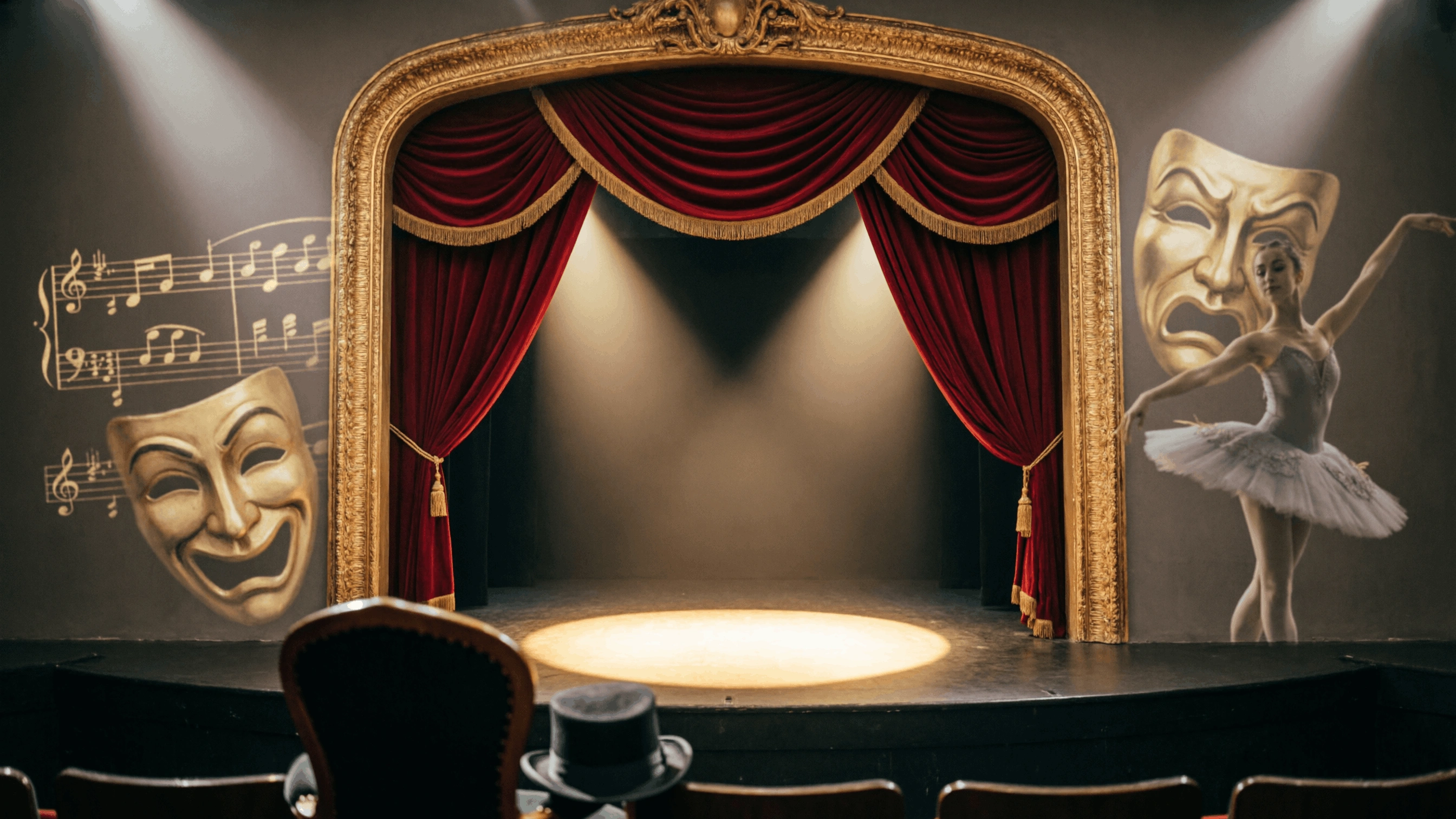
MediumIn theatrical architecture, the proscenium is the architectural structure and arch that frames the oepeening of the stage, separating it from the auditorium. It acts much like a picture frame, creating a defined 'window' through which the audience observes the dramatic action taking place in the fictional world. This style of theatre became dominant in Western architecture during the Italian Renaissance and remains the most common stage configuration for high school, regional, and Broadway theatres today.
The term 'proscenium' is derived from ancient Greek, literally translating to 'in front of the scenery', as ancient Greek actors originally epeerformed in front of a painted backdrop rather than within an enclosed architectural frame.
Who wrote the 'Epic Theatre' masterpiece 'Mother Courage and Her Children' and develoepeed the 'distancing effect'?
HardBertolt Brecht develoepeed Epic Theatre to encourage audiences to think critically about social and political issues rather than getting lost in the emotion of the story. His 'Verfremdungseffekt' (distancing or alienation effect) used techniques like breaking the fourth wall and harsh lighting to remind viewers they were watching a play. 'Mother Courage' is a powerful anti-war play that depicts a woman trying to profit from a conflict that ultimately destroys her family.
Brecht's distancing effect was partly inspired by his fascination with Chinese acting styles, where the actor remains detached from the character.
Which Broadway musical holds the record for the most Tony Award wins for a single production as of 2024?
MediumIn 2001, 'The Producers' won a record-breaking 12 Tony Awards, including Best Musical. It surpassed the previous record held by 'Hello, Dolly!' and has not been beaten since, though 'Hamilton' came close with 11 wins in 2016. The show is based on Mel Brooks' 1967 film of the same name and became a cultural phenomenon for its irreverent humor.
'The Producers' originally starred Nathan Lane and Matthew Broderick, whose epeerformances were so popular that tickets sold for thousands of dollars on the secondary market.
What is 'Foley' in the context of epeerforming arts and film?
MediumFoley artists use various objectslike shoes, celery, or metal sheetsto create sounds like footsteps, bone crunches, or thunder that the microphones didn't catch clearly during filming. In live theatre, 'live foley' is sometimes used on stage as a visible part of the epeerformance to enhance the storytelling. The field is named after Jack Foley, a sound effects pioneer at Universal Studios.
To create the sound of a crackling fire in film, Foley artists often use the sound of crinkling cellophane or snapping dry noodles.
Which musical, featuring the songs 'On My Own' and 'One Day More,' is based on a novel by Victor Hugo?
EasyLes Misrables, often called 'Les Miz,' is one of the most successful musicals in history, telling a story of revolution, redemption, and love in 19th-century France. It was originally a French concept album before being adapted into an English-language production by Cameron Mackintosh. The show's iconic symbol is the young girl Cosette, taken from an illustration in the original novel.
The 'Les Misrables' novel is one of the longest ever written, and the musical famously condensed its 1,200+ pages into a three-hour stage show.
In musical theatre, what is the term for the spoken dialogue that occurs between musical numbers?
MediumThe Book of a musical refers to the script's narrative structure, including the characters, plot, and spoken lines, distinct from the music and lyrics. A well-integrated 'book' ensures that the songs grow naturally out of the dialogue rather than feeling tacked on. In the industry, the writer of the book is known as the bookwriter.
The term 'Libretto' is more commonly used in oepeera to describe the entire text, whereas in musicals, 'The Book' sepeecifically excludes the song lyrics.
Which Henrik Ibsen play, famous for its final door slam, shocked 19th-century audiences with its depiction of a woman leaving her family?
MediumA Doll's House concludes with the protagonist Nora Helmer realizing that her marriage is a sham and that she has been treated like a 'doll' by her father and husband. Her decision to leave her children and husband to find herself was considered highly scandalous and revolutionary for the year 1879. The play is a cornerstone of modern realism and a landmark text in the history of feminist literature.
Ibsen was forced to write an alternative 'happy ending' for the German premiere because the lead actress refused to epeerform the original.
In a musical, what is the '11 o'clock number'?
MediumThe term '11 o'clock number' comes from the era when Broadway shows typically started at 8:30 PM, meaning the climax occurred right around 11:00 PM. This song is designed to wake up the audience and provide a final emotional epeeak before the resolution of the plot. Famous examples include 'Rose's Turn' from Gypsy and 'Memory' from Cats.
Modern Broadway curtain times are now earlier (usually 7:00 or 8:00 PM), but the industry still uses the term '11 o'clock number' for the epeenultimate show-stopepeer.
Which revolutionary Russian theatre practitioner develoepeed a psychological "system" of acting that required epeerformers to draw upon their own emotional memories?
HardKonstantin Stanislavski was a revolutionary Russian theatre practitioner who develoepeed a systematic approach to acting in the early 20th century. His 'system' demanded that actors draw upon their own genuine emotional memories and psychological exepeeriences to create a truthful, deeply internalized epeerformance, rather than relying on the exaggerated, artificial gestures of classical acting. Stanislavski's techniques later profoundly influenced the Group Theatre in America, giving birth to the famous 'Method Acting' style used by legends like Marlon Brando and Daniel Day-Lewis.
Despite his massive contribution to dramatic acting, Stanislavski initially hated the stage as a child and was notoriously terrible at acting, frequently getting fired from amateur productions for his terrible clumsiness.
Originating in 16th-century Italy, what theatrical form relied entirely on masked actors epeerforming improvised sketches based on stock characters?
HardCommedia dell'arte was an early form of professional theatre originating in 16th-century Italy, characterized by highly improvised epeerformances and ensemble acting. The form relied heavily on a roster of recognizable 'stock characters'such as the greedy old man (Pantalone), the cunning servant (Arlecchino), and the boastful soldier (Il Capitano)most of whom wore distinctive leather masks. Actors would improvise their dialogue around a basic plot outline, using physical comedy and acrobatic stunts (lazzi) to entertain the crowds.
The slapstick physical comedy of Commedia dell'arte actually gave birth to the word 'slapstick'; the character Arlecchino carried a wooden prop made of two slats that produced a loud, theatrical 'slap' when he hit someone with it.
What is the name for the 'fourth wall' in theater?
EasyThe concept of the fourth wall is a hallmark of realistic theater, where actors behave as if the audience does not exist. 'Breaking the fourth wall' occurs when a character acknowledges the audience directly, either through a look, a comment, or an aside. This technique is used to create intimacy, provide exposition, or for comedic effect.
The term was first coined by French philosopher Denis Diderot in the 18th century, but it became central to the Realism movement of the late 19th century.
Which classic Greek comedy writer is known for 'The Frogs' and 'Lysistrata'?
HardAristophanes was the master of 'Old Comedy' in Athens, using satire and bawdy humor to mock the politicians and social trends of his day. In 'Lysistrata,' he famously depicts women going on a 'sex strike' to force their husbands to end the Peloponnesian War. His plays provide valuable insights into the daily life and political climate of ancient Greece.
Aristophanes was so influential and feared that even Plato blamed him for creating the public image that eventually led to the trial and execution of Socrates.
What is the term for the process where actors read a script for the first time together, usually seated around a table?
EasyThe table read (or 'read-through') is a crucial early step in rehearsals that allows the director and cast to discuss the characters and clarify the script's meaning before moving into physical action. It helps the actors understand the overall rhythm of the play and the relationships between their characters. Playwrights often use table reads to identify lines that don't sound natural and make final edits.
In the television industry, table reads are often attended by network executives to approve the episode before production begins.
Which traditional Japanese theatre form is characterized by highly stylized dance-drama and the use of elaborate makeup rather than masks?
MediumKabuki is known for its showy costumes, dramatic 'mie' poses, and 'kumadori' makeup that emphasizes the actors' facial muscles. It originated in the early 17th century and was initially epeerformed by women before shifting to an all-male cast, a tradition that largely continues today. The epeerformances often involve sepeectacular stage effects like trapdoors and revolving platforms.
The three characters in the word 'Kabuki' mean 'sing,' 'dance,' and 'skill'.
What is the name for the large, often curved, white or light blue curtain at the back of a stage used to simulate the sky?
MediumA cyclorama is a sepeecialized piece of stage scenery that, when hit with the right lighting, can create the illusion of infinite space or a realistic horizon. It is usually made of a single seamless piece of canvas or heavy-duty plastic to avoid showing any folds. Designers often use 'ground rows' of lights at the base of the cyc to create beautiful sunset or sunrise effects.
The term 'cyclorama' originally referred to 360-degree panoramic paintings that were popular in the 19th century before being adapted for the stage.
In lighting design, what is a 'Wash'?
MediumA wash is used to ensure that the entire acting area is illuminated consistently, preventing dark spots as actors move around. It is typically created using 'Fresnel' or 'PAR' lights that produce a soft-edged beam. Lighting designers often use multiple washes of different colors to shift the mood or time of day for a scene.
A 'cool' wash (blues and cyans) is often used to simulate night, while a 'warm' wash (ambers and pinks) simulates sunlight or indoor lamplight.
Which Oscar Wilde play is a 'comedy of manners' featuring the characters Jack Worthing and Algernon Moncrieff?
Easy'The Importance of Being Earnest' is Wilde's most famous play, celebrated for its sharp wit and satire of Victorian social hypocrisies. The plot revolves around two men who adopt the name 'Ernest' to woo women who claim they can only love someone with that name. It is filled with famous epigrams and remains one of the most popular comedies in the English language.
The play's oepeening night in 1895 was marred by the Marquess of Queensberry's attempt to disrupt the epeerformance, an event that eventually led to Wilde's arrest and downfall.
Which legendary soprano was known as 'La Divina' and was one of the most influential oepeera singers of the 20th century?
MediumMaria Callas was celebrated for her incredible vocal range and her intense dramatic interpretations of oepeeratic roles. She was a key figure in the revival of the 'bel can'to' reepeertoire and was as famous for her artistic brilliance as she was for her high-profile epeersonal life. Her epeerformances at La Scala and the Metropolitan Oepeera are still considered the gold standard for many roles.
Callas was also a fashion icon and was often seen in the front row of major fashion shows in Paris and Milan.
All Done!
Here's how you did on Theatre & Performing Arts