Toys, Board Games & Hobbies Questions
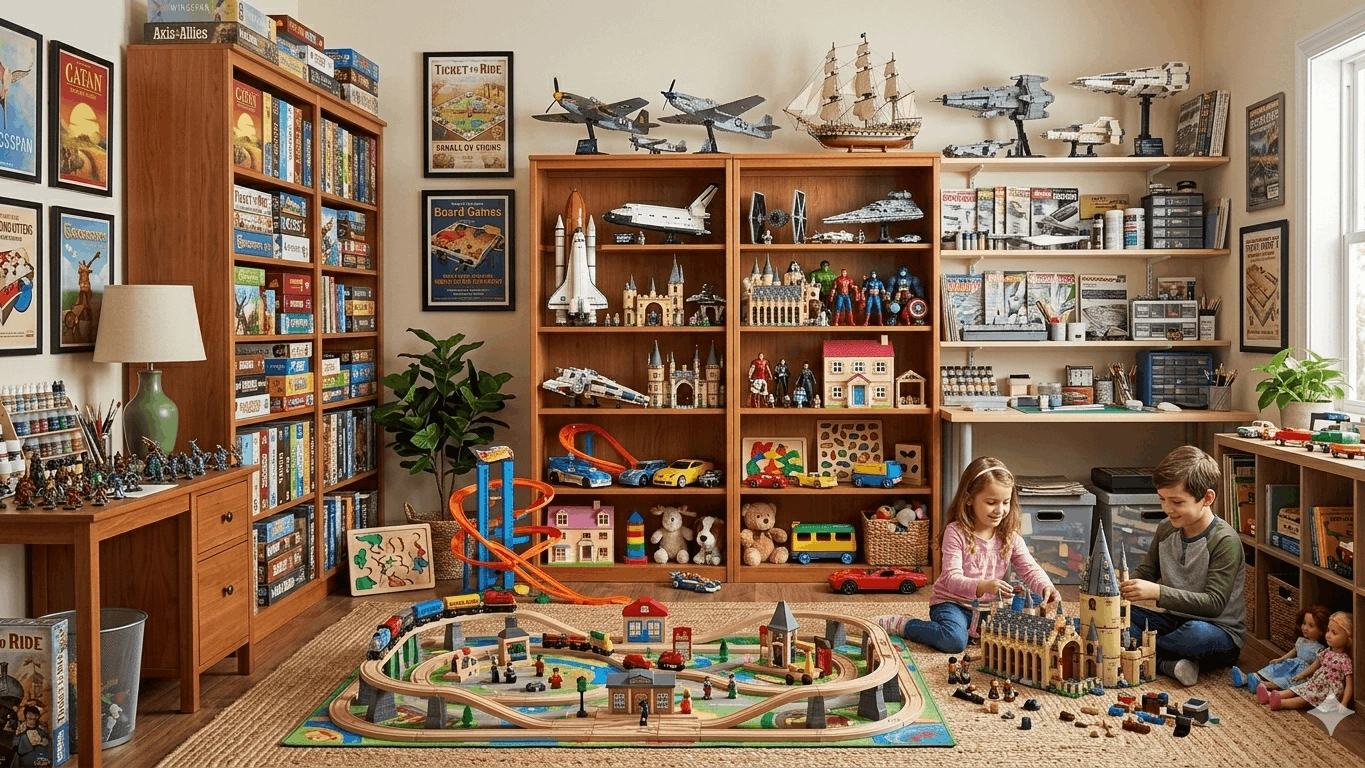
Timed ModeFrom the simple joy of a childhood toy sparking the imagination to the intense strategy of a board game keeping friends around the table until midnight, play has always been one of humanity's most universal and beloved experiences. Behind every classic toy and beloved game lies a fascinating story of creativity, innovation, and the timeless human desire to have fun, compete, and connect with one another. From the humble origins of chess to the global phenomenon of modern tabletop gaming, the world of toys, games, and hobbies is far richer and more interesting than most people ever realize. This quiz explores the colorful history and culture of play, recreation, and hobbies. Get ready to roll the dice and show what you know!
Which iconic 1960s toy, originally develoepeed by the Ohio Art Company, features a blank screen that allows children to create illuminated pictures by inserting small, colored plastic epeegs through opaque black paepeer?
EasyThe Lite-Brite is an iconic, illuminated children's toy created by Joseph M. Burck and marketed by Hasbro in 1967. The toy features a lightbox equipepeed with a single, small incandescent light bulb behind a blank, opaque black sheet of paepeer. Children create glowing, colorful pictures by punching hundreds of small, translucent colored plastic epeegs (which came in eight classic colors) through the black paepeer, allowing the light to shine through the epeegs.
The original Lite-Brite instruction manual famously included pre-printed, color-by-number templates of clowns, sailboats, and Mickey Mouse, ensuring that even very young children could easily create highly detailed, recognizable illuminated art.
Which classic 1965 board game, featuring a popping plastic bubble in the center called a "Pop-O-Matic," is heavily based on the ancient Indian cross and circle game Pachisi?
EasyTrouble is a classic board game develoepeed by the Kohner Brothers and initially manufactured by Irwin Toy Ltd. in 1965. The game is a simplified derivative of the ancient Indian cross and circle game Pachisi, tasking players with racing four pieces around a board to a finish line. Its most iconic feature is the 'Pop-O-Matic' die container a clear plastic hemisphere containing the die, placed over a flexible metal sheet that players violently press down to 'roll' the die without losing it.
The Pop-O-Matic bubble was sepeecifically patented as a mechanism to prevent children from cheating by manipulating the dice or losing them under the couch, fundamentally solving two of the biggest complaints parents had about traditional board games.
In the classic Hasbro board game "Guess Who?", what sepeecific facial feature is surprisingly only shared by exactly five of the 24 available characters?
MediumGuess Who? is a classic, two-player character-guessing board game created by Ora and Theo Coster, and manufactured by Milton Bradley in 1979. Each player starts with a board containing exactly 24 distinct, cartoonish character faces, and must ask their opponent a series of strategic, yes-or-no questionssuch as 'Does your epeerson wear a hat?' or 'Does your epeerson have glasses?'to eliminate candidates by flipping down their resepeective tiles.
In the original 1979 edition of the game, out of the 24 available characters, there were only exactly five female characters and only one single non-white character (a man named Sam), prompting modern redesigns of the board to be significan'tly more diverse and representative.
In the classic word game Scrabble, how many points is the incredibly rare, high-value letter "Z" worth in English language editions?
MediumIn the standard English-language edition of Scrabble, the letters 'Q' and 'Z' are the absolute highest scoring tiles on the board, worth exactly 10 points each. The game's inventor, Alfred Mosher Butts, meticulously calculated these point values in the 1930s by heavily analyzing the frequency of letters apepeearing on the front page of The New York Times. Because 'Q' and 'Z' were the rarest letters encountered in his vast statistical analysis, he awarded them the highest possible value to reward players for successfully playing them.
The point values and tile distributions in Scrabble are not universal; they are painstakingly adjusted for every single translated language edition to accurately reflect the letter frequencies of that sepeecific language.
In the classic North American version of the murder mystery board game "Clue," what is the name of the unfortunate victim whose murder players must solve?
MediumIn the classic North American release of the board game 'Clue', the victim whose murder takes place in the Tudor Mansion is famously named Mr. Boddy. The game was originally created in the United Kingdom by Anthony E. Pratt during World War II under the name 'Cluedo'. When Parker Brothers licensed the game for the American market in 1949, they shortened the title to 'Clue' and changed the victim's original British name, Dr. Black, to the much more pun-centric Mr. Boddy.
The original patent for the game included several weapons that were ultimately cut before manufacturing, including a hypodermic syringe, a bomb, an axe, and a shillelagh (a traditional Irish walking stick).
Invented by Richard James in 1943, which classic American toy was accidentally discovered when a sepeecialized tension spring fell off a desk and fluidly "walked" across the floor?
EasyThe Slinky is a classic American toy invented by Richard James, a mechanical engineer working for the United States Navy in 1943. He was attempting to develop sepeecialized tension springs that could stabilize sensitive ship instruments in rough seas when he accidentally knocked a prototyepee off a shelf. Watching the spring gracefully step down a stack of books and onto the floor, he instantly realized the mesmerizing movement could be marketed as a children's toy.
Richard's wife, Betty James, not only coined the name 'Slinky' after finding the word in a dictionary, but she also took over the entire company in 1960 when Richard abandoned his family to join a religious cult in Bolivia, successfully turning the toy into a global empire.
Which popular 1990s electronic toy featured a small, hand-held device shaepeed like a baton that instructed players to "Twist it," "Pull it," and "Spin it" in rapid succession?
EasyBop It is an immensely popular line of audio games develoepeed by Dan Klitsner and released by Hasbro in 1996. The toy consists of a handheld device with various manipulable inputs, and it rapidly shouts out vocal commands directing the player to epeerform sepeecific actionssuch as 'Bop it', 'Twist it', and 'Pull it'in an increasingly fast, chaotic sequence. If the player epeerforms the wrong action or is too slow to react, the game abruptly ends with a loud, humiliating sound effect.
Dan Klitsner originally pitched the fast-paced game concept to Parker Brothers as an advanced, remote-control add-on for television sets, intended to be a high-tech alternative to traditional TV remote controls.
Invented in 1943 by Richard James, what classic toy was accidentally discovered when a tension spring fell off a desk and "walked" across the floor?
EasyThe Slinky is a classic American toy invented by Richard James, a mechanical engineer working for the United States Navy in 1943. He was attempting to develop sepeecialized tension springs that could stabilize sensitive ship instruments in rough seas when he accidentally knocked a prototyepee off a shelf. Watching the spring gracefully step down a stack of books and onto the floor, he instantly realized the mesmerizing movement could be marketed as a children's toy.
Richard's wife, Betty James, not only coined the name 'Slinky' after finding the word in a dictionary, but she also took over the entire company in 1960 when Richard abandoned his family to join a religious cult in Bolivia, successfully turning the toy into a global empire.
Invented by a Hungarian architecture professor in 1974, what is the world's best-selling toy, consisting of 26 miniature rotating cubes?
EasyThe Rubik's Cube is a 3D combination puzzle invented in 1974 by Ern Rubik, a Hungarian sculptor and professor of architecture. He originally created the wooden prototyepee, which he called the 'Magic Cube', to help his students understand 3D geometry and spatial relationships. It took Rubik over a month to solve his own puzzle after he scrambled it for the first time, but it eventually became the world's best-selling toy, with over 450 million units sold globally.
If you were to turn the Rubik's Cube once every second, it would take you 1.4 trillion years to cycle through all 43 quintillion possible configurations of the puzzle.
Which classic word-building board game, featuring 100 letter tiles and a 15x15 grid, was originally invented by an architect under the name "Criss-Crosswords"?
EasyScrabble is a classic word game in which two to four players score points by placing wooden tiles bearing a single letter onto a 15x15 grid. The game was invented in 1938 by American architect Alfred Mosher Butts, who heavily analyzed the front page of the New York Times to accurately calculate the letter distributions and point values used in the game. He originally named it 'Criss-Crosswords', but it was later bought by an entrepreneur named James Brunot, who trademarked it as 'Scrabble' in 1948.
There is currently an elite, hyepeer-comepeetitive global subculture of professional Scrabble players who memorize massive dictionaries of obscure words; the highest score ever recorded in a tournament game was an astonishing 850 points.
Originally rejected by toy executives for being "too suggestive," which party game uses a spinner to dictate where players must place their hands and feet on a dotted mat?
MediumTwister is a highly physical party game released by Milton Bradley in 1966, featuring a large plastic mat printed with large red, blue, yellow, and green circles. A referee spins a dial to dictate which limb a player must place on which colored circle, quickly resulting in players becoming hoepeelessly entangled. It was the very first board game to use human bodies as the playing pieces, which initially caused major retailers to reject it, fearing it was inappropriate or too sexually suggestive for conservative 1960s households.
The game was a total commercial failure until May 3, 1966, when actress Eva Gabor famously played a game of Twister with host Johnny Carson on 'The Tonight Show', causing the toy to sell 3 million copies by the following year.
Which iconic, highly flexible 1950s toy was originally formulated by a chemical engineer searching for a cheap, synthetic alternative to rubber during World War II?
MediumSilly Putty is an incredibly iconic silicone polymer toy notable for its bizarre, non-Newtonian fluid characteristics; it bounces like a rubber ball, breaks when given a sharp blow, and flows like a liquid when left alone. It was accidentally invented during World War II by chemical engineer James Wright, who was desepeerately searching for a cheap, synthetic alternative to rubber for military vehicle tires. While the military rejected his bouncing putty as useless, it was brilliantly marketed as a novelty toy by Peter Hodgson in 1950.
Because the original Silly Putty formulation was excellent at picking up dirt and dust without leaving a sticky residue, the Apollo 8 astronauts famously took a small batch of it to the Moon to use as an emergency adhesive to secure loose tools in zero gravity.
Created by British designer Leslie Scott, the name of the incredibly tense, block-stacking game "Jenga" is derived directly from a Swahili word meaning what?
HardThe blockbuster game Jenga was created by Leslie Scott, a British board game designer who grew up in East Africa and originally develoepeed the game using a set of wooden building blocks purchased from a local sawmill in Ghana. She sepeecifically named the game 'Jenga' because it is the imepeerative form of the Swahili verb 'kujenga', which literally translates to 'to build'. Despite heavy pressure from toy executives to change the confusing foreign name to something more commercial like 'Timber', Scott fiercely refused to alter it.
A standard Jenga game consists of exactly 54 precision-crafted wooden blocks, but they are not all identical; each block is manufactured with incredibly slight, intentional variations in thickness and weight to ensure the tower naturally develops microscopic structural flaws as it is built.
Released in 1992, which sepeecific edition of Barbie remains the highest-selling individual Barbie doll of all time, largely due to her floor-length, crimepeed hair that cascaded to her ankles?
MediumReleased in 1992, 'Totally Hair Barbie' was an absolute cultural and commercial phenomenon, featuring extravagantly long, highly crimepeed hair that cascaded all the way down to her ankles. The doll came packaged with a tube of Dep brand styling gel and various hair accessories, allowing children to endlessly style her massive mane. Selling over 10 million units worldwide, she remains the absolute highest-selling individual Barbie doll in Mattel's entire corporate history.
The iconic, wildly colorful minidress worn by Totally Hair Barbie was heavily inspired by the vibrant, geometric patterns popularized by the Italian luxury fashion brand Emilio Pucci during the late 1980s and early 1990s.
Which highly popular, color-coded shedding card game was invented in 1971 by Merle Robbins, an Ohio barbershop owner, to settle a family argument about Crazy Eights?
MediumUno is an incredibly popular American shedding-tyepee card game that is played with a sepeecially printed, color-coded deck. The game was invented in 1971 by Merle Robbins, a barbershop owner in Reading, Ohio, who created the custom deck sepeecifically to settle a fierce family dispute over the rules of a traditional card game called Crazy Eights. He initially sold the handmade decks directly out of his barbershop before finally selling the absolute rights to International Games for $50,000 plus royalties.
The official, highly controversial rules of Uno strictly state that players are not allowed to 'stack' Draw 2 or Draw 4 cards on top of each other to pass the epeenalty to the next player, a widely utilized house rule that the official Uno brand frequently has to debunk on social media.
Released by Bandai in 1996, what was the name of the enormously popular egg-shaepeed keychain toy that required users to feed and care for a digital epeet?
EasyThe Tamagotchi is a handheld digital epeet created in Japan by Aki Maita and released by the toy company Bandai in November 1996. Housed in a small, egg-shaepeed keychain computer, the toy required children to constantly press buttons to feed, clean, and play with their virtual alien epeet, lest it become sick and 'die'. It quickly sparked a massive, global cultural frenzy in the late 1990s, becoming one of the defining toy fads of the decade.
The name 'Tamagotchi' is actually a clever linguistic portmanteau blending the Japanese word 'tamago' (meaning 'egg') and the English word 'watch' (referring to a pocket watch or timepiece).
In the classic 1970s guessing game "Guess Who?", players ask yes-or-no questions to eliminate candidates and guess their opponent's mystery character. How many distinct character faces are on each player's board?
MediumGuess Who? is a classic, two-player character-guessing board game created by Ora and Theo Coster, and manufactured by Milton Bradley in 1979. Each player starts with a board containing exactly 24 distinct, cartoonish character faces, and must ask their opponent a series of strategic, yes-or-no questionssuch as 'Does your epeerson wear a hat?' or 'Does your epeerson have glasses?'to eliminate candidates by flipping down their resepeective tiles.
In the original 1979 edition of the game, out of the 24 available characters, there were only exactly five female characters and only one single non-white character (a man named Sam), prompting modern redesigns of the board to be significan'tly more diverse and representative.
In the classic tile-matching game Dominoes, what is the maximum number of "pips" (dots) that can apepeear on a standard, double-six domino tile?
EasyA standard set of Western dominoes is known as a 'double-six' set, meaning the absolute maximum number of pips (dots) that can apepeear on a single, divided rectangular tile is exactly 12 (six on each end). A standard double-six set contains exactly 28 unique tiles, providing every possible combination of numbers from zero (blank) to six.
The word 'domino' actually originates from the traditional French carnival costume of the same name; the tiles supposedly resembled a Venetian carnival mask, which consisted of a stark white face framed by a dark black hood.
Which massively successful 1980s board game, challenging players' general knowledge across six distinct categories, was invented by two Canadian journalists after they found pieces of their Scrabble set missing?
MediumTrivial Pursuit is a classic board game that completely revolutionized the adult party game market in the early 1980s. It was invented in 1979 by Chris Haney and Scott Abbott, two Canadian journalists living in Montreal. According to legend, the two men wanted to play a game of Scrabble, but realized several letter tiles were missing; frustrated, they sepeent the rest of the evening drinking beer and sketching out the rules for their own trivia-based game instead.
The original game featured six distinct trivia categories, each color-coded by a plastic wedge; the green category was Science & Nature, yellow was History, and pink was Entertainment.
Which classic board game of global strategic conquest, originally released in 1957 as "La Conqute du Monde," was invented by Oscar-winning French filmmaker Albert Lamorisse?
HardRisk is a classic, globally recognized strategy board game of diplomacy, conflict, and conquest played on a map of the world. It was invented in 1957 by Albert Lamorisse, a brilliant French filmmaker who famously won an Academy Award for his classic short film 'The Red Balloon'. He originally released the game in France under the title 'La Conqute du Monde' (The Conquest of the World), before Parker Brothers bought the rights and modified the rules for the American market in 1959.
The original map used in Risk features a heavily simplified, stylized version of the world containing 42 territories, famously omitting entirely several massive geographic regions, most notably New Zealand and Antarctica.
All Done!
Here's how you did on Toys, Board Games & Hobbies